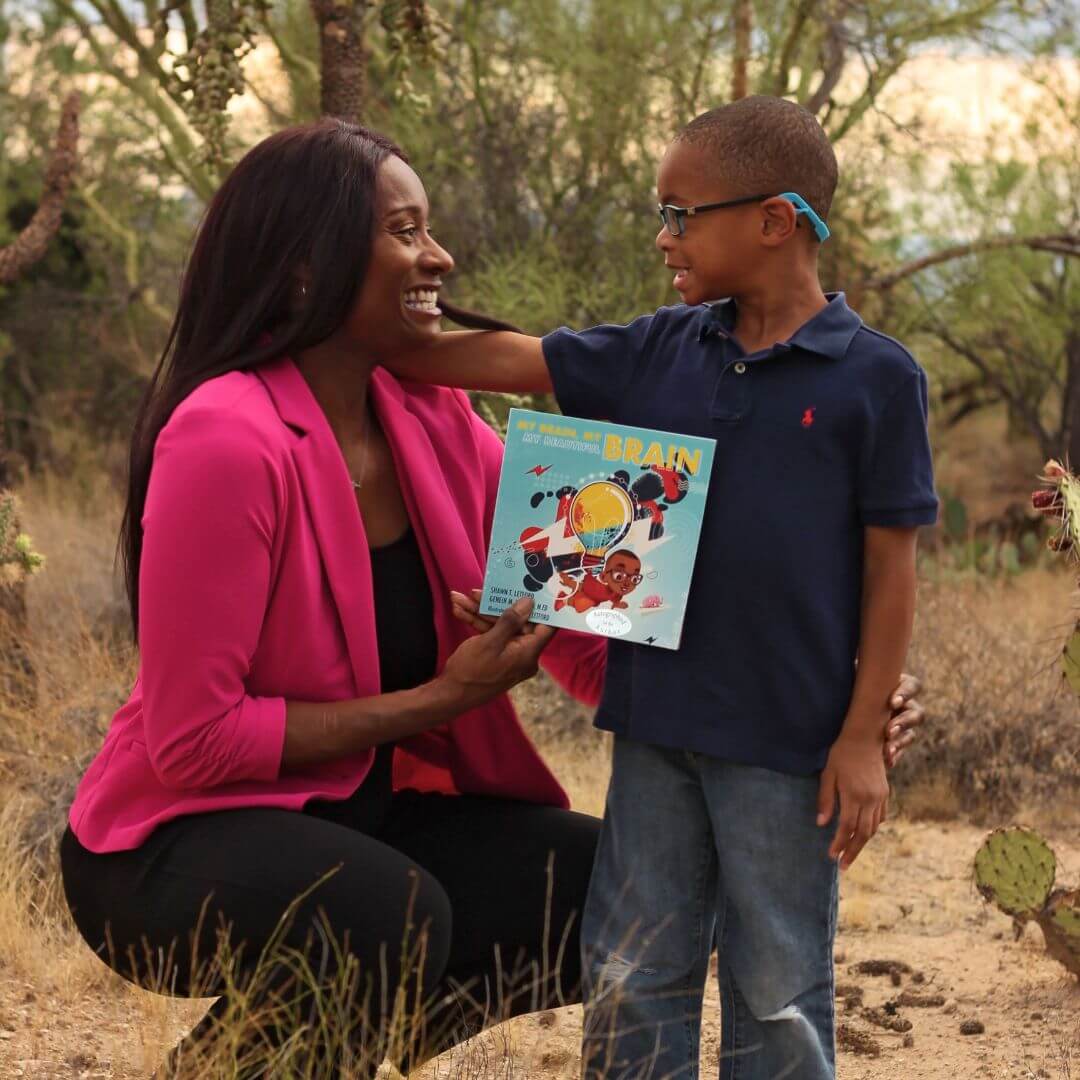
In this week's episode, Drs. Daniel Correa and Katy Peters are joined by mother-son duo Genein and Shawn Letford. Genein, the founder of Brainolicious, a nonprofit dedicated to promoting brain health in a way that’s fun, accessible, and lifelong, reveals how integrating arts and early childhood education can build resilience, prevent dementia, and even shape future leaders. Her 8-year-old son, Shawn, then shows us how kids can become brain advocates—speak before city councils, petition for World Brain Day, and spread awareness with confidence.
Follow and subscribe wherever you get your podcasts!
Apple Podcasts Spotify Libsyn
Additional Resources
- How One Family is Teaching Kids About Brain Health
- Brainolicious
- Steps to Building a Stronger Brain: Brain Health After Brain Injury Webinar
- Why Bike Helmets Are Essential for Kids
- Become a Brain Health Advocate
Episodes on Similar Topics
- Neurology Advocacy Out Loud: Live from the AAN’s Annual Meeting
- Embracing Inclusion and Empowerment with Isabelle and Eliza Woloson
Follow us!
- Guest: Genein Letford @BrainoliciousAdventures
- Hosts: Dr. Daniel Correa @NeuroDrCorrea; Dr. Katy Peters @KatyPetersMDPhD
- X: @BrainandLifeMag
- Instagram: @BrainandLifeMag
- Facebook: Brain & Life Magazine
We want to hear from you!
Have a question or want to hear a topic featured on the Brain & Life Podcast?
Record a voicemail at 612-928-6206, or email us at BLpodcast@brainandlife.org.
Episode Transcript
Dr. Correa:
From the American Academy of Neurology, I'm Dr. Dana Correa.
Dr. Peters:
And I am Dr. Katie Peters, and this is the Brain & Life Podcast.
Dr. Correa:
Welcome back to the Brain & Life Podcast. Now we all go through challenges, especially medical issues. Katie, have you had to rehabilitate from an injury or an illness in the past?
Dr. Peters:
Oh, yes, Dan. Oh yes, yes. I can be a little clumsy at times and I'm a little bit of a daredevil. I've had my share of rollerblading accidents that did require some PT for recovery and also some bandages. I would say it was road rash from my waist down to my ankle. It was pretty bad.
Dr. Correa:
Oh, wow. Okay.
Dr. Peters:
But of course my mother has forbidden me from rollerblading and now I'm in my 50s and I don't know if I should still follow the rules. But to our mothers, we're always just little kids having accidents.
Dr. Correa:
Yeah. I mean, both from my own medical experiences and I've learned from my family and patients and personal experiences that recovery at some point transitions from just the short term to adaptations to your day-to-day. Figuring out and including maintenance for our overall health, or maybe our different joint and mobility issues and challenges, and then prevention of other injuries or illnesses. So maybe making at least sure you wear a helmet when you rollerblade, Katie.
Dr. Peters:
Oh, I always wear my helmet and my wrist guards.
Dr. Correa:
Well done. Love that.
Dr. Peters:
Yeah.
Dr. Correa:
And similarly, recovery does not end right after a brain injury. The brain has an ability to adapt and heal over time. With the right support, many people can continue to improve their functioning and quality of life long after the injury.
Dr. Peters:
So we want to let all of our listeners know that on July 22nd from 2:00 to 3:00 PM Eastern Time, join the Brain Injury Association of America, the National Academies of Sciences, Engineering and Medicine, and the American Academy of Neurology in AARP for Steps to Building a Stronger Brain: Brain Health After Brain Injury. And this is a webinar for people living with brain injury, caregivers, and healthcare professionals. And during this webinar, we will discuss steps you can use to support brain health and how these approaches can help the brain continue to heal and adapt. And the registration link is in our show notes.
Dr. Correa:
So our episode today will continue on this idea of brain health for everybody, but we also wanted to thank a summer intern and production assistant that helped us in the preparation for this episode, Catherine Arbaugh from the Princeton University's PIX program. Really enjoyed working with Catherine this summer and she'll be featured as a production assistant in some other episodes that are coming this summer with you.
So we're going to go on to now introducing our guests.
Welcome back to the Brain & Life Podcast. So today we have a double combo. We are joined by two community guests, Genein Letford, the founder of Brainolicious, a nonprofit dedicated to promoting brain health in a way that's fun, accessible and lifelong. Through Brainolicious, she's created youth education and family programs that help support brain education across generations. And in this work, she's collaborated with organizations such as the American Society of Black Neurosurgeons, the European Brain Council, the National Academy of Neuropsychology, and this work and advocacy has also taken her to the United Nations General Assembly's Brain Economy Summit, where she championed for creativity and the arts as essential to brain health and human development.
Totally all within the things that we really love and care about. We're also joined by one of her family members, which will be introduced in a moment, but this is one of our special episodes where together we have two hosts. So Katie, please let us know about our other guests.
Dr. Peters:
I know. I will let you know about our other guests. And it's great to be here with you today, Daniel and with Genein. But most importantly, we are joined by Genein's eight-year-old son. Together they are the example that brain health advocacy can truly run in families. Shawn Letford, better known as The Creative Kid, has joined Genein in co-authoring, wow, co-authoring several children's books as part of the Brainolicious series. And travels with his mom to schools, communities teaching kids about creativity, brain safety, healthy habits through storytelling and the arts. He's even spoken before the mayor and City Council of Avondale, Arizona to advocate for bringing brain health education into our elementary schools.
And he's showing his brain now. And with his mother, they successfully petitioned the city of Avondale to recognize World Brain Day coming up soon on July 22nd. So together, Genein and Shawn are empowering families and communities to integrate in appreciation for the brain into everyday life and also into family life. So welcome.
Shawn Letford:
Hi.
Genein Letford:
Hi.
Dr. Correa:
Shawn and Genein, thank you so much for joining us here on the podcast. And Shawn, I wanted to start off with getting to know you a little bit. What are you excited about for your activities for this summer?
Shawn Letford:
I'm excited to do lots of math. And I like reading too. And I also do track and field.
Dr. Correa:
Oh, wow. So you're doing activities outside and inside with your brain. Really great.
Genein Letford:
And can you let them know what's going on with track and field next week?
Shawn Letford:
I made it to regionals.
Dr. Correa:
Wow. Already. That's amazing.
Genein Letford:
Yes. So there's the Junior Olympic Regionals in Texas and then if he makes it, he goes to the Junior Olympic Nationals in California. So he's number two in the state of Arizona.
Shawn Letford:
In my 100.
Genein Letford:
And then what else?
Shawn Letford:
And I'm fourth in my 200.
Dr. Correa:
Wow. All right. Well, maybe we get to see you in one of these future Olympics. And Genein, tell us a little bit more about you and your family beyond the advocacy and the public health work, just in the home.
Genein Letford:
Sure. We just love to play games, dance and sing. He brought a puzzle and it's a 300 piece puzzle and I didn't think he would ever try that. And we did it together and we-
Shawn Letford:
And I finished it.
Genein Letford:
He finished it. So we love that. We love showing examples about that. But it's just being creative, really getting to the different ways of interacting. A lot of our research with the brain health journey has helped us be a better family and connect more analog things going on in the home, more just Legos and building. And we love music, lots of music as well. And then connecting with our neighborhood and things like that, right?
Shawn Letford:
Right.
Dr. Peters:
And Shawn, in addition to sort of running and doing mathematics, what else do you like to do?
Shawn Letford:
I also like to play.
Genein Letford:
What do you like to play?
Shawn Letford:
I like to play with my Legos and I like to play board games with my mom.
Dr. Peters:
When you play those games, how does it make you feel about how your brain is working to play those games?
Shawn Letford:
It makes my brain feel happy.
Dr. Peters:
I like playing puzzles too. And I have a 500 piece puzzle that I need your help with.
Genein Letford:
He also got into stop motion. You want to tell them about that really quick?
Shawn Letford:
Yeah. I put puzzles in an order and then I press the pause button. And then I put another piece and then I press the pause button, and then I put another piece.
Genein Letford:
So it's on my cell phone. I didn't even know my cell phone can do that. On the video there's a pause button. And so you can do stop motion on... I have an iPhone. And it's like, what are you doing with my phone? And isn't that the cool thing about kids when you just let them explore? They find new things that you didn't even know the stuff you've had for years can do. So he does stop motion with the camera function on my cell phone.
Dr. Correa:
That's amazing. Yeah. How much we learn from the kids and the younger generation in our families. It's amazing.
Dr. Peters:
I don't even know what that is. I'm so intrigued. That's fascinating.
Genein Letford:
It's when people take still photos, but they look like they're moving, but they're just photos that are moving in line. So it looks like the little Legos are walking, but they're just photos and you just move it a little bit and you take a photo and you move it a little bit and you take a photo. So he figured out how to do that with the video function on my phone this summer.
Dr. Peters:
Wow. Definitely creativity is something you like to do, right Shawn?
Shawn Letford:
Right.
Dr. Peters:
Absolutely. Well, I'm going to ask your mom a quick question. So Genein, at the UN Brain Economy Summit, you described the brain as a multi-language generator capable of literacy, numeracy and also artistry. Could you unpack that sort of idea for our listeners?
Genein Letford:
Sure. Well, my background is in education and so I taught kindergarten through fifth grade. And so I got them at five years old. So having one, a human of my own, I got to see from day one. And seeing that, seeing how they're born musical. So what you're talking about, that is the research from Dr. Michael Tout out of, I believe, the University of Toronto. And he says that and Dr. David Eagleman and Dr. Daniel Levinton talk about this as well. The brain is musical. The brain learns through these images and you know how we do metaphors. So sadly in school, we really focus on the mathematics, which I love math. Math is great. He loves math too.
Shawn Letford:
I like math and I'm doing algebra.
Genein Letford:
And he's doing algebra.
Dr. Peters:
Oh my gosh. It's amazing.
Genein Letford:
We feel a big part of that he's able to grasp his higher math concepts is because he has a musical background, because he has a dance background. He understands spatial relationships. Music is very spatial in the relation of chords and keys and things along that. So we have literacy, math numeracy, which we focus on in the school system, but the artistry is left to the wayside. And so our work just wants to communicate that. Especially as we head into the AI era, that leg of that tripod is going to be even more important for teachers, parents and leaders to really grasp because it's that leg, that artistry leg, that ability to understand how images communicate concepts and metaphorical connection. That's what's going to help your leaders rise to the top as AI continues to do what it does.
Dr. Peters:
And I mean, it just sort of hearkens that you need to have an educational system that isn't just about one thing, that you need to have that math, that literacy, and then the arts sort of integrated into even into the earliest education. Wouldn't you agree?
Genein Letford:
Do you agree? Well, why do we start so young?
Shawn Letford:
Because if you have dementia at older ages, it can go on.
Genein Letford:
Yeah, so we-
Shawn Letford:
So we try to stop dementia at younger ages so they can have good lives.
Genein Letford:
Yes. So we talk about dementia prevention in utero, right? And that's why he's doing what he's doing and he's speaking to kids who can see themselves in him, more than maybe me. Is because we want parents to understand that we can build brain health and cognitive reserve, which is helping the brain just get more fortified and stronger earlier as possible. So if insult or issue does come on in later life, they're able to withstand it longer.
And so the brain is beautiful and that opening period from prenatal to that zero through three, crazy time. And so I wish we would put more investments in that early childhood and that infant timeframe. Do more education for pregnant parents as well. I've been following the work of Dr. Martin Picard and he's big on the mitochondrial thing of energy and how do we get kids excited about mitochondria?
Well, that's connected to our brain health, right? And so what Shawn and I do, and his father's the illustrator of all our books, so it's a family affair, is how do we make this esoteric academic... You've read them, the eight point font papers that you all have to publish in your journals. How do we make that cool to an eight-year-old? That's our job.
Dr. Correa:
Yeah. No I love the approach and just that anchoring on this idea that of course the best day to start investing in our futures, whether it's our brain in other ways was yesterday and before. But if not then today is always okay to go ahead and start and we can start in the prenatal phase with children, or at any other point as an adult. It's never too late to start working on our brain health.
And Genein, during that presentation, you even shared and described how the lack of an arts education could be an injustice. Have you seen music, movement or visual art really change communities and people's brain health in ways that you felt traditional education doesn't?
Genein Letford:
Yes. Yeah. So what do you love best about music?
Shawn Letford:
I love the piano.
Genein Letford:
And how does it make you feel?
Shawn Letford:
It makes me feel calm when I play it.
Genein Letford:
And so it's things like that, in addition to the neurological, like the anatomy of what's going on. And so if we're going to be raising kids and retooling ourselves, right, this is for adults too, to be adaptable and resilient and even regenerative in this new landscape that we're in with AI. They have to be aware that they need all the tools in their tool toolkit to be able to function through this unknown that we're in. And another thing why I call it as an injustice is, do you remember this part? The corpus what?
Shawn Letford:
The corpus callosum.
Genein Letford:
The corpus callosum. For those of you who are listening, I'm actually holding up a model of a brain. But we actually have data. There's research that shows that when you start music earlier in the lifespan, especially in that critical period of that zero through like eight years old or so, the anatomy of the brain is even different. And I also share that you can look at a brain and you can't tell if the person was a construction worker, a teacher, or a librarian. But people, especially people with a trained eye can look and tell if the person was a musician.
So if that's true, which I believe it's true, Dr. David Eagleman talks about it in his book Livewired, then that means this is a justice issue. Because if we're raising kids that have to have all of the hardware and the software to be able to be flexible in this future that no one knows what's going to look like.
AI changed some things in the past two weeks. I saw a lecture from someone from Anthropic talking about just the changes in the past two weeks. So Shawn, we'd have no idea what this future is going to look like for Shawn when he's 18. So for him to have a stronger corpus callosum to get these ideas back and forth and you know everything that happens with that.
Now it's a justice issue because a kid down the street has no music training at all. So his brain will structurally be different than a brain for a child that has music training, dance training, that has been an improvisational training. That's huge now, especially for leaders to be able to improv and think on your feet.
All that is tied to this. And so now we're talking about justice and we believe that the arts have embedded within them all of these skills for the neural growth, but also for the interpersonal and interpersonal creative leadership growth.
Dr. Correa:
Yeah. And for our listeners, this corpus callosum structure is basically one of the major highways for a lot of connections that go back and forth between the left and right side of the brain and between other areas in the brain. I love it because we just recently had presentations from students in some of our high school summer programming here at our medical school.
And we had several of the students actually taking a look at music and movement education and reviewing studies that show that, yeah, there are many areas of the brain, not just also the corpus callosum, some other areas with language and memory that increase in size even in people who didn't previously have exposure to training and then get some training.
What's interesting to know is whether or not it's just music or all things that have some interaction with music, whether it's playing an instrument, writing music, dancing, these are all things that might have an effect. And with more research, hopefully we'll have it. But I think the best place to start is the one that you feel energetic and engaged to do. And yeah, sure, maybe in the future we learn that there are certain types of music or certain skills that you learn that might be better in certain situations. But start with what excites you, I think.
Genein Letford:
Yes.
Dr. Peters:
Yeah. I can even see the visual arts could be beneficial too. Just like what you said, Genein, that when you think about composing a painting or a piece of artwork, you have to be aware of sort of the spatial consistency. Also aware of textures and colors and how we see it. So I can see there's going to be so many ways to get excited about this.
Genein Letford:
Yes. So we talk about waves a lot. I'm a big metaphorical thinker. So the logo of my... For the for-profit is a diamond and for the nonprofit, it's a Phoenix. So I write everything has a reason, a connection and waves. Colors are actually waves, right? The light waves and then water waves and sound waves.
Shawn Letford:
I even went to a wave pool.
Genein Letford:
But that's what I love. I'm talking about one thing and he makes a connection to something else. And that's really what we want to see in our children and our leaders as far as this associative thinking. But yeah, just the ups and downs of life and how visual art helps you be more discerning with color difference and things. I talk about that in my first book, how people who speak Russian, they have different words for their different colors of blue. But in English, we just call it all blue, like light blue, dark blue, right?
And so they can really pinpoint differences in color faster than English speakers because of that visual art difference. And so I'm just trying to communicate to parents and educators like this stuff is for real. Don't treat the arts as an extra. I believe it'll be the arts that really move this next generation to the top. And so that's why we have to start seeing it more in policy, advocating it more and seeing more funding as well.
Dr. Correa:
Yeah. And to acknowledge a lot of the science right now we're looking at, and we've described before as associations, things that we find in common in certain situations when we're doing the research. We still have time for that research to show us what we call causality, that doing a specific thing or adding on a new activity has this definitive change. But we're seeing it so consistently. And these aren't things that have a risk or have a significant cost.
And if it is, if certain classes for a student, or a child or an adult are out of that cost range, then looking for the opportunities for movement and music that aren't might give you just as much benefit.
And Genein, you've spoken about now, as you mentioned before, AI. And as brain health is becoming even more important and we're expanding how we're thinking about it in education and workspaces and now AI is moving into those same spaces and it's becoming increasingly capable of doing a variety of tasks. Comes the question, what are some things you see that are unique to the human cognitive skills and with your teaching background? And what should we be investing in for our brains and communities that AI can't do?
Genein Letford:
Yeah. There's a lot there.
Dr. Correa:
Yeah.
Genein Letford:
Well, so what do we do with the three before me? Explain that.
Shawn Letford:
So we usually do three educated guesses and then we ask Siri so our brain doesn't get worse.
Genein Letford:
So in my classroom with my third graders years ago before AI even came on the scene, before even smartphones, I realized that the kids were just coming straight to me right away with the questions. And I was like, "Well, I'm not going to be with you for your whole life. So you're going to have to learn how to find information in multiple ways in multiple situations." So I did a three before me. You got to go talk to a friend, go look at a book, go look at three other ways before you come to me.
And we have this white pod in the kitchen. And I realized we were going to Siri a lot. And I was like, "Oh wait, am I teaching my son not to sit and ponder? Not to sit in his discomfort of not knowing?" And he goes straight, straight to Siri. So we had to implement the three before me, right?
Shawn Letford:
Yeah. But one thing you can ask before the three before me is, "Hey Siri, what time is it?"
Genein Letford:
But he knows how to read an analog clock. I made sure he was reading analog clocks by two years old. It was like, you will learn how to read a clock because you need to know how to run your routine. So I'm deep in the research with that being a foot in education, a foot in parenthood, and a foot in corporate training and school training because it's something that we have to get out.
And really quickly to your other point of causation and things, I will say I'm not an academic. I don't have any published papers. I've written a few books, but I don't have a doctorate. But sometimes we're waiting so long to get things into communities because we're waiting, but I don't want people to wait for the paper to say music is important, until we fight for funding and opportunity to get music into schools, into early childhood educations. And so I would love to see more conversation around that. But still having the hard science is still so important and I do applaud that. And I thank those who are presenting that work.
And so with AI, there's a lot. There's terms, big terms that are coming out, cognitive surrender, intuition inhibition, hippocampal atrophy, just like terms that seem a little bit scary. And so my job is say, okay, well, what does this look like? I sat down with the two neuroscientists from Wharton, Dr. Shaw and Dr. Nave, I believe his name is. And they were looking at cognitive surrender like our adults who have had training, you and I came up in a time there was no AI, there wasn't even smartphones. So we had to go to the library, get the book and synthesize the information ourselves, right?
But if adults are cognitively surrendering the thinking automatically to that, what does that mean? But even for Shawn who is still building his capabilities of that critical thinking, that synthesizing of information, the sitting with uncomfort of having two opposing ideas and not having it resolved. That's a dissonance that they have to learn to deal with that they're not getting the time to deal with because we're kind of training them without even knowing it. We're not doing it on purpose. We just don't know it.
And the last thing I'll say is he's a part of the Phoenix Boys Choir, which is an amazing group and choir singing is one of the best things you can do for your brain at any point of life. There's even dementia research about that. And I remember sitting in my head like, "Hey, how do I get from the boys choir back to my home?" And I couldn't do it. I couldn't use my imagine. And I've driven him for, he's been in about a year, right? And what do you love about the boys choir?
Shawn Letford:
I love that my friends like to play street ball after the choir.
Genein Letford:
Well, he loves street ball. But he also just loves to sing together and there's so much research about just the vagal nerve and all that good stuff of singing together. But I couldn't get home in my imagination. And that scared me. Because here's the thing, and I know GPS isn't AI, but I was using GPS to get there even though I never trained myself to get there off of my memory. So my brain was like, "Well, why am I going to log this as a memory if you're not even needing it?" And so now we have a rule because now we place these AI and advanced technology rules in our home or guidelines, should we say, of we don't use GPS for places we go on a regular basis.
If it's a new place, yes. But if it's a place that we attend like his Phoenix Boys Choir, then mommy needs to use her memory to get there. The fact that my brain did not log it and if I was at the Phoenix Boys Choir and didn't have my GPS, I wouldn't know how to get home. That's a little bit frightening.
Dr. Peters:
Well, I am now going to take the three before me. I'm going to find so many ways to use that.
Dr. Correa:
Yes. I like it.
Dr. Peters:
I think it's a really great thing. And Genein, I think all of this really sort of boils down to advocacy and you've really advocated for awareness of the future potential of the increase of new dementia cases in the United States. There could be nearly over one million every year by 2060 with a lifetime risk increasing of 42% after the age of 55. Now, what has really motivated you personally to start working towards greater awareness and preventive measures against specifically dementia in such a young age group like Shawn?
Genein Letford:
Yes. Well, being an educator, and I think it was a blessed position that I started teaching in elementary school because I always say that school, N.E.W. Academy Canoga Park was my womb where I really trained. And when you look at an eight-year-old, if you see Shawn 10 years from now, you wouldn't expect him to look this exact same way. You would expect him to be an 18-year-old and have facial hair or be six feet tall or whatever, and to be reading well and higher vocabulary. It'll be a red flag if his vocabulary stayed the same as you.
All these red flags that we see with children if they're not progressing. And so I have the ability to see almost into the future where I look at children and I see them as adults. And so once the research started coming out of dementia is not an elderly disease. They saying that it could show up in the brain in midlife. So now you're talking about your 30s and 40 year olds. And so if you look at that, and I just sat in on some lectures from the EBC, they just had their brain summit in May over in Brussels. That's my goal to get across the pond one day.
And Dr. William Hensel from IHME, he said that of course the prevention starts earlier in the lifespan, but the behaviors start earlier in the lifespan. And so if they're dealing with things that can cause dementia or increase dementia like your type two diabetes, your high blood pressure, what does mommy have at the table?
Shawn Letford:
The blood pressure machine.
Genein Letford:
Yeah. So he helps me check my blood pressure, but that's like I'm indirectly teaching him that, hey, this is what blood pressure is. Of course, the science is always connected. I'm an educator, so we're always talking about the educational piece. But he's intuitively saying, "Hey, I need to watch these numbers. They're important." And so if these behaviors start in childhood, if I'm giving my son five sodas a day, I shouldn't be surprised if there's an issue by the time they're in their 20s. So the things I start in childhood. And so we have to, of course Of course, move it, just support those with dementia and of course caregiver support.
Get into the midlife, especially women, people of color tend to have higher rates. And then how do we say, "Hey, moms and dads and grandmas and grandpas, let's really tie this to the behaviors." Because a lot of times the kids, these aren't their choices. It's the parents in the home that's making these behavior choices, but the kids are learning them and will continue with them as they leave the home. So I believe going upstream, that's what we talked about with the mayor of Avondale and the City Council. How do we go upstream to get ahead of this tsunami?
Dr. Peters:
Yeah. And one of the things, and you sort of touched on it a little bit, is that with various neurologic conditions, different places and different people can be affected. And you want to be able to reach out really brain health for all. It's not just for one particular group. So we know that patients or families that are in a lower income status or lower income bracket can be more disproportionately affected. How does this impact sort of how you relay your message about brain health? And how do you sort of like provide outreach to sort of all people for brain health?
Genein Letford:
Well, I think Shawn can take the first part of that question. How do we go out and tell people about this?
Shawn Letford:
Well, we usually read books and sometimes I go on stage to talk about the brain.
Genein Letford:
And we believe in partnerships. So there's a lot of organizations that already have their hands in the community. So it's not about us trying to get folks. So we reach out to the Boys and Girls Club. We just did a reading for Juneteenth day at the Avondale Public Library. They were very nice to open up their area. The City of Goodyear has like 5,000 people to their Juneteenth event. So we did a table over there and passing out just little pamphlets. Our goal is to have some grant funding to be able to give out our books. We're not there yet. So if anyone wants to support, let us know.
But that's the goal is to be able to give out the books and teach the parents how to read it and connections that they can do in their own life, but get their kids excited. One thing that Shawn and I are able to do is, like I said, I can sit with the top neuroscientists. We can go to these meetings where people with a slew of degrees are sitting, but then him and I can go into a Title I free lunch school.
So we're very versatile in our groupings. We're creating a program that helps professionals like yourself learn how to get into the community with Brainolicious. Just how do we make connections? It's all about those bridges. How do we bridge connections between professionals like yourself and the community and the families and the faith base? I just reached out to a few pastors, to the Jewish Council in Phoenix. People who already have these connections to these different groups.
And then showing them the importance, because a lot of people, even in Arizona, we just got the proclamation from the Arizona governor for July 22nd of this year. We're having our Brain Capital at the Capitol event where we're trying to get together the top thought leaders across sectors, education, healthcare, government, tech, even AI. How do we get everyone in the same room so we can start having this conversation? Texas is doing a great job. They're leading the way. Florida's trying to be the brain capital coast of the world and we want Arizona to be a part of the process.
Dr. Peters:
Well, that's great. And you mentioned the Brainolicious curriculum. And I'm going to ask now Shawn a question if that's okay, Shawn. Can I ask you a question?
Shawn Letford:
Yeah.
Dr. Peters:
So part of that Brainolicious... I love that name. Brainolicious curriculum is all about brain safety, including wearing helmets during sports and biking. So when you're at school, Shawn, or out riding bikes, do you notice that the kids are usually wearing their helmets?
Shawn Letford:
I usually notice some of them are not wearing their helmets when they're riding motorcycles and bikes and stuff.
Dr. Peters:
Oh wow.
Shawn Letford:
But some people do wear their helmets.
Dr. Peters:
Okay. And would you sort of tell a friend who says they don't need one, what would you tell them? What would you tell a friend of yours who said, "Hey, I don't need to wear that helmet."
Shawn Letford:
I would say, "But it will protect your brain. And if you have a good brain, you'll have a good life."
Dr. Peters:
I like that. As neurologists, we're always preaching about wearing helmets and brain safety. So kudos to you. I agree. Let's wear our helmets when we're out there on our bikes.
Genein Letford:
Do you want to tell her about Senator Sears or the Senator?
Shawn Letford:
Well, I'm trying to make a... Wait, can I tell you we're trying to make a helmet law?
Dr. Peters:
Oh, great.
Dr. Correa:
For there in Arizona.
Shawn Letford:
Yeah.
Dr. Correa:
Yes. I mean, it's unfortunate that Arizona, along with many other states, don't have a law for helmets. Even in some states they do have a law and not everybody ends up wearing them.
Genein Letford:
This is true. This is true. So at least for the kids, we're not going to test the adults, because we don't want any drama. But we would like to present to the Senate the data on why we should at least start the conversation of starting a helmet bill, right?
Shawn Letford:
Right..
Genein Letford:
And what were we going to call it really quick?
Shawn Letford:
Helmets of Hope.
Dr. Peters:
I like that.
Dr. Correa:
I think that's a great one. Yeah. I mean, I wish and we hope and we want people to know that anytime you are moving faster than you would be running, or especially on any vehicle or sports device with wheels, you should be wearing a helmet because if you were to fall, get launched, trip on something and you hit your head, that is one of the ways that you can get a traumatic brain injury. If we can do things to prevent those injuries, then we should to help, as we said, protect that brain capital or the reserve of our brains.
Now, Shawn, you've worked with your mom on many books, including Brainolicious Adventures, I Am Creative, My Brain, My Brain, My Beautiful Brain and The Power I Am. So what's been your favorite book to write and why?
Shawn Letford:
I like the second I Am Creative because it has more details, and it tells people more about the brain.
Genein Letford:
Does it?
Shawn Letford:
Yeah.
Dr. Peters:
And I think that's a picture... Is that you on the cover?
Shawn Letford:
Yeah.
Dr. Peters:
That's pretty awesome.
Shawn Letford:
It's me jumping through clouds and landing.
Dr. Correa:
Ah, okay. And is that-
Genein Letford:
I'm sorry.
Dr. Correa:
No, no, please go ahead.
Genein Letford:
So we show people how to be what?
Shawn Letford:
Creative.
Genein Letford:
Which is one of the risk factors to lower your risk for dementia and other brain disorders on staying mentally stimulated and being just creative with other people. So this goes over the 16 diamond tools of creative thinking. And we do talk about dementia prevention and reduction of risk in the back as well. And this was illustrated by his dad.
Dr. Correa:
Yes. So yes, exploring the arts and creativity helps make those connections like we talked about before with music. And I like that. I'll have to check that book out.
Genein Letford:
Yes.
Dr. Peters:
I will too. I will too.
Dr. Correa:
Now Shawn, I have a feeling you were also going to tell us about something else and another risk factor based on what you were holding.
Shawn Letford:
A brain.
Genein Letford:
Oh, well, what is this for?
Shawn Letford:
Oh, what? It's a floss. Oh, yeah. You can also protect your brain by helping your teeth stay clean. That actually helps your brain.
Dr. Correa:
That's right. Yes. More recent evidence in the last several years has shown. Taking care of your teeth, going to the dentist, flossing and brushing all are key ways to help prevent some of the inflammation and risks that add to dementia. So again, we could start those very early.
Genein Letford:
Yes. Yes.
Dr. Peters:
And Shawn, you're doing amazing on this podcast and you've spoken to a lot of different people. And you also spoke to the mayor and the City Council and Avondale to ask for brain health education in elementary schools. You are also getting the city to recognize World Brain Day and that's just so amazing. Did you ever feel nervous in front of all those adults?
Shawn Letford:
Nope.
Dr. Peters:
Okay. Well, that's good. Now, how do you stay so confident?
Shawn Letford:
It's because I'm not scared.
Dr. Peters:
I like that.
Dr. Correa:
Okay.
Dr. Peters:
I like that. So Shawn... Sorry. Go ahead.
Genein Letford:
He does practice as well, but he did prepare a few questions for you as well. So whenever you're ready for those.
Dr. Correa:
Yeah. Yeah.
Dr. Peters:
Oh, I'm ready. Yes. I'm ready.
Dr. Correa:
Yeah. I think that practice is probably what helps you feel not scared because you have explored it already at home.
Genein Letford:
Yeah. And what happens in the brain when you do something over and over again?
Shawn Letford:
My neurons myelinated.
Dr. Correa:
Great. That's great. Now, Shawn, you had some questions for Katie and me, right?
Shawn Letford:
Right. How do you become a brain surgeon?
Dr. Correa:
Oh, wow. So you know that there are lots of different doctors who take care of the brain and the spinal cord. Dr. Peters, Katie and I are both neurologists. We work alongside the doctors who do surgery on the brain by helping take care of all the people who don't necessarily need surgery or maybe after they get surgery. So Katie specializes in the cancers that end up in the brain and she works with the neurosurgeons a lot. And I work with people who are experiencing seizures. And sometimes when the seizure can't really actually be treated with medicines, then the neurosurgeon might be able to help.
So to become a neurosurgeon, the doctor that does surgery for the brain, you have to finish college, then go to a medical school. And while you're at medical school, people decide that they want to do surgery and then they apply for extra years of training. And for neurosurgeons, that's seven extra years.
Genein Letford:
Wow.
Dr. Correa:
So it's lots of extra time, but I want those neurosurgeons to get all that training if they were going to do surgery on my head.
Dr. Peters:
And I think, Shawn, one of the things that's really important is when you're doing that path, we don't just go to college to learn science. We also have to learn how to write, how to communicate, how to teach others. Because part of that whole process we have an adage in medicine is called see one, do one, teach one. Because you're constantly evolving and you always want to keep on learning and moving.
And the other thing about medicine that I think is really important is that we have to do what is called continuing medical education credits. That means that Daniel and I have to keep on learning and we learn so much from our guests and so much from the experts on this podcast. I feel it's bonus education for me every time we do it. So that's the path to becoming, I guess, a neurosurgeon or a neurologist or a doctor.
Genein Letford:
Awesome. Awesome. Any thoughts about that? You have to keep learning as well. Do you have the second one?
Shawn Letford:
The second one, what does the brain feel like?
Dr. Peters:
Oh, wow. I like this one. Okay. So I always like to think about sort of the texture of the brain. So the brain is very gushy. It's very soft. I like to think it's a little bit like jello, and it needs to float. So the brain has to be very floating because as you know, our brain is in the fluid that bathes the brain called cerebral spinal fluid or another thing is we just call it CSF. And the brain sort of has to float around in that fluid.
So I would say I often tell my patients it feels a little bit like a jello salad that's a little uneven. But that's why when people have to have procedures, the brain is so delicate. That's why I explain to patients, that's why we have the skull that's helping protect our brain. And then we even have layers, special layers that surround our brain called dura that even protect it even more.
So your brain has the skull, the dura, the cerebral spinal fluid, also known as CSF, and it's sort of that jello salad hanging in there.
Genein Letford:
As an educator, you just gave me an idea. This would be a great lesson for the kids to make jello and to put it in a mold of a brain.
Dr. Correa:
Oh yeah.
Genein Letford:
And then have them use a plastic knife to...
Dr. Peters:
Yes. I've actually done... I have that jello mold. Almost every neurologist probably has that jello mold.
Genein Letford:
That tells me that there's ones out there, so I should try to make them.
Dr. Correa:
There absolutely are. Yes. And Shawn, what's very interesting is we were talking about what the brain feels like if you were touching it. Some people sometimes wonder what does the brain feel itself? And what's very interesting is Katie was telling you about all the things around the brain that help protect it. Some extra wrapping, the bones, all of those things you feel. If something happens to those, they have a warning sign to help make sure that your brain still stays protected.
But your brain all by itself doesn't feel anything if you were to touch it. But every other part of your body connects to your brain. So your brain actually feels everything that you feel. When you see something, when you smell something, when the wind blows by and you feel it on your skin, all of those things you're feeling is because your brain receives all that information and is putting it together. So you are what your brain feels like.
Genein Letford:
Oh, interesting. We'll [inaudible 00:45:31] on that. What do you think?
Shawn Letford:
I think it's good.
Dr. Correa:
Awesome. Now Shawn and Genein, what are some things... We talk about brain health here every day. You doing it in the community. We're both reaching out. So what are some things you try to do for yourselves or together each day that you're doing for your own brain health?
Genein Letford:
What did we do yesterday morning?
Shawn Letford:
Yesterday morning I did the garden with my dad.
Genein Letford:
The gardening with your dad and then you and I walked to the park. And what do we do at the park?
Shawn Letford:
We watched dragonflies.
Genein Letford:
So that was actually a thing we didn't even plan on doing that, but we sat by the lake and did we just stop. I walk around the lake, this little lake where we live a lot, but when you stop, you start to see all the activity. And there's a lot of research that we were looking at about just the power of water, listening to water, looking at water, looking at landscapes on the brain, that panoramic type of effect of calming. But we just stopped and sat down and then once you stop, all these dragonflies started coming around.
Dr. Correa:
Wow. Wow.
Genein Letford:
What colors were they?
Shawn Letford:
There were green ones, red ones, blue ones. We even saw a really cool orange one too.
Genein Letford:
Yes. And some of them were-
Shawn Letford:
Mating.
Genein Letford:
... were mating. So we had a small conversation about that. You never know when that's going to come up. And it was just a reminder of number one, it was just him and I and just we stopped and sat and there's water there. So we know the neural effects of being around water and that our brains are full of water. That's why we drink water. But just being around nature and just seeing how nature will come to you and help you increase your brain health if you just stop and become more a part of it.
And just the beauty of the diversity, the reminder of how gorgeous the landscapes are and the insects are. And just the orchestra going on around you. Our next book coming out is The Brain Symphony. So we use that metaphor of an orchestra. But yeah, there was a symphony of just beauty around us yesterday morning. It was just a surprise. And I really treasured that moment, that mother and son and lake and dragonfly moment.
And we talk about dragonfly thinking. There's some framework out there that's like in world of AI, you should have dragonfly thinking, just how it's multi-diverse and multiple perspectives. So it's like this one dragonfly moment at the lake brought up all these topics that we could discuss.
Dr. Correa:
Yeah. I mean, that's wonderful. And it's a nice example of how one activity, taking a break for it taps into so many things. The movement, an opportunity for mindfulness, the creativity, your connection in your own family as a community, that sense of purpose. It's such a great combination.
Genein Letford:
And we'll [inaudible 00:48:38].
Dr. Peters:
I know. Again, I just wrote down dragonfly thinking. I would say that right now I've been doing hummingbird thinking because all the hummingbirds are out, and that is a lot of fun to see because we have a hummingbird feeder. And I think dragonflies are coming by too. What, Shawn?
Shawn Letford:
I actually one day went to the park and got to pet a hummingbird and one landed on my mom's shoulder.
Genein Letford:
It landed right here. I didn't think hummingbirds would come that close, but Arizona has a lot of hummingbirds.
Dr. Peters:
Wow.
Genein Letford:
So yes, I'm so glad you had your hummingbird experience.
Dr. Peters:
Yes. That sounds amazing. Definitely. So Shawn, I have a final question for you. If you could reach sort of every kid out there, what would be one thing that you'd share with them about our brains or about brain health?
Shawn Letford:
I would tell them to put their helmets on when they ride scooters or bikes and I would tell them to eat healthy foods and get good sleep.
Dr. Peters:
Awesome.
Dr. Correa:
I like it. Yeah. So the active event of sleeping and rest, what we do and put into our bodies and then protecting that brain that's in there. That's perfect.
Genein Letford:
Yes.
Dr. Correa:
Well, Shawn and Genein, it was so much fun getting a chance to meet you and talk with you guys today. We really look forward to sharing your story and your information in the show notes that you can find information for Brainolicious and the books. And thank you so much for doing everything that you do in the community, outreach to the UN, and helping try to see if we can maybe get something like a helmet law. You guys are really doing a lot in so many spaces for us.
Genein Letford:
Well, we thank you for opening up your platform for us to share our work. We know that this is so important.
Shawn Letford:
And we have one more question for you.
Dr. Correa:
Okay.
Shawn Letford:
Arizona does not have a helmet law. Do you think we should have a law?
Dr. Correa:
Absolutely.
Dr. Peters:
Yes. Yes.
Dr. Correa:
I think every state should have one, especially for children. And I kind of wish there were some for adults or at least really strong information and education on why. It's an investment. The action of putting on your helmet, it's an investment in your brain and in your future.
Genein Letford:
And for our economies and our communities and everything. So thank you so much for opening up your platform. We're actually going to share this episode with our Congress folks as well. And our goal is to get a million books into a million homes around the world so they can start having this conversation. So this is just one step toward that goal. Thank you so, so much.
Dr. Peters:
Thank you.
Dr. Correa:
Thank you again for joining us today on the Brain & Life Podcast. Follow and subscribe to this podcast so you don't miss our weekly episodes. You can also sign up to receive the Brain & Life Magazine for free at brainandlife.org.
Dr. Peters:
Also, for each episode, you can find out how to connect with our team and our guests along with great resources in our show notes. We love it when we hear your ideas or questions. You can send these in an email to blpodcast@brainandlife.org and leave us a message at 612-928-6206.
Dr. Correa:
You can also find that information in our show notes and you can follow Katie and me and the Brain & Life Magazine on many of your preferred social media channels. We're your hosts, Dr. Daniel Correa, connecting with you from New York City and online at neurodrcorrea.
Dr. Peters:
And Dr. Katie Peters joining you from Durham, North Carolina and online at KatiePetersMDPhD.
Dr. Correa:
Most importantly, thank you and all of our community members that trust us with their health and everyone living with neurologic conditions.
Dr. Peters:
We hope together we can take steps to better brain health and each thrive with our own abilities every day.
Dr. Correa:
Before you start the next episode, we would appreciate if you could give us five stars and leave a review. This helps others find the Brain & Life podcast. See you next week.