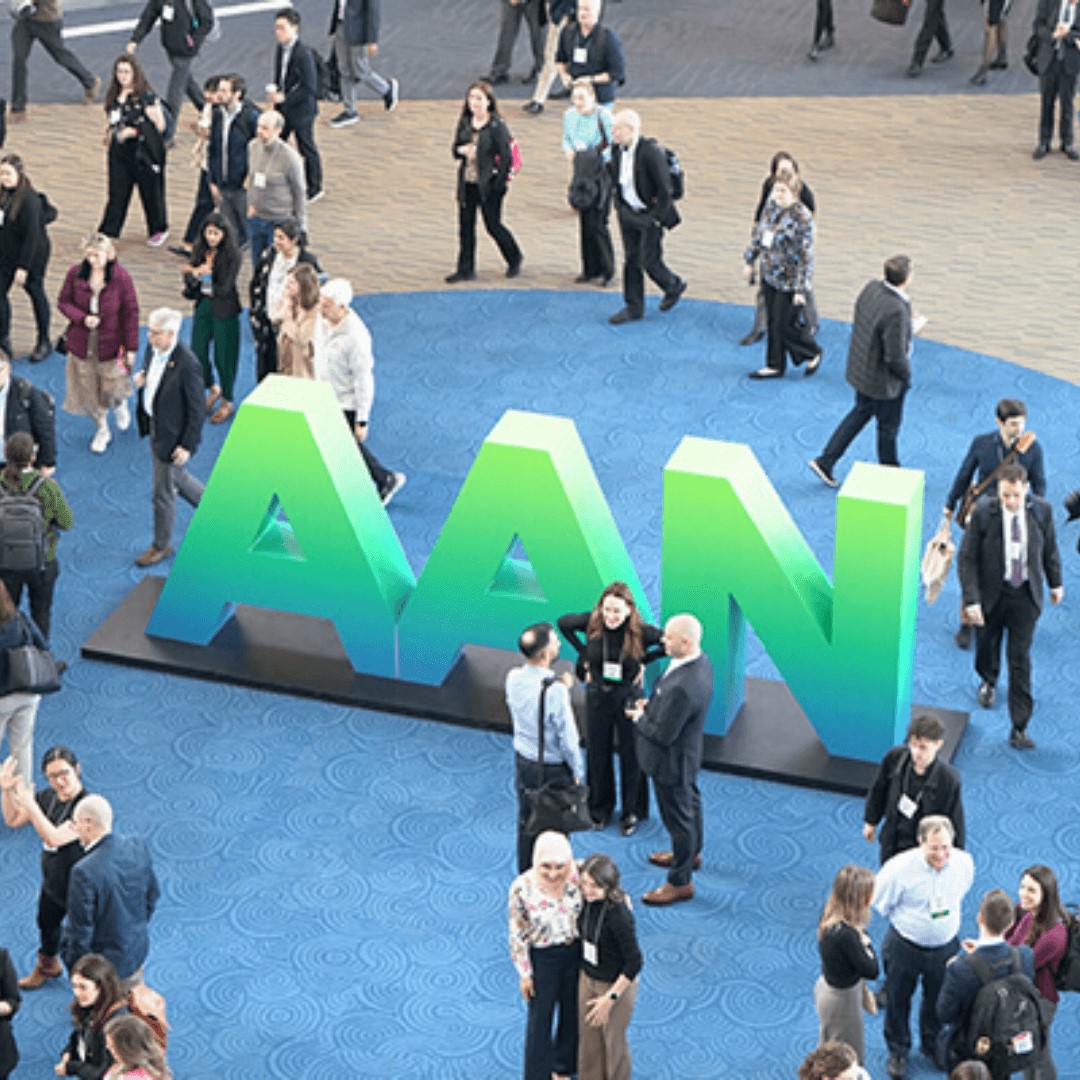
This episode of the Brain & Life Podcast was recorded live at the American Academy of Neurology’s Annual Meeting. Co-hosts Dr. Daniel Correa and Dr. Katy Peters were joined by Jen Pollack from Alzheimer’s Association, Rich Brennan from ALS Association, and Julienne Verdi from Alliance for Headache Disorders Advocacy to discuss how advocacy and sharing stories make a difference. Tune in to hear these field experts share the positive effects of collaboration and advocacy!
Follow and subscribe wherever you get your podcasts!
Apple Podcasts Spotify Libsyn
Additional Resources
- Become a Brain Health Advocate
- The Why Behind Your Weakness- ALS Association
- ASAP Act- Alzheimer’s Association
- HEADACHE Act- Alliance for Headache Disorders Advocacy
Follow us!
- Guest: ALS Association @ALS; Alzheimer’s Association @AlzAssociation; Alliance for Headache Disorders Advocacy @AllianceforHeadacheAdvocacy
- Hosts: Dr. Daniel Correa @NeuroDrCorrea; Dr. Katy Peters @KatyPetersMDPhD
- X: @BrainandLifeMag
- Instagram: @BrainandLifeMag
- Facebook: Brain & Life Magazine
We want to hear from you!
Have a question or want to hear a topic featured on the Brain & Life Podcast?
Record a voicemail at 612-928-6206, or email us at BLpodcast@brainandlife.org.
Episode Transcript
Dr. Correa:
From the American Academy of Neurology, I'm Dr. Daniel Correa.
Dr. Peters:
And I am Dr. Katie Peters, and this is The Brain and Life Podcast.
Dr. Correa:
Welcome back to The Brain and Life Podcast. So, I think it's really essential that we get down to the most important matters today after game one. Katie, Knicks, Spurs?
Dr. Peters:
You're trying to get me in trouble with our San Antonio listeners. One of my dearest friends is in San Antonio, and I got something about a San Antonio Spurs watch party. But I'm for the Knicks this year. I just think they deserve a win. NYC is such a great town to celebrate in, and they have such a great team. I think my favorite player is Jaylen. Jaylen something. Jaylen... [inaudible 00:00:58] Isn't it supposedly that there's so many Jaylens? Isn't that like [inaudible 00:01:04]
Dr. Correa:
Okay.
Dr. Peters:
Yes. It's not going to be safe saying there's a Jaylen, but for us in North Carolina, it's all about hockey. It was the first game. The Stanley Cup, go Hurricanes for the Stanley Cup. So, back to you, I'm putting you in the hot seat. Canes, or Golden Knights.
Dr. Correa:
I would have to say I'm generally pretty agnostic on that one because I don't watch much hockey, but I'll pick going along with you, and the Canes.
Dr. Peters:
Okay, great. Thank you. Now we have another supporter.
Dr. Correa:
Always [inaudible 00:01:34].
Dr. Peters:
I appreciate it. Okay, good. Good, good, good.
Dr. Correa:
No, but I'm really looking forward to watching games with friends, and cheering along Jaylen Brunson, and the Knicks. It's a fun time to be in New York City. I mean, it's a sports year for New York City between the Knicks, the Liberty playing very well, the World Cup coming throughout many cities in the United States, but with the final, and many of the games happening in New York, and New Jersey. It's been really exciting. And every year we have an exciting event for a neurologists, and that's the American Academy of Neurology's meeting. We're bringing together neurologists from around the country, and around the world. And as we've mentioned a few times, when Katie, and I were with our colleagues together in Chicago, we did a live recording this year like we did last year together with a panel of guests. Last year's episode, if you go back, and listen to it, we interviewed neurologists who they themselves live with neurologic conditions, or neurodiversity.
And this year we went to the community leaders, and representatives, and while at the AAN, we had a live panel discussion with Jen Pollack representing the Alzheimer's Association, Rich Brennan from the ALS Association, and Julienne Verdi from the Alliance for Headache Advocacy. All of us coming together to talk about the work that many of these community, and patient advocacy organizations are pushing, and doing to move forward research, and policy to improve brain health, and how everyone lives better with these different conditions. Katie, since we've been getting back to the swing of things at work, is there something from the meeting, or our discussions that you've carried forward?
Dr. Peters:
First of all, I just want to say that this live panel discussion was really, I guess, inspired by what we do on the podcast, because we've interviewed so many different leaders, or advocates in that space. But it was a banner year. It was our Super Bowl at the... I guess for us, we're at the AAN. It was a banner year for neuro-oncology section with more abstracts accepted this year, more platform presentations. I'm so proud of all the presenters seeing the amazing science. And I would say sort of outside of neuro-oncology, of course, you, and I have already talked about how amazing it is to be with our colleagues in neurology that there's such a community, but it's also about the science, and what's happening to change patients' lives. And there were some really exciting things, and diseases that have not had a lot of traction.
So, diseases like Ataxia-telangiectasia, there's some new advanced therapeutics. There's a hope for early detection of ALS, which can only lead to maybe more better outcomes for those patients. So, it was very hopeful, and exciting for patients with those conditions, and many other rare neurologic conditions.
Dr. Correa:
Absolutely. I mean, for me, it was just across the board amazing to see the leadership, both of neurology community members there who were there representing different organizations, and conditions, and also our fellow neurologists across the country have been pushing forward scientific advances, but also things that impact social determinants of health, and policy changes across the country. This work continues. We can stay together as a hopeful community, but our community, and society also needs your voice as a listener, as a community member, either impacted yourself by neurologic conditions and/or living, and supporting others. And your voice can help us move forward advances to support those living with neurologic conditions, and the community overall. So, please check out the show notes for more information about the organizations that were featured on this panel along with the AAN's own advocacy work, and through The Brain and Life website at brainandlife.org/getinvolved/advocate.
You can find more information about how you can get involved alongside the AAN, and Brain and Life, and advocating across neurologic conditions, or you can just search the Brain and Life website advocate, and find it right there. So, welcome everybody. Thank you for joining us. As it was mentioned in the program, this will actually also be a live recording for The Brain and Life Podcast along with our guests. So, welcome to The Brain and Life Podcast. We have three guests here joining us here at the American Academy of Neurology's annual meeting in Chicago. Katie, how has the meeting been going for you? I mean, I've been seeing updates about new treatments that are coming out in terms of myasthenia, new immunotherapies for selective genetic disorders, and neurologic conditions. And I'm looking forward to discussing some of those with the public on the podcast, but what have you been seeing?
Dr. Peters:
Daniel, thank you so much, and it's great to be here today, and great here to be with our advocates. I think what is so wonderful is that we're finally seeing interventions that are making really positive change, not just in survival of patients, but also into their quality of life, and their function. And it sort of trickles down to also those very, very important care partners for them, and how they live. So, it's been a wonderful meeting, lots of great innovation that's helping both adults, and children with neurologic conditions.
Dr. Correa:
And so for those that are joining us here at the meeting, or maybe finding this podcast for the first time, because you saw it on the listing in terms of the American Academy of Neurology's conference activities, my name is Daniel Jose Correa. I am a neurologist, and epileptologist, and the editor, and co-host of The Brain and Life Podcast, really trying to help reach our community, and bring us together, and understanding both at the community level alongside with our colleagues in healthcare. And?
Dr. Peters:
And I'm Katie Peters. I'm a neurologist, and neuro-oncologist at the Preston Robert Tisch Brain Tumor Center at Duke. I am Daniel's co-host for the podcast, and I look forward to talking to our advocates today.
Dr. Correa:
So, through The Brain and Life websites, and the materials, including the podcast, we really try to bring together communities, and individuals' perspectives with a really public understanding about living with neurologic conditions, and increasing awareness, and key partners to this are patient advocacy organizations, and we're glad today to be joined by representatives from three organizations across the spectrum of neurologic conditions. So, I'm going to ask them to introduce themselves, and tell us both the organization that you're here representing, and maybe how neurologic conditions have touched you, or your family's life.
Jen Pollack:
Sure. I'm Jen Pollack. I'm the Senior Director of Access, and Regulatory Policy for the Alzheimer's Association. I've been with the Association for almost nine years now, and fun fact is that I wrote my law school essay on wanting to do public policy work for the Alzheimer's Association. And so it's really exciting to be here. Growing up, two of my biggest influences were my grandmothers, and they both eventually lost their lives to Alzheimer's, or another dementia. And so it's just a really personal passion for me here, and I'm really glad to be able to work alongside all of my great colleagues, and all the researchers, and neurologists in the field.
Julienne Verdi:
Hi, I'm Julienne Verdi. I am the Executive Director of the Alliance for Headache Disorders Advocacy. I am also a person living with migraine as well as the care partner of my 10-year-old son living with the disease as well. I come to this work with personal lived experience with the disease, but also with several other neurological disease states. Our family has had several folks living with multiple sclerosis, Alzheimer's, Parkinson's, and ALS. So, really understanding how all of brain health impacts all of us, and there's a lot of overlap I think with a lot of the issues that we talk about.
Rich Brennan:
I'm Rich Brennan. I'm the Vice President of Federal Affairs with the ALS Association. And I come to this role after spending really my career in Washington DC advocating for healthcare services, approved healthcare services for a number of patient populations. And so people living with ALS particularly because they're in such great need, and really tap into all the aspects of our healthcare system really demand excellent service, and also innovations. And so what I've worked on is just trying to make sure that their stories are also told. So, I'm here on behalf of a number of our ALS advocates that even have recently passed away. They're very special, those people that we work with because we integrate them into all aspects of our advocacy efforts, and I'll go into more of that later. Thank you.
Dr. Correa:
Yeah. I mean, I think it speaks to that number, and some of the epidemiologic data that we've heard, and come out more recently that one in two people in their lives are touched by neurologic conditions. And I have a similar experience, I think to many as you described. In my household of just my wife, and three pets, she lives with migraines. I had concussions growing up. Our dog has caudal occipital malformation syndrome for those who know about veterinary conditions, and that's just within our house. And there's my sister's history with concussion, and migraines, my mom's history with epilepsy, neurodegeneration within the aging members of our family. The reality is I think when we all step back, and really take a look at how neurologic conditions impact us, and our communities, we're never more than an arm's length away from someone who really needs that understanding, and truly excellent care that we should all be providing across the world. And Katie, I know that it's been a big impact for you both personally, and in the work that you do.
Dr. Peters:
Absolutely. Taking care of brain tumor patients, advocacy is so important because there's a lot of isolation after they get diagnosed with a disorder, particularly a neurologic disorder, and it can really impact everyone. I sort of harken back to one of our really great guests, Jessica Slice, who has a neurologic condition, and she said everybody at some time in their life will have some kind of disability, even though it may not have happened to you now, it will happen in the future where you'll have to contend with it, or you'll be a care partner that has to contend with it. So, I guess one of the questions, and I was going to just start with you, Julienne, if you could sort of tap into what was that journey like for you in becoming an advocate?
Julienne Verdi:
Yeah, thank you for that. I think I came to this work like so many others. I fell into advocacy because I had to. I think so many patients, we just want to live our lives to our fullest potential, but the healthcare system doesn't always allow that easily. And so when you're living with a chronic condition, you have to learn the laws. I'm an attorney, and I have that background, but it's even difficult for me in this being in this world, having the legal knowledge that I have, and still having to navigate insurance appeals, and all of the other things that impact access to care. It is a full-time job living with a chronic condition, and it shouldn't be. You should just be focused on your care, and not have to deal with all of the administrative stuff just to get access to what you need to live your life. So, I think for me, that's really where my passion for this has come from, not just for myself, but watching my loved ones deal with these situations as well.
I went to law school in the first place actually because my mom worked at the World Trade Center, got hurt about six months before nine eleven, fell on broken concrete, and she was one of the only women in her job, she was in telecommunications, got hurt, and was quickly fired for getting hurt. And thankfully she had a union that fought for her, and got her job restored, and she ended up going on disability, but watching her journey in that, and how important it was to have the understanding of the law behind you to advocate for lots of different things that impact someone's life. I mean, that was really why I went into this work. And when the opportunity came up to lead the work at the Alliance for Headache Disorders Advocacy, I thought what a unique opportunity to combine my lived experience with my passion in health policy. And it has been just really the honor of my life to work with our patient community, our clinicians, our researchers, our care partners to advocate for policies that make life better for the 40 million Americans living with migraine, and headache disorders.
Dr. Correa:
And Rich, I know you came to your position working in health advocacy in a different, and unique way. So, I was wanting to hear about how you got connected with ALS Association, and what brought you to healthcare advocacy.
Rich Brennan:
It really started very early for me. I am a survivor of a rare disease. I had childhood leukemia, about 3,000, or 4,000 children are diagnosed with that every year. And I was diagnosed in the late 70s. So, my chance of survival was minimal. I mean, no one was supposed to survive. In fact, I'm surprised that I'm standing here, and speaking to you now, but part of the story of that was I was diagnosed early. They were able to pick it up at a blood test. I had benefits from recent research that came out of St. Jude's that was the new chemotherapy regimens that had just launched, and I was one of the early kids through that. Combination of those things can easily translate to any disease where we want to make sure that people are diagnosed properly, and timely, that they have access to the best therapies. And so that type of situation launched me into not only a stint with...
I went to film school at the University of California, partly because I wanted understanding how to influence public policy using film, and television, and then came to Washington DC, and started working on these national campaigns to influence healthcare, and get needed changes for healthcare. So, those type of efforts just continue to triangulate into a patient population like ALS where they demand literally in about a two to five year period of time because it's a terminal diagnosis, you go through every single conceivable healthcare experience that our nation has to offer from diagnosis to hospice in a very short period of time. And it's extraordinary what they go through, but there's a tremendous lessons that can be learned by looking at them, and understanding what their lives are like, and engaging them in this dynamic change we want for to improve the American healthcare system.
Dr. Correa:
One of the first barriers that our community members can run into after they actually able to get access to care, and get a diagnosis is just the understanding of the health condition that for themselves, and their family. I know that each of your organizations along with the AIN through brain, and life, and other efforts are really targeted towards increasing health literacy across neurologic conditions. What do you see are some of the biggest challenges, and gaps, and really trustworthy health information around the conditions that each of your organization supports? Maybe Jen?
Jen Pollack:
I think that some of the biggest challenges are just basic understanding of the disease from a large public perspective, from a policymaker perspective, and even from a clinician healthcare provider perspective Alzheimer's used to be the disease where when you got the diagnosis, there was nothing you could do. And so we would see that people wouldn't even get diagnosed because clinicians were not comfortable because there was nothing else for them to do, but we're not there anymore. We're in a new era of treatment. We have disease targeting therapies that can slow the progression of the disease. We are also in a really exciting, innovative time for blood-based biomarkers. So, a simple blood test could tell you whether, or not you have the disease, or screen you to lead you to additional testing. And so I think really catching the public up, and catching policymakers, and clinicians up with where we are, it's very different than even five years ago in terms of the landscape.
And so we do a lot of that through social media, and we do a lot of that through news stories, local engagement, national engagement. We have something called ALZpro, which is for providers, and talks to them about the entire continuum of dementia. And we also have something called My ALZ Journey App, which is an app for both caregivers, and for people living with dementia. And it has specific information based on what your situation is so that you're not overwhelmed by just doing a Google search of everything that exists out there, including things that people may want to be good for your brain health, but maybe don't have any evidence for being good for your brain health.
Dr. Correa:
Yeah. We wished everything we did was good for our brain health sometimes.
Dr. Peters:
Yeah, absolutely.
Dr. Correa:
And Julienne, or Rich, can you tell us a little bit more?
Julienne Verdi:
Yeah, I think one of the first things that we really try to do is just break down that migraine, and headache disorders are not just a headache. I think for us, I think we're really starting at that basic level because our disease data is so highly stigmatized. I think a lot of people when they hear, "Oh, you're living with migraine, or cluster headache, go take some over-the-counter medication, and move on with your day." And so I think really trying to normalize, and help our patient community know that this is not just in your head, it's in your head, but it's happening here, but all the other things that you're experiencing with it is part of the disease. So, migraine comes with lots of other things. It's the brain fog, the nausea to the point of vomiting. I think for us, it's really telling those stories about what this disease actually looks like.
I think for a lot of us, too, because it tends to run in families migraine, it becomes really normalized. So, I know for myself, I grew up in a migraine household. My dad lived with migraine, my mother lived with migraine. And so when I started experiencing it, it was just like, well, everybody gets a headache. And with my dad in particular, he didn't realize he had migraine. He always called them sinus headache. And so I thought for a long time, that's what I had. And it was not uncommon to see him come downstairs in the morning, and he'd have a cup of coffee on his head on his face because the heat felt good on his face, and it was always one-sided. It's classic migraine. So, when I started to experience it, and be in the sort of cave of migraine, to be nauseous to the point of vomiting, and dealing with just the intense pain, brain fog, and even aphasia.
So, I get sort of transient aphasia during my migraine attacks, I just thought it was normal. So, I think for us it's explaining to folks, you don't have to live like this. This does not have to be your normal, and that there are treatment options out there to help you. And just helping folks get on a path to better days, I think is really what we are trying to do, and not normalize that everybody gets a headache. That's not actually true. And I think when I was older, and I heard that for the first time, someone said, "Oh, I never get a headache." I'm like, "What?" And so I think really trying to just help folks get to a provider that's understanding, help folks understand that you also need to be your own advocate during this whole process. So, coming to your first appointment with data like a headache journal where you're tracking when this is happening, what are the different things that you're experiencing so that you can go into that first appointment prepared, and to get to a treatment plan that works for you.
Dr. Correa:
And Rich, the presentations, or the ways people can present, or have initial symptoms of ALS can be so varied. I imagine this is such a key area for the ALS Association, and addressing understanding.
Rich Brennan:
Yeah, certainly a lot of our efforts of the ALS Association are focused on public education. I don't know if everybody's familiar with this, but ALS has been around for about 150 years as far as a diagnosis. It hasn't been to the last 15 years where it's really risen to prominence, partly because we had this social media phenomenon called the Ice Bucket Challenge that you would find that launched, and went crazy, and still goes crazy to this day. In fact, we have spinoffs like it's called the CEO SOAK. So, people who are heads of major corporations, and nonprofits can dunk their bosses, and raise money for the ALS Association. So, that's a lot of fun. I've done myself several times at this point. So, I would say participate in that kind of effort, but that also helps people understand basically by just something as simple as that, understanding that this is something to pay attention to.
And so I work on campaigns. In fact, we have campaigns that are front facing to not necessarily neurologists, but the frontline physicians that need to understand, I need to refer this person to a neurologist. So, we have a tool called the Think ALS tool that we developed internally that is simply meant to be able to have the signs, as you said, am I miss-stepping? Am I losing my ability to swallow? The typical signs that people have where they might think that something is not necessarily just muscular, it is neurological. And so helping people understand that is important. I also work in coordination with various groups as well beyond the ALS Association. So, there's a new tool that was just launched in March called the Why Behind Weakness, and it's whybehindweakness.org, and it tracks all the neuromuscular conditions, and their symptoms, and then it helps people understand necessarily what I may have, and what questions I need to ask my doctor.
And then it has the doctors actually raise these questions up to the neurologist to say, "This is somebody I need to refer out." So, that's part of the public campaign, but then we also work with educating members of Congress, and also members. I'm the Vice President of Federal Affairs, so I do a lot of talk with our federal agencies with the National Institutes of Health, and the Food, and Drug Administration, and the Centers for Disease Control, and the Department of Defense, and anybody considerable with a three letter acronym under their name. And it's part of a conversation because there's a huge effort that needs to happen as far as we have both public, and private partnerships that are providing the money for ALS research. And while the ALS Association has been able to benefit from the ice bucket challenge, in fact, we took all $140 million that was raised by this challenge, and put it into ALS research.
So, there's like 540 research projects across the world really for ALS research. We opened up a hundred more ALS clinics. We did things like develop new biomarkers such as NFL, and antisense, and oligonucleotide technology. So, those kinds of things are all part of the ecosystem that we need in order to better diagnose, and then treat this disease. And we're getting closer, and closer to an actual cure, but right now it's just trying to make it a livable disease so that people can turn this disease from a terminal disease to a chronic disease. And so that's where we are now.
Dr. Peters:
And Rich, it's amazing the changes for those ALS patients, and just how all of you are so good at engaging patients, and caregivers. But I was going to ask you, Rich, since you mentioned how you engage with Congress, and federally, can you give us a tender of what that is like, and how other advocacy organizations can really tap into that so that it can be a trickle-down effect?
Rich Brennan:
Yeah. So, I have a couple examples. I would say patient advocacy, and involving patients in our work is part of our DNA. So, it's not just sending somebody an alert to say that there's the Act for ALS, or Better Care Act, the Healthy Brains Act has been introduced, and that they need to take action, and let their member of Congress know that this is important to them. So, we do those kinds of campaigns, but we also do things like we deal with access issues constantly. And so people are denied because of utilization management, and prior authorization, various equipment, services, and drugs, and in ALS because it's progressive disease, if you delay somebody's ability to get something, it changes the timeline for them so they actually progress much quicker if indeed we're restricting needed services to them. So, part of this is I've had like Katie Adams, for instance, out of Kentucky, I heard from her that she was having difficulty with her power wheelchair system, and I had worked on a new Medicare benefit to allow for these seat elevation systems, and power wheelchairs.
She was still being denied that technology, and so I set up a call with the deputy director of CMS, and had her tell her story, and explain what she was going through, and CMS actually about a month later issued a national guidance to all the Medicare Advantage plans to say that indeed you need to necessarily follow the protocols. There was that on the seed elevation. And I did a similar effort with one of our drugs that was being denied, and CMS again sent another alert out to all the Medicare Advantage plans to let them know that then indeed if you're coming across somebody with ALS that has SOD1 ALS, and they are qualified to, it's called COSADI, if they can be maintained on that drug, there's no reason for denial. So, those kinds of things are front facing as far as the federal agencies have the ability to make a tremendous difference for us.
And so part of it is just telling the story, and allowing somebody like Katie, or Larry Felivina tell their story, and why this is important to them, and it's needed for their care, and wellbeing, and their quality of life. Those are two examples.
Dr. Correa:
I like hearing those individual, and personal stories. And so I was wondering maybe if Jen, and Julienne, if each of you could share one, first explain so everyone on all of our audience listening at home, or here know, and understand what we mean by the Healthy Brain Act, and then how advocacy for that, or one of your other advocacy initiatives might impact someone, or community members that work with your organization.
Jen Pollack:
Yeah. So, I think one of the things, and I think Rich hit on so much in what he talked about, but for us, we always tell our advocates that their story is their superpower. You don't need to know all the technical details of the bills, or how Congress works, or how the regulatory process works in the administration. You need to know your story, and you do because it's lived experience. And so sharing your story, I mean, we find it with Alzheimer's, and dementia, not to speak for others, but I imagine they feel the same way that most members of Congress at this point, and most policymakers in states, or in the regulatory agencies have a connection to our diseases, and disorders. And so being able to share your story right now we're working on something called the Alzheimer's Screening and Prevention Act, or the ASAP Act.
And this one essentially is looking to allow Medicare the opportunity to cover screening blood tests for Alzheimer's, and other dementia. Right now, Medicare cannot cover screening tests without explicit permission from Congress, or from the US Preventive Services Task Force. And so we are following in the steps of what cancer has done in times past. So, we're kind of viewing this as a mammogram moment, if you will. It's really an opportunity to make early detection the standard of care. And so we ask our advocates to go, and meet with their members of Congress to do social media posts, to make videos, to call them, to go to town hall events, and share their story of why early detection is so important to them. And being able to make that connection will help members of Congress. I mean, we have members on both sides of the aisle who may be just completely opposite politically, but will come together, and work really hard to ensure that people living with Alzheimer's, and other dementia, and the rest of the community have what we need, whether it's in appropriations, or through things like the ASAP Act.
And so I think sharing the stories I'm a former Capitol Hill staffer, and I haven't been on the Hill in well over a decade at this point. And I can still tell you the names of an advocate from the ALS Association, and an advocate from the Parkinson's Action Network. They are folks that I kept in touch with long after I left the Hill. And so those stories are so important. And we've had the opportunity to have some of our advocates, like a woman named Sue from Maryland. She testified in front of one of the house committees about her caregiving story, and what it was like getting her parent diagnosed. And we've had a gentleman named Tony from California who even with all of his resources, and knowledge, and living near really incredible institutions in Northern California took him two, and a half years to get the right diagnosis.
And so the idea of this early detection screening people during annual wellness visits, or when they're having other touchpoints with their providers, primary care specifically is just so important, and sharing the stories with the policymakers will make that happen.
Julienne Verdi:
Yeah. I can echo so much of what you said. I think one of the things that when we're training our advocates, we always tell them if statistics alone were enough to change hearts, and minds, none of us would be up here because we'd already get everything that we're advocating for. Unfortunately, that's not enough. We know we have statistics on our side. So, that's not what I need our advocates when they're going into these meetings. I don't need them to talk about all of those stats. What I need them to do is make that personal connection, to tell their personal story of how migraine, and headache disorders have impacted their life. And by telling those stories, that's how we're going to change hearts, and minds. And so a couple of the things that we do is sort of very similar. As we walk into the room, and for every single congressional meeting, we start by asking the staffer, or the member of Congress that we're meeting with, "Do you, or anyone you know live with migraine, and headache disorders?"
And so starting to make those personal connections, understanding what they might know, and what they might not know, and talking about how it's a spectrum disorder, and potentially a progressive disorder, and making those personal connections, and trying to change those hearts, and minds through those personal stories. So, absolutely important. For us, our main bill that we're advocating for is called the Headache Act. And I think this bill, what's so great about it really kind of shows how much all of our organizations work together, and learn from one another. So, we based our bill after the success of what has happened in the Alzheimer's space, and looking at a bill that they passed many years ago, and that then was introduced for Parkinson's, and the National Plan and Parkinson's Act. And so I was actually sitting at an AAN patient advocacy round table that the AAN brings together on a quarterly basis, and heard about the Parkinson's Bill for the first time. Light bulb went off. Why can't we do this for headache? And so we took some time, and did some listening, and learning from these other disease today.
It's really analyzing their bills, and how it's impacted the research pipeline, and all of the funding, all of these different things, all of the issues that we are seeing in the headache space. We are severely underfunded in the headache space. When you're looking at NIH funding compared to disease burden, we're one of the least funded diseases, and that needs to change. And we have a workforce issue, all of these different things that we think that we can achieve through our bill, which would essentially create a national plan for migraine, and headache disorders. It's the first standalone bill ever introduced in our disease state, which is sort of wild to think about 40 million Americans living with migraine, and headache disorders, and there's never been a bill for us. And so we're really thrilled the bill was introduced in September by Representative Lori Trahan, and Representative Brian Fitzpatrick. We have secured a Senate need to get the bill introduced in the Senate.
So, we hope to see that happen in the next couple of months. But I think really kind of looking at other disease states, looking at what's worked, what hasn't, how we can build upon those successes, and bring it to a disease state that, again, has been highly stigmatized, not thought of as worthy of needing something like this. But just a reminder that migraine is a leading cause of disability globally. It is the leading cause for young women in this country, and we need to do more. And I think that's what the Headache Act will achieve when we get it done.
Dr. Peters:
Part of our audience, our neurologists, and neurology providers, how do you suggest that neurologists really become part of the advocacy plan for you, and for all of your organizations? How can they get involved, and then also how can they then pass that information onto their patients?
Jen Pollack:
I'll go first here. I love that question. I think that as neurologists, as specialists in this field, your voices are just as important, and having you share what you see with your patients, what you experience in your own practice, what you have going on AAN, and I'll shout out the team who's sitting here, they have a phenomenal advocacy team that as Julienne mentioned, they work very closely with us as patient advocacy groups. So, I think we would welcome any, and all neurologists who would like to participate with the Alzheimer's Association. You can write your member of Congress, you can come to our advocacy forum, you can engage in other ways AAN has supported our bills in the past, and including ASAP, and lending the voice of the neurologists is really, really important to members of Congress to hear that it's not just a one-sided issue, but that you bring in the role of the people who are directly related to the care for people living with Alzheimer's, and other dementia.
Julienne Verdi:
Yeah. I think a lot of what you said, but I think what I think neurologists bring to the table when we are together in Hill offices, it's so wonderful to have the patient's story. We always want to be centering the patient's story, but when the neurologist is in the room with them, the amount of credibility that that adds to the patient's story really can't be underestimated. I think advocacy has to be a partnership between patients, and clinicians together. And I think that there are several ways to do that. I think one is definitely coming, and being a part, and being a part of advocacy in the first place, and coming up, and showing up for these bills, and different things. So, certainly come to Headache on the Hill, or neurology on the Hill, and advocate. So, that's one way to do it. And I think always remembering that things like prior authorizations, and step therapy issues, this cannot be the work of the patient alone.
We need it to be something that we work on together a partnership. I think another way is by prescribing advocacy. And this is something that we've talked about a lot in the headache community, and how clinicians can prescribe advocacy to their patients as part of the treatment plan because living with a chronic health condition can be really isolating. With migraine, and headache disorders in particular, you're in a lot of pain, and you tend to kind of go in the cave of migraine when you're in that, and it's just the people in your life may not understand what you're going through, and it's hard. So, by prescribing advocacy, you are helping your patients find community. And I think that that is such an important part of getting well, and living well with a chronic health condition, with a chronic neurological condition. So, we encourage you to prescribe advocacy, help connect to patient advocacy organizations.
Also, I think part of why that's so valuable is it helps to stop catastrophizing what you're going through, and helps you feel like you're kind of gaining some sort of ownership, and agency back in your life because now you're giving someone a purpose. And I think that's what we hear over, and over again with participants at a headache on the Hill, and how empowering it is, but it's also about that community, and just feeling like I am not suffering in vain. I am using my personal experience to try to make change for me, and for so many like me. And I just think that that could be such an important part of the treatment plan if we prescribe it, and not just say, "Hey, you should find advocacy", but give them those tangible steps on how to find it, how to get involved. It can just be as simple as having a flyer, and a QR code in the office.
I think there are a lot of really simple things that does not have to be huge, and time-consuming. I know you don't have a lot of time in the office, but those simple steps I think could make such a huge difference in patients' lives.
Dr. Correa:
What do you see really as the difference between just providing the patient, and their family information about the Alzheimer's Association, Headache Society, this specific organization that supports their condition beyond actually giving them information about the advocacy efforts of the organization?
Julienne Verdi:
Yeah. I mean, we've been sort of encouraging folks to even just have things about the bills. So, we've designed flyers that specifically are just on Headache Act that our clinicians can have in their office. And I think we can talk about explaining to the patient why I'm prescribing this medication, but we have to get the prior authorization first, and explaining, well, why? What is that, and why do we have to go through these steps? And then you can point to, oh, but there's a bill that could potentially change this, or there's work to be done here, and right now we have to do it this way because of X, Y, Z, but it doesn't always have to be this way. And I think making those connections, and helping the patient understand why something is happening, it's not just because the office wants to do this.
Certainly the clinicians don't want to be spending their time having to do this. But I think in terms of the Headache Act, and other things, it could be around research. We don't know certain things because we're not investing in the research. So, saying if they ask a question, and you don't have the answers, we need more research in this space. It's something that I'm really passionate about. And if it's something that might be interesting to you, there's a bill that you can learn more information about. Or again, you can find this advocacy organization. You can come with me. I go to this event called Headache on the Hill. I'm not going to be in the office next week because of X, Y, Z. And explain what that's like. I think it's taking that a step further, and helping to connect what's going on in someone's life to the policy behind it.
Dr. Correa:
And Rich, prescribing advocacy for an individual, and their family living with ALS, how do you see that potentially impacting, or empowering them?
Rich Brennan:
Well, so like I said prior, we have our campaigns for various pieces of legislation that we have introduced that are currently in Congress. So, they are directed to people living with ALS, and their caregivers, but they're informative enough that would be really relevant to a neurologist, a physician as well. I think that what I would like to say is that neurologists have a stake necessarily whether, or not we succeed on ALS, or any of these diseases. And it really does like on disease state, and the success does really affect the ecosystem of things that are going on, especially the research, and the research, and the commitment from Congress to continue to invest in research. So, it's interesting to me that if I were to look at the bills, so the ACT for ALS can provide for $100 million for ALS research over the next five years.
And actually that's $100 million a year for the next five years. That's a reason to engage. The Better Care Act would provide for more funding for ALS research because we would give extra funding for multidisciplinary clinics to be able to conduct the clinical trials, and the neurologists, and also, because the neurologists are over the clinical trials, and are also residents at the clinics, that's a reason for them to engage. The Healthy Brain Act, which was recently introduced, will provide for more funding for the environmental factors of neurological diseases in general. So, it's beyond ALS. I mean, this is anybody that would come across any toxicity whatsoever, whether, or not affects their disease state. There's another reason for neurologists to necessarily understand what are these pieces of legislation, what are they trying to address, and how will it affect what I do as a neurologist? I think that can be very impactful for them to sort of get under the hood of those things as well.
It also affects, as you said, the health, and wellbeing of their patients, whether, or not these vehicles make it. Secondarily, we also have, I mentioned public-private partnerships because of our relationships with the National Institutes of Health, and the research that goes through that institution, and the National Institutes of Neurological Disorders and Strokes, for instance. All that funding that goes through that is directed towards ALS, or neurodegenerative diseases in general. There's actually a new fund that was created, it's called the Rare Neurological Disease Grant Program that is run by the FDA as well. Those are leading to new innovations. So, everything from cognitive brain interfaces to new diagnostics, and blood tests, and ways of intervening, ocular test, those kinds of things that are helping to diagnose brain disorders are all part of this ecosystem of funding activities, and they need to engage in them.
So, I think the one, for instance, is ALS has, it's called the All ALS Consortium, and that's connecting all the ALS clinics across the country, and all the neurologists across the country, and they're now engaged in data sharing efforts, and common collaboration over blood samples, and collecting all the biospecimens, and so forth, and then sharing all that across. So, we're actually digitizing everything, and building these master databases so that researchers would be able to tap into these things. So, that's another reason to get involved because you want to contribute as much as receive the best information possible by collaborating with these efforts. So, that's another reason for neurologists to engage.
Dr. Peters:
I love the term prescribing advocacy, and I just think about it changes as a practicing physician, and neurologist, and neuroncologist, we prescribe that advocacy for many different reasons. It can be just for early information to begin with, and say, you can go to one of your organizations. The next could be in regards to getting a treatment about those prior authorizations, and getting access to those. And then finally, it would also be support for caregivers. If you could think about in 10 years from now for each of your organizations, what is really going to be the next big dynamic step for each of you for whether it's headache, whether it's ALS, or whether it's Alzheimer's?
Rich Brennan:
Next 10 years we're going to double the population of people living with ALS, which is going to take a tremendous effort. So, part of the results of new therapies, and better technologies, and new care models is that we're extending people's lives. That is also an interesting dynamic because right now we're taking something, and extending their lives, but we also need to find, and continue our ways of providing access, and things like delivery of care in the home environment beyond clinic environments, and new technologies like the telehealth, and telemedicine, and those kinds of things that can extend the care into places where we can't possibly get to now, so rural communities.
So, things like that, we're just going to continue this momentum of the care delivery model extensions, and have to reshape how we serve people currently because we're going to have, at least in ALS, like I said, twice as many people I think with all the disease states as we get to that where people are surviving, and they're having long-term survival of these disease states, we need to continue to not only track, well, we're worried about diagnosing them properly, and in a timely manner, but we're actually going to think about what does our lives look like so that we maintain their quality of life throughout this new way of thinking that they have.
But at the same time, how do we engage people more if indeed they have better quality of life, and it's sort of like, "Okay, I'm better off now." I think that those kinds of things we want to be able to continue that people are active, and participatory, and saying engaged because I mean, the people that I work with that are living with ALS, they are on fire. I mean, they literally are so dynamic in telling their story, and activating with Congress, and talking to federal policymakers. I don't want to lose that. I want people that are continuing to be engaged. So, we're going to have to put some thought behind that as well.
Julienne Verdi:
So, I think when I think about the next 10 years, first, I want to look at the last 10 years. I think that there has been so much progress in the migraine, and headache disease state. There's so many new treatment options out there with the CGRP therapies, and how much that has improved patients' lives. What I think is the challenge is that they're not working for everybody. And we still have patients who are living with chronic migraine who are incredibly disabled by their disease state. And then there are lots of other headache disorders beyond migraine where there are just very limited treatment options out there. I'm thinking of my cluster headache friends, and our community living with new daily persistent headache.
It is a crime that there are not the treatment options out there yet to give these people the lives that they deserve. So, I think looking ahead at the next 10 years, I hope we pass the Headache Act soon, and that we see the impact that that will have on the research pipeline, the investment in our disease state, the investment in the workforce that we need to treat these people who deserve so much more than they have right now. So, that's where my head is at. And then in the next 10 years, what I hope is that screening is just, it happens annually. It's part of the well woman visit that we're screening women for migraine, or part of just the primary care annual visit. ID migraine is three questions. This is simple. If we can get folks diagnosed early, and we can get them on a treatment plan, maybe we can stop that progression from episodic to chronic.
And then certainly in the children's population, I think that there is so much work that needs to be done when we're talking about pediatric headache disorders, and again, the amount of treatment options out there currently for kids. I think about my son Jude, and what he goes through, and how little help we have thus far, even though I'm in this world, he deserves to not progress to chronic migraine. I have three children after my son who I worry about, and I hope that in 10 years we have better treatment options, better screening, more research, and more clinicians to treat our folks so that they get more good days at the end of the day. I think that's what migraine, and headache disorder patients deserve is the more good days to live their life to their fullest potential.
Jen Pollack:
I'm hopeful that in 10 years we'll have the first survivor of Alzheimer's. I hope that we will... We're seeing just incredible innovation over the last decade, even a little bit longer around disease modifying therapies, around new research in neuroinflammation, in tau, in so many different areas. And I think a lot of that comes from starting earlier, making sure that we're talking with folks about brain health holistically. We've been in the brain health space for decades, and we are continuing to update our programs, and have these conversations with providers, with public health professionals, all of these things that can modify your risk, or slow your decline. And so I think we're going to be in the next 10 years, I'd love to see that we're catching people really, really early. There's a couple of drug trials that are going to read out in the next couple of years that are looking at people in stage one, and two of Alzheimer's disease, which are people who have the biomarker changes but aren't exhibiting any cognitive symptoms.
What if we start treatment in that stage? What does that mean? Does it mean that we don't progress? Does it mean that we get longer times being ourselves being with our families? We just released yesterday, April 21st, the 2026 Alzheimer's Association Facts and Figures report that we put out every year, and this year's special report was called Brain Health in America. And it looked at how Americans understand, and act on brain health, and it comes on the heels of the Landmark US Pointer Study, which showed that lifestyle modifications can really make a difference on your memory, and your thinking, and your cognitive abilities. And so for this special report, we surveyed more than 3,800 adults age 40, and over to ask them about brain health what they know. And nearly nine, and 10 said that maintaining brain health as they age is very important. They believe lifestyle behaviors such as diet, physical activity, sleep play an important role in maintaining brain health, but fewer connect these behaviors to reducing dementia risk.
While they overwhelmingly believe healthy behaviors support brain health, they don't practice them consistently. So, we saw that only about half report getting at least seven hours of sleep daily, or on most days, 39% say they eat a healthy diet, 34 report percent report daily physical activities. And so I think for us, brain health is this lifelong priority. We're continuing to expand our comprehensive portfolio on brain health, working with partners like you all here at AAN to make sure that brain health is all encompassing. It's including everybody from all different cultures from all different areas to make sure that we're taking brain health seriously from the beginning of life all the way through the end of life.
Dr. Correa:
Yeah. So, we're here at the Brain Health Hub at the American Academy of Neurology. And as you were describing in some of what the Alzheimer's Association, taking a look at how they're conceiving, and thinking of brain health, and the community's understanding. A key part of the AAN mission is that phrase brain health for all. We heard some of it from Jen now, but I'm wondering for the headache, and ALS associations, how are your organizations thinking about that concept of brain health for all in coordination, and collaboration with your community?
Rich Brennan:
Well, we have an unanswered question on the ALS side is we still have 90% of our cases are sporadic, and we don't know what the factors are behind that. So, a lot of our studies that are actually are military directed because you're twice as likely to develop ALS if you're a military service veteran are trying to understand the toxins that we come across in our environments. There's the other part of the science where we are making inroads on where there are at least 50 genetic forms of ALS that have been identified. We have a genetic therapy for just one of them. So, part of this is necessarily thinking of the science behind the genetic forms because it doesn't mean that if you have a genetic predisposition that it's going to be triggered, but it could be triggered by a toxic environment. There's also research that needs to be done on the nutritional side of diet, and exercise, and those kinds of things that would possibly then act as I guess a condition towards a trigger of the disease state as well.
But I feel like I'm not the medical science at all, but it's a complicated disease, and it's complicated to diagnose, and it's complicated to understand. And so I'm guessing that all the factors that we have involved in this, it's like diet, and nutrition is probably like one of those building blocks that we need to discover, but there's so much there that we still don't understand that we're literally trying to pick apart all these pieces of the puzzle to translate it to the target, and say that this is the overall answer that we need to focus on this. I think part of what we try to do is we want to lower the prevalence of the disease state. And if there's something that we can do to help somebody not to develop ALS, guess what? We'll do everything if that's discovered, we'll work with the federal government, make sure that that is a common practice for everybody to be like, just avoid this because this disease is terminal, and it takes your life in two to five years.
Julienne Verdi:
Yeah, I think similar, we don't know enough about why someone develops a headache disorder. I think we have some ideas for some cases, but not across the board. So, I think at the end of the day, that research component is key. We need more research in this space to be able to get to some of those answers. But I think in the meantime, we know that there are certain things that we could do to increase our trigger threshold. So, I think what we've been trying to think about is not so much about... I think migraine patients, and headache disorder patients, generally we tend to think like, "Oh, if I eat that chocolate, chocolate triggers my migraine." And that's probably not really true. The science is not quite there in terms of specific foods being triggers, or things like that, but lifestyle changes can help reduce your threshold to attacks.
So, I think that's where we see really a connection to the brain health kind of mantra. And also migraine, and headache disorder patients live with a lot of comorbidities. And so all of the lifestyle changes, and all the things that we can do there are important for migraine patients in headache disorder patients, because often they're not just living with migraine, which is hard enough. And I think the other piece of the puzzle is that migraine patients, we know that there's perhaps a higher disposition to things like stroke. So, brain health is absolutely important to our community. We want to be a part of the brain health discussion, and we are really grateful to AAN's leadership in this space, and partnership as we think about ways that we can bring the brain health discussion into the headache, and migraine community a bit more.
Dr. Correa:
Well, I want to thank you guys so much for joining us here today, both at the meeting, and today on this recording for The Brain and Life Podcast, and in the Brain Health Hub. I know from the meeting I made a connection, and some really interesting learning about ways I can advocate for those who are migrants in the United States, and in the US, and we'll be taking home some ideas about migratory health advocacy. Katie, what's something you're taking home from the meeting?
Dr. Peters:
Well, first of all, thank you so much for chatting with us. One of the things that I'm taking home from this meeting, prescribing advocacy. I love that quote. And I feel that we all have our own organizations that are advocacy organizations that we get to work with, and get that opportunity. So, I'm just going to say, I'm going to encourage my colleagues to be advocates.
Dr. Correa:
And we're going to make sure to include information about each of these organizations, links to their advocacy pages along with an episode about each of these conditions, or associated conditions. So, those who are listening who would like to learn more about ALS, motor neuron disease, headache disorders, or Alzheimer's, or dementia. But we have many episodes across these various conditions along with each of these organizations have a lot of excellent audio, visual, public health education, content that it can be very helpful to connecting with the community. Thank you all for joining us.
Dr. Peters:
Thank you.
Dr. Correa:
Thank you again for joining us today on The Brain and Life Podcast. Follow, and subscribe to this podcast so you don't miss our weekly episodes. You can also sign up to receive The Brain and Life Magazine for free at brainandlife.org.
Dr. Peters:
Also, for each episode, you can find out how to connect with our team, and our guests along with great resources in our show notes. We love it when we hear your ideas, or questions. You can send these in an email to blpodcast@brainandlife.org, and leave us a message at 612-928-6206.
Dr. Correa:
You can also find that information in our show notes, and you can follow Katie, and me, and The Brain and Life Magazine on many of your preferred social media channels. We're your hosts, Dr. Daniel Correa, connecting with you from New York City, and online @neurodrcorrea.
Dr. Peters:
And Dr. Katie Peters joining you from Durham, North Carolina, and online @KatiePetersMDPhD.
Dr. Correa:
Most importantly, thank you, and all of our community members that trust us with their health, and everyone living with neurologic conditions.
Dr. Peters:
We hope together we can take steps to better brain health, and each thrive with our own abilities every day.
Dr. Correa:
Before you start the next episode, we would appreciate if you could give us five stars, and leave a review. This helps others find The Brain and Life Podcast. See you next week.