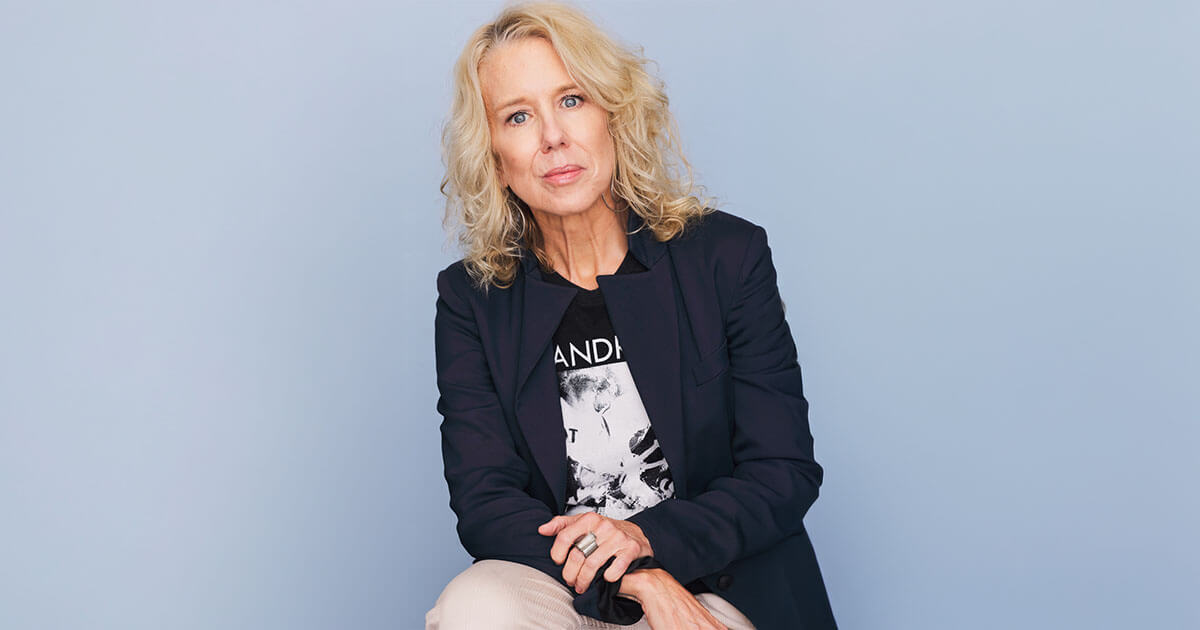
Every chance she gets, Rita Moreno compliments people. “I'm a person who's constantly saying to total strangers, ‘Oh my gosh, what beautiful eyes you have!’ That does something to someone,” says the actor, singer, and dancer. “I've made it a habit now. Whenever the impulse comes over me, I just say it out loud. It puts a smile on people's faces, and it makes me feel so good. I've become a very jolly person. I wasn't like this before.”
At 91, Moreno—one of only 17 people to have won an Oscar, an Emmy, a Grammy, and a Tony award—may be the happiest she's ever been. She's certainly more vigorous, energetic, and effervescent than many people half her age, and she attributes much of that to her mental health and joyous outlook on life. But it's been a hard journey to get there.
Early in her career, the Puerto Rico–born performer dealt with so much racism and sexism that her successes often felt like failures. It wasn't until she started therapy that she began to understand herself. “I really wanted to stop loathing myself,” Moreno says. “The only time I wasn't in therapy was if I was working out of town. I even joined group therapy. I was terrified because then there were other people who were going to know all those dreadful secrets about me, but I did it because I was determined to improve my mental health.”
Recognizing her negative patterns was one of the most important things she learned. “I always wanted to find a man I could make love me,” Moreno says. “I learned to say to myself, ‘Oh, I see, I'm with a fellow who's not good for me.’ It was about men who would never really accept me for who I was.”
She encountered similar attitudes in her professional life. Throughout the 1950s, she was constantly cast in “dusky-skinned, flashing-eyed” roles of varying ethnicities, like Tuptim in The King and I (Thai), Jara in El Alaméin (Bedouin), Ula in Seven Cities of Gold (Native American), and Honey Bear in The Yellow Tomahawk (Native American). “At first I accepted that, but it got to the point where I was doing nothing but that,” Moreno says in Just a Girl Who Decided to Go for It, the 2021 PBS documentary about her life. “That's all I ever got, and it began to really hurt.”
What surprised her is that she thought so little of herself, Moreno says. “I would say to myself, ‘You know that given the chance, you would probably do better than you're doing now. What's wrong with you?’”
She also was subjected to sexual harassment and misconduct by men, including her own agent, who raped her when she was a teenager.
In 1954, when she was 22, Moreno met Marlon Brando on a film set. Their ensuing relationship added to her emotional instability. “This famous, gorgeous, sexy man loved me, as much as he was able to love anyone, and that meant everything to me, but it was for all the wrong reasons,” she says. When she discovered he had begun an affair with his co-star in Mutiny on the Bounty, Moreno took sleeping pills she found in his bathroom. Fortunately, Brando's assistant got her to the hospital to have her stomach pumped. A few months later, she became the first Latina to win an Academy Award, as Best Supporting Actress for her performance as Anita in 1961's West Side Story.
Personal Growth
Ironically, it was Brando who encouraged Moreno to seek the therapy she credits with sustaining her mental and cognitive health. “He had seen me on a local TV show where I was ostensibly being myself, and he said, ‘With me, you are as honest as you can possibly be, but I saw a completely different you on that television show, and I think you need to see a therapist.’ He was dead right. He was a reader of people, which is what made him such a terrific actor.”
Moreno spent the next eight years in therapy. By the early 1970s—around the time she joined a then-unknown Morgan Freeman and guest stars like Mel Brooks and Gene Wilder on the classic children's series The Electric Company (Moreno bellowed the famous “Hey, you guys!” phrase that opened the show, and won a Grammy for a cast album)—she felt ready to graduate from therapy.
“I began to believe that I actually was a nice person,” she says. “One of my biggest breakthroughs was when I said to my therapist, ‘You know what? I think I like myself.’ Several months after that, I told him I was ready to quit, and he agreed. I told him that if I ever needed help, I would come back. Sometimes I think I probably should have!”
In 1965, Moreno married cardiologist Leonard Gordon. Two years later, they had a daughter, Fernanda Luisa Gordon. Moreno's multifaceted career has gone through peaks and valleys, but she was almost always working, with guest appearances on numerous hit television shows, from The Love Boat to Grey's Anatomy; parts in movies such as 1981's The Four Seasons; and a stint as the voice of Carmen Sandiego on the animated series Where on Earth Is Carmen Sandiego? She won Emmys in the 1970s for guest roles on The Rockford Files and The Muppet Show, and decades later earned critical acclaim for her portrayal of Sister Pete, a prison psychologist, on the HBO drama Oz. She also has been in more than half a dozen Broadway shows, winning a Tony in 1975 for the comedy The Ritz.
Dealing with Depression
When Gordon died in 2010 at the age of 90, Moreno went through another period of depression. “Even though we didn't have the most fabulous relationship in the world, I loved and respected him. I felt helpless without him, something I now understand he encouraged in me without my realizing it,” she says. (After retiring from his cardiology practice, Gordon had become Moreno's manager.) “I was just weeping all the time, until my daughter finally took me to a psychiatrist. He asked if he could put me on some medication, and I said, ‘Great, I'd love to not be crying all the time.’”
But while she has found her way to happiness, Moreno says she often feels fragile. She calls the negative inner voice that never completely goes away Rosita, her childhood nickname. (Her real first name is Rosa.) “She comes up and says, ‘Ha ha, I told you you couldn't do it.’ The only way I have learned to handle that voice is to say, ‘Go to your room, you little snit.’ Sometimes it works, and sometimes it doesn't. When you are traumatized, I don't think you ever completely heal. I still get hurt if I'm judged for my skin color and background, but I've learned to forgive myself.”
In recent years, Moreno has been as busy as ever. She starred on the 2017–2020 reboot of the sitcom One Day at a Time and appeared as the narrator on ABC's live Beauty and the Beast TV special in December 2022. Steven Spielberg created a role just for her as drugstore owner Valentina in his 2021 remake of West Side Story, in which she sang a haunting rendition of “Somewhere.”
In her latest movie, 80 for Brady, out in February 2023, she co-stars with Sally Field, Jane Fonda, and Lily Tomlin; it's a comedy about superfans on a road trip to the Super Bowl to meet Tom Brady. “That was so fabulous. It really boosted my ego,” she says. “I think the four of us are just swell together.”
Adapting to Aging
Memorizing scripts takes more work these days, admits Moreno. “Once I could memorize something overnight if the situation called for it. I can't do that now,” she says. “And I can't remember names of people. I see the faces, including those of movie stars, but the names just don't come, and it drives me nuts. I get annoyed and grit my teeth and swear several times. Those words I remember!”
Despite lapses like these, Moreno says she has benefited from a lifelong pursuit of mental wellness and from following common recommendations that neurologists and other doctors make about long-term cognitive health, like getting plenty of sleep, eating well, and exercising. She doesn't dance or do high-impact exercises anymore. Instead, she focuses on core and balance work, using a balance ball. “I stand on it near a wall so I can catch myself, trying to balance.”
Another favorite exercise was inspired by an article her husband wrote for Vogue about how orchestra conductors stay healthy into old age. “He theorized that it's because they use the upper parts of their bodies so vigorously,” Moreno says. “I thought, ‘I could do that,’ so I took a pencil and started to conduct, and I was out of breath in no time. It's fabulous, and you can do it with any kind of music. Beat your arms up and down or side to side in time to the music and you'll get a great workout.”
She particularly likes to conduct marches, but what really gets her moving is Bruno Mars. “His music makes me want to dance, but I can't dance because of my knees, so I conduct and wave my behind around, and it is so much fun.”
Moreno also does specific activities for cognitive stimulation. “One day it occurred to me that I should practice writing with my nondominant hand. I've done it for years, and it no longer looks like the scrawl it once was.” Another regular practice takes place in an empty dance studio she rents (“Do not do this at home where there's furniture,” she warns): “I walk backward, putting my hand on the wall so I don't fall. I made it up, but it seems logical to me. I thought that anything you're not accustomed to sounds like it would work the brain.
“To challenge your brain,” she adds, “you just have to use your imagination. There are all kinds of things you can do.”
How Mental Health and Brain Health Are Connected
Entertainer Rita Moreno believes years of therapy helped keep her brain sharp, and the idea that taking care of your mental health could protect your brain is gaining credence among researchers. A 2018 report from the AARP's Global Council on Brain Health found a correlation between mental well-being and brain health as people age.
“Poor mental well-being…may interfere with people's abilities to think and reason, as well as how they interact with others and how they regulate their emotions,” the report says, noting that multiple studies have connected greater mental well-being to better brain health later in life. An example is a 2018 analysis of more than 10,000 people participating in the Health and Retirement Study that found that a purpose in life was associated with a reduced risk of dementia.
“There are significant associations between stress and cognition, and clearly depression and anxiety are very stressful disorders that challenge one's well-being,” says Liana Apostolova, MD, FAAN, endowed professor in Alzheimer's disease research at Indiana University School of Medicine in Indianapolis. “Unsuccessfully coping with life's adversity can have a damaging effect on brain function and brain structure,” she says.
At least three reports published in 2020 supported the idea that improving mental health may help protect the brain. A study in the Journal of the American Medical Association (JAMA) showed that people who experience trauma early in life appear to face a higher risk of later cognitive impairment; a report in The Lancet included depression among the top 12 modifiable risk factors for dementia; and a 2019 review in Maturitas of existing studies found that anxiety is significantly linked to the risk of dementia.
“If you compare people who have depressive symptoms and those who don't, we know that those with depression have almost twice the risk for developing dementia over the next two years,” says Sudha Seshadri, MD, FAAN, founding director of the Glenn Biggs Institute for Alzheimer's & Neurodegenerative Diseases at UT Health San Antonio in Texas. “But the question is, which came first, the dementia or the depression? We know that one of the first places in the brain to be affected by Alzheimer's disease is the locus coeruleus, which is also involved with responses to stress. It may be that depression is a reaction to the fear and anxiety of possibly being in the early stages of dementia.”
Research has also been finding that our social lives can have an impact on our brain health. “Having strong social networks and connections and not feeling lonely are associated with larger brain volume on MRI,” says Dr. Seshadri. “A 2021 study in JAMA Neurology from NYU researchers found that people who had someone to talk to did better on cognitive examinations than those who did not. The resilience of the brain may be improved by these social connections.” According to a study in The Lancet, older adults with stronger social networks had higher cognitive function (even if they had beta-amyloid plaques in the brain) than those with less social support.
“If anyone had any doubt about the effect of social interaction on cognition, we got our answer during the height of the COVID-19 pandemic,” says neurologist Christopher M. Wilson, MD, senior medical director for specialty care with American Health Network in Indiana. “Among our patients with mild cognitive impairment who are still high-functioning and able to live independently, the isolation of the pandemic really hurt them. I've never seen the cognition of so many people change so much in such a short time frame.”
Managing stress is another key factor. The AARP survey found that older adults who frequently managed stress effectively were more likely to rate their cognitive functions as “excellent” or “very good.”
“Many of the same habits that are good for your mental health and wellness are also associated with reducing your risk of developing dementia later in life,” says Dr. Wilson. “We know that people who get enough sleep and exercise, manage their stress, and are socially engaged tend to have lower levels of dementia later in life. While we don't have clinical trials directly showing that caring for one's mental health reduces dementia, it's pretty clear that what is good for your mental wellness is also good for your brain.”
Read More