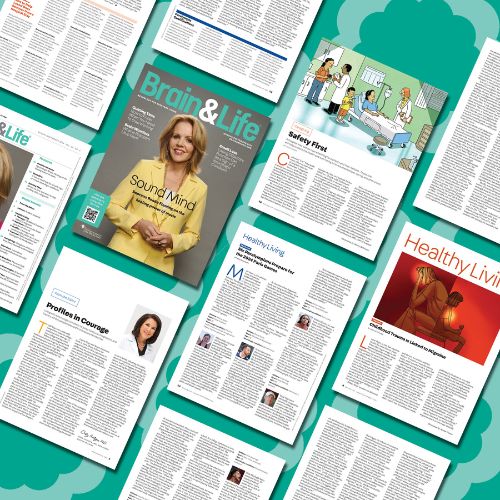
In this episode, Brain & Life Podcast hosts Dr. Daniel Correa and Dr. Katy Peters highlight some of their favorite articles from the August/September issue of the Brain & Life Magazine! They discuss six Paralympic athletes and their impressive feats, how childhood trauma is linked to migraine, and methods of keeping loved ones safe in the hospital. If you would like to read these articles and more, be sure to subscribe to Brain & Life Magazine for free!
Follow and subscribe wherever you get your podcasts!
Apple Podcasts Spotify Libsyn
Additional Resources
Brain & Life Articles Mentioned
- Meet Six Paralympians Preparing for the 2024 Paris Games
- How Childhood Trauma Is Linked to Migraine
- How to Keep Loved Ones Safe in the Hospital
Other Brain & Life Episodes on this Topic
- Paralympic Athlete Helen Kearney on Living her Dreams with Friedreich’s Ataxia
- Exploring the Science of Everyday Wonder with Dacher Keltner
- Broadcast Journalist Deborah Roberts on Living with Migraine
Follow us!
- Hosts: Dr. Daniel Correa @NeuroDrCorrea; Dr. Katy Peters @KatyPetersMDPhD
- X: @BrainandLifeMag
- Instagram: @BrainandLifeMag
- Facebook: Brain & Life Magazine
We want to hear from you!
Have a question or want to hear a topic featured on the Brain & Life Podcast?
Record a voicemail at 612-928-6206, or email us at BLpodcast@brainandlife.org.
Episode Transcript
Dr. Correa:
From the American Academy of Neurology, I'm Dr. Daniel Correa
Dr. Peters:
And I am Dr. Katie Peters, and this is the Brain and Life podcast.
Dr. Correa:
Welcome to the Brain and Life podcast. So, we're back to sports and inspirational feats. With the Paralympics going on right now in Paris, we can all imagine working for months towards a goal. And it's exciting to see these athletes and our community members putting their hearts into their best effort. If you want to learn more about six specific athletes in the Paralympics, the Brain and Life magazine's August and September issue, and the website features interviews with several different athletes. In today's episode, we'd like to highlight that article and some other articles and topics that we wanted to make sure you didn't miss. After reading the issue this Paralympics, I've been watching to catch Allysa Seeley. She's in the Para Triathlon and got a bronze medal in the triathlon, and she lives with Chiari II, a Basilar Invagination and Ehlers-Danlos Syndrome, so several different challenges. And to see her complete a multi-hour endurance feat like that is amazing.
Nick Mayhugh on the Para Track and Field lives with cerebral palsy and epilepsy and runs the 100-meter dash, the 200-meter dash, 400-meter dash, I mean, a whole variety of really high-speed running efforts. And you might actually see and catch online he did a red and blue haircut design that makes his hair look like it's structures of the brain, really interesting. And Brittni Mason, another Para Track and field athlete, lives with Erb's Palsy and also won a silver in the 100-meter dash. And we're excited to see the results of her other races. What about you, Katie?
Dr. Peters:
Yeah, so in the article, we had Steve Serio. His sport is wheelchair basketball. He actually has a spinal cord tumor, but he was a member of the team and competed, so very exciting. And Todd Vogt, he's actually a member of the Para Rowing team. He has Parkinson's. And again, as part of that team, he competed at the Paralympics. And Leanne Smith, her sport is swimming, and her neurologic condition is generalized dystonia. She previously got the world record in the 50-meter butterfly and also has medaled before in the hundred meters. And at this Paralympics, she got a gold medal and a silver, so kudos to her and a kudos to all the Paralympians.
Dr. Correa:
Yeah, there's something particularly unique. In the Olympics, we might see the world records, the fastest, the highest, the farthest of everything. But to see these athletes live and fight and push past so many different barriers that they've encountered, whether it's an ability issue or another medical condition, it's just amazing.
Dr. Peters:
Yeah. And to qualify for the Paralympics, athletes must have at least one permanent impairment caused by some type of underlying health condition. And this is determined by a really stringent set of medical and performance criteria. And it's also specific to each sport. So, depending on what the sport is, there's certain criteria that they have to meet. And categories of impairment can include impaired muscle power if they have issues with maybe passive range of motion. Have they been an amputee? And we actually talked to an amputee before, John Kreisel, when he came and discussed just about phantom limb pain. If there's a leg length difference, if they're short of stature, also, if they have any kind of conditions such as hypertonia. Now, this is an increased muscle tone that makes it difficult to move. Maybe they have problems with coordination or can also have impaired movements like we see in Parkinson's disease and even impaired vision and also impaired intellectual development.
Dr. Correa:
And as you mentioned, each sport has specific guidelines for which the impairments qualify into different categories. So, it's not always just everybody with some impairment gets thrown into the same starting line. For example, rowing has three different classes. You can imagine there's a lot of different parts and muscles that are needed for the typical rowing movement. And so, because of the various challenges, there's a class for paralysis from the chest down, paralysis in just the legs, or partial function in your torso and legs. So, at each of those functional levels, then you have a competition team that can compete, and they have their own modifications to the boats and to the devices so that they can complete their activity and their exercise.
The athletes are classified after a variety of tests. So, it's not just a self-report. Once classified, athletes can qualify for the games in one of three ways. They could vie for a spot in a competition at the US Paralympic team trials. They could be submitting competition results from another international qualifying event or be selected as a part of the team in the team evaluation process. It's just amazing to see how all this comes together, but really, most inspirational to see them out on the field and play.
Dr. Peters:
I think what it also points to is it really points to the concept of neurodiversity and that with all the situations that ... maybe we have a challenge in a particular area. But guess what? You can continue to exercise and continue to compete and be part of a community. So, I think all in all, what this really points to is that there's a place for everyone, and we can all just keep on moving, and keep on thriving, and keep on exercising, so I better get out there and work with my trainer tonight.
Dr. Correa:
Yeah, it's just clear that movement is good for all of us.
Dr. Peters:
Yeah. So, there was another article that I read in the magazine recently, and it's on a little more tougher topic. It was how childhood trauma is actually linked to migraine headaches. And I have many of my patients that have challenges with headaches, whether it's from an underlying brain tumor, or more commonly, they have just a primary headache disorder such as migraine. And it was fascinating to learn that there was a possible connection between childhood trauma and the development of migraine later on in life. And where this came from is it came from a meta-analysis done by a group that published in the Neurology Journal in 2023.
And for us non-statisticians, what a meta-analysis is is a technique where they take a bunch of different multiple independent studies that focus on one particular topic, and they try to produce some kind of generalization or more precise estimate about what's really happening, particularly in regards to a relationship. Like did X cause Y or did X cause Z? So, this method really brings together all those results, and it wants to point out any kind of patterns or discrepancies or overall trends. And so, they were able to look at this in this meta-analysis that included 28 studies, and they found that people that had some kind of primary headache disorder had some association with an exposure to an adverse childhood experience. What do you think about that, Daniel?
Dr. Correa:
I mean, neurologists and neuroscientists also suspect that it has something to do with the hypothalamic-pituitary and adrenal axis. A lot of different words combined, but to shorten it, the HPA axis. And basically, the structures of this axis and this combination in your brain are what drive and adjust your body's response to stress. And so that then can potentially be involved in a pattern that has developed.
Dr. Peters:
Yeah. And I think what they defined is really those adverse childhood experiences were things that were pretty horrific, like sexual abuse, physical abuse, and also being neglected, or bullying, or social isolation, or divorce, or death of a parent. And so really, to me, it really points out that we need to be really vigilant about supporting our youngest patients and what's happening to the, and be willing to ask the tough questions and to help those youngest patients moving forward. And you mentioned this hypothalamic pituitary adrenal axis, and my head starts to spin. I think that understanding the endocrine system is truly one of the trickiest and most mysterious in all of medicine.
Dr. Correa:
Y. I mean, people are ... sometimes, their mind is expanded to the ideas of all the different neurons and wires and connections, but in some ways, the idea of a wire connecting to things, turning things on, off, or even just adjusting them like a volume control is easier to understand than the complex interactions of hormones in our system. It's difficult for doctors, and we can totally understand even how it's difficult for others too. It's not simply just when one hormone is present that something happens. It's a balance of many different things going on.
This structure, the HPA axis, includes connections between the hypothalamus, pituitary gland, and the adrenal gland. And so those are the three that are mentioned there in HPA. And they work together to produce the hormones that trigger the release of cortisol in stress situations and turn it off when levels get too high. So, it really is working throughout your body and measuring different levels of hormones in your body to adjust things up and down or maybe turn off when something is being produced. And you could see how, in many ways, either a habitual pattern that is abnormal could be developed or how one small part of these three things interacting or the things it has to measure in your blood could be thrown off. Frequent or intense stress can cause the axis to malfunction and may lead to increased inflammation as well as changes in the brain structure and function.
Dr. Peters:
And so, Daniel, this reminded me of our conversation that we had with Dr. Keltner. His book, the Awe: The New Science of Everyday Wonder and How it Can Transform Your Life, it's really sort of the flip side of this. Maybe by having those awe-rific and good experiences, you can have positive impacts on your brain health. So, I'm going to recommend that we check out that podcast again and his related books because I think we all need an awe-rific experience.
Dr. Correa:
Yeah. It just makes me think of an interview that I just did recently that's going to be coming up for future release with you guys about how memories work, and really, just the importance and the intention that we put in developing memories. So, stay tuned for a future episode on learning more about how our memories work. Another one of the articles in this issue highlights how to keep your loved ones safe in the hospital. For our loved ones, it can be difficult getting to the hospital, being in there when everything else is going on. It's a different setting. I know for my grandmother, it was always a challenge with my family when they took her, really feeling that she was safe and that she would be taken care of, that they were going to take care of all of her medicines the way they needed to be. What about you, Katie? How has it been for you in terms of getting a family member to the hospital and safe while they're there?
Dr. Peters:
Oh, I just think that this is so important. This article highlighted how to keep people safe in the hospital. Sometimes, it's even challenging getting to the hospital because my mom and one of her caretakers, on a rainy day, there's lots of traffic. They're going to a big city hospital, and they live in the country. They had a little fender bender that happened. And so, again, even outside of the hospital, once in the hospital, it can be very ... things are dynamic and disorienting to patients, and sometimes they have to go from facility to facility to actually finally make it into the hospital itself. So, I think this can be really, really challenging. What do you think?
Dr. Correa:
Yeah, I mean, I think this is something that all of our community experiences, not specific to neurologic disorders. But for our family members and loved ones with a neurologic disorder, there are particular challenges that can arise that are different from just everything that we're all doing to try to navigate the hospital system, get to the right hospital, get to the right doctors. And I appreciated that in the article, they highlighted specific risks for neurologically impaired patients in hospitals, including some conditions. They can have a worsening of their symptoms. There can be medication errors. Some of the medicines used to help treat and manage conditions or symptoms of different neurologic conditions are not super common in other areas, and that can really cause some confusion about interactions. They may think, "Oh, it's okay to stop this medicine because they're not swallowing right now," and it might cause more challenges. Or even if their medical condition or the current situation affects their communication, now you're disconnecting that primary part that we have to communicate and talk, and even have a discussion or a voice and what's going on with our medical providers.
Dr. Peters:
Yes, I think it's important for caregivers to be there to advocate for their loved ones. I think this is really important, particularly in regards to certain diets or maybe allergies that the patients have that if they can't communicate. So, those caregivers can be a really important influence to help the care of those patients in the hospital. And they also can bring really a tenor of what it's going to look like when they leave the hospital of what kind of tools and things that they're going to use. So, having a caregiver there and making sure we can advocate them is just so important.
We also make sure to always bring an updated medication list when you go to the hospital. You want to make sure that the staff knows about all their conditions. I think this is also really important when people have maybe low vision or difficulty hearing. People are coming in and out of those hospital rooms. You want to announce yourself that someone is actually in there and making sure that the patients feel safe. And the next, if you do have a neurologic condition, check out ... if you do have time, check out the hospital first or identify people within your care group or support system to see what you can do when you get to the hospital to improve outcomes and your comfort when you're eventually in the hospital.
Dr. Correa:
Yeah, I think this is a place where particularly the support networks and support groups that are available through a variety of the different patient advocacy organizations for many of the different neurologic conditions can be incredibly helpful in your region and in your area. You might be able to get online to one of these support groups and just have an understanding of, hey, when something goes on with another medical condition, what hospitals have others found that were very helpful and reliable? And so, that might help identify certain hospitals, at least that others have had good experiences, and then help you understand and figure out what were some of the reasons why they had a good experience and either seek similar places or maybe even seek out those hospitals when you have that time. When it's an emergency, it's best to get to the hospital and then adjust from there.
Dr. Peters:
So, Daniel, I love reading this magazine every time it comes out. And a compliment to this is us, our podcast, our wonderful Brain and Life podcast. And we want to hear from the readers. We want to hear from the listeners. So, if you're a reader or a listener or any way you're sort checking out Brain and Life, we want to hear from you.
Dr. Correa:
And we also just want to say a particular thanks. Every now and then, we get a chance to look at some of the reviews that you put on social media, on the streaming platforms, and our team wanted to particularly highlight as a thank you and also one review that we just recently saw. So, Carol wrote to us saying, "I just finished listening to an episode which was forwarded to me. My husband had a stroke three years ago. I participate in a support group for caregivers, which is extremely helpful to find resources and share our story. I've listened to a lot of podcasts lately regarding various neurologic conditions and the problems caregivers face. I give this podcast five stars." Thank you so much, Carol. "I will also share this episode with the women who are doing their best to manage their husbands' conditions and behaviors. Thank you for your awesome mission."
Oh, Carol, we appreciate that you find that this is helpful. We are trying to work to help educate others about conditions that they or their families aren't experiencing, but also to be aware of things that they could then share for others that they find would be helpful. And then, when it's a condition that is experienced by you or a family member, then really help you with more information that's helpful and actionable and resources. So, please let us know more information, more topics, people you want to hear from, or just send us in questions, and we will compile those together to either include in some of our episodes or put together an episode to answer your questions. We hope you enjoyed this discussion and this issue of the article. Make sure to check out the Brain and Life Magazine website and the issue. There's so much more, past issues and great material, there for you to read and learn from.
Thank you again for joining us today on the Brain and Life Podcast. Follow and subscribe to this podcast so you don't miss our weekly episodes. You can also sign up to receive the Brain and Life magazine for free at brainandlife.org. Don't forget about Brain and Life in Espanol.
Dr. Peters:
Also, for each episode, you can find out how to connect with our team and our guests, along with great resources in our show notes. We love it when we hear your ideas or questions. You can send these in an email to Blpodcast@brainandlife.org and leave us a message at 612-928-6206.
Dr. Correa:
You can also find that information in our show notes, and you can follow Katie and me and the Brain Life Magazine on many of your preferred social media channels. We are your hosts, Dr. Daniel Correa, connecting with you from New York City and online at Neuro Dr. Correa.
Dr. Peters:
And Dr. Katie Peters, joining you from Durham, North Carolina, and online at Katie Peters MD PhD.
Dr. Correa:
Most importantly, thank you and all of our community members that trust us with their health and everyone living with neurologic conditions.
Dr. Peters:
We hope together, we can take steps to better brain health, and each thrive with our own abilities every day.
Dr. Correa:
Before you start the next episode, we would appreciate if you could give us five stars and leave a review. This helps others find the Brain and Life Podcast. See you next week.