In this episode of the Brain & Life podcast, co-hosts Dr. Daniel Correa and Dr. Katy Peters discuss some of their favorite articles from the most recent edition of Brain & Life magazine! They give tips to feel healthy during the holidays, discuss career changes after a neurologic condition diagnosis, and explain what Sunflower Syndrome is. Check out the articles and more here.
We invite you to participate in our listener survey! By participating in the brief survey, you will have the opportunity to enter your name and email address for a chance to win one of five $100 Amazon gift cards.
Follow and subscribe wherever you get your podcasts!
Apple Podcasts Spotify Libsyn
Additional Resources
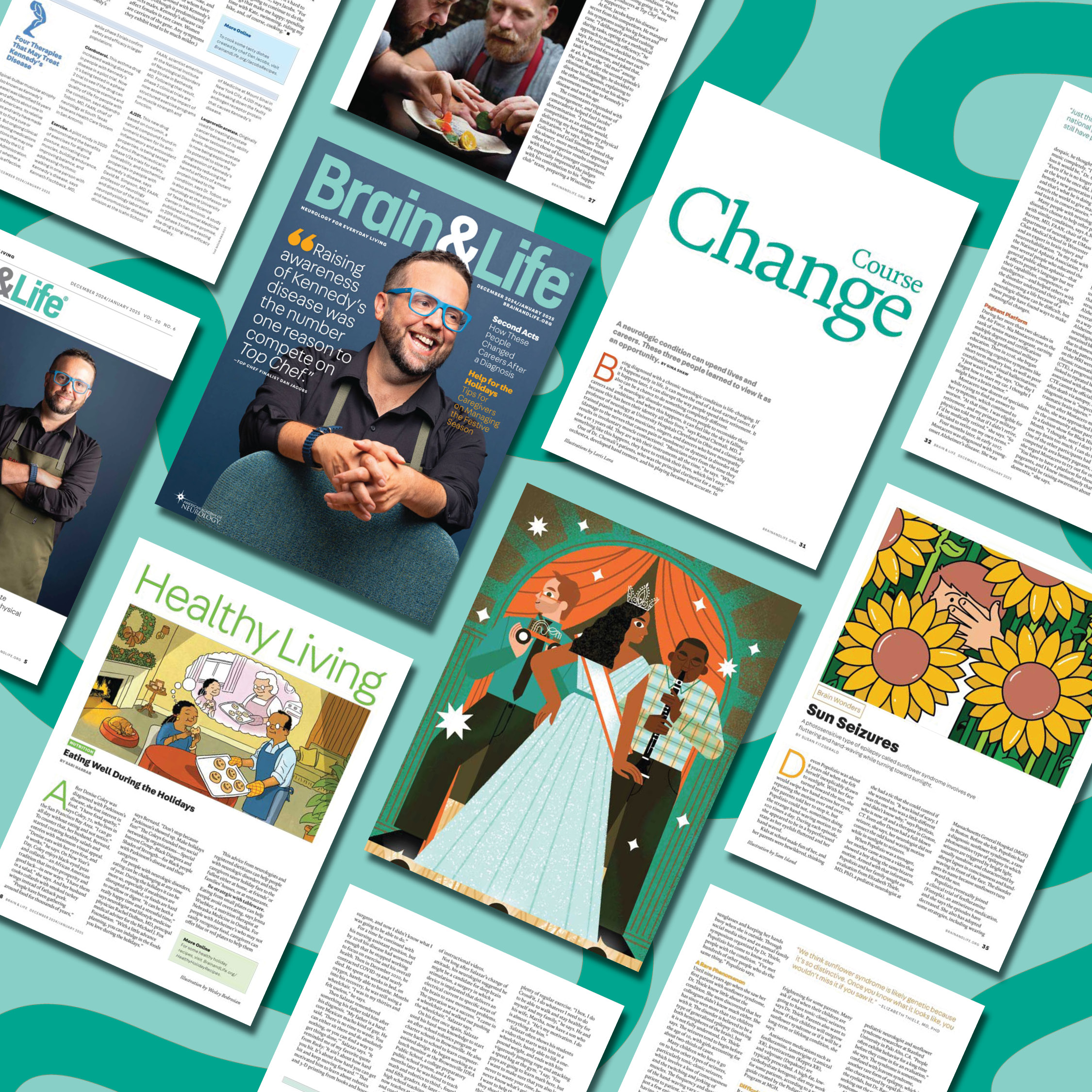
- Three People Share How They Changed Career Course After a Neurologic Disorder Diagnosis
- Smart Ways to Eat Well During the Holidays
- What Is Sunflower Syndrome?
- Thriving in the Kitchen with Chef Dan Jacobs
- Part One: Community Stories of Navigating a Rare Epilepsy Diagnosis
Follow us!
- Hosts: Dr. Daniel Correa @NeuroDrCorrea; Dr. Katy Peters @KatyPetersMDPhD
- X: @BrainandLifeMag
- Instagram: @BrainandLifeMag
- Facebook: Brain & Life Magazine
We want to hear from you!
Have a question or want to hear a topic featured on the Brain & Life Podcast?
Record a voicemail at 612-928-6206, or email us at BLpodcast@brainandlife.org.
Episode Transcript
Dr. Correa:
From the American Academy of Neurology, I'm Daniel Correa.
Dr. Peters:
And I am Dr. Katie Peters, and this is The Brain and Life podcast.
Dr. Correa:
Welcome back to The Brain and Life podcast. We're glad to be here with you throughout this holiday season and in this new year, and we wanted to highlight some of our favorite articles from this last issue, and from Brain and Life. Katie, have you had a chance, through the holidays and your break, to take a look through this last issue? We had a great discussion with Dan Jacobs, and that interview and podcast episode with him, and his full article is featured in the issue, but I had a fun time just taking a look through all the other articles.
Dr. Peters:
Yes, the articles in this issue were just great, and it was wonderful, with Mr. Jacobs, and everything that he did, and discussed Kennedy's disease. I think it was really important. What a great discussion, but also, the articles I thought really touched on so many different areas that can really help patients and caregivers.
Dr. Correa:
One thing that really stood out for me was that whole context, and I also saw the social media posts about this article of people living with neurologic conditions, but actually changing their careers, or what we ended up describing as a second act.
Dr. Peters:
It was an article that was about three individuals who essentially changed their career course after their neurologic diagnosis.
Dr. Correa:
I found that their experiences are great examples of not seeing a limitation in their condition, in some ways, some of them learning from and using their adaptations to then actually inform the new path, or just seeing as another step in their journey, as they picked a new direction for their career.
Dr. Peters:
Some key lessons from this article, first was, assess what your current job is. You want to evaluate whether your impairment actually affects your ability to work. Next is, you want to be adaptable for your role, and find measures to stay in the profession, even at a different level. I often will talk about this with my patients when they're trying to go back to work. Think about what your role is. Maybe you can't do some of the tasks that you were able to do before, but you could still work within that company, particularly people that have manual labor jobs, but they can still do management, or maybe they can do jobs that don't require them to drive, because so many of my patients can't drive after their diagnosis.
Our next tip was to shift your role. Explore alternative roles within your field that align with what makes you feel good, what is your passion, or transition to adjacent areas. I've found this a lot of times if people particularly have been educated in one career, then maybe they can switch to another one that is just close to it, whether they've been in, as somebody who was a statistician and was doing medical research, interestingly enough, now they're going back to medical school, so they just transitioned to an adjacent area. Kudos to them for doing that. And then, I think you need help. You need a mentor. You need to find someone that is maybe experienced in the field, and I would actually say, also find mentors within maybe the condition that you have. There may be some other people that have also had job issues, or had issues with switching careers, so definitely find those friends and mentors for guidance.
Dr. Correa:
Yeah, I think mentors are so important as champions and advocates for us throughout all of our life, regardless if you're changing careers, if it's related to adapting after a medical condition, or just at any other stage. For your first and second points. I think it's also important for people to remember that a lot of the adaptations that might be needed after a neurologic condition can be considered and protected under the American Disabilities Act. Really work with your company's your job's human resources, and really look at your possibilities at adapting the role that you do have.
I can think of someone that I know that lives with epilepsy and tried for a while, because they were a chef, to adapt and work within the limitations of the kitchen. Many things they had no issues with, and making sure they take their medicines. It was often the hours that limited their ability to stay controlled with their seizures later on. They worked within the restaurant group that they were in to be able to shift a role, to help with the logistics and ordering of the foods across restaurants, in a role where they had more regular hours, but they were still involved in the menus and the planning for those restaurants.
A few of the other tips that they highlight in the episode is, if you are looking outside of your current role or your area, then, expanding on your hobbies, and maybe turning that hobby into, as we call it a side gig, just to bring in more money now, and make it a full-time effort. For some people, this is actually engaging the whole family, and creating this entrepreneurial process. Whether that's an artistic endeavor, whether it's expanding a fishing hobby to a more professional activity, or working with a professional fishing group, maybe you love photography, and exploring actually doing it when working alongside and assisting a professional photographer as you develop your own skills. For some things, it might require some additional education, or certifications, but this can be a fun area to explore in your life, to really change what had been focused on before. More than anything else, I think with any challenge in life, it's also important to keep an open mind.
Dr. Peters:
Absolutely.
Dr. Correa:
Yeah, staying receptive to new possibilities, focusing on what you can do, having conversations with those around you about the things that you love and that you enjoy, whether or not it's been something that was financially part of your planning, that sometimes can help jog ideas to get a sense of what might be the possible directions you can explore. By engaging more of the people that care about you and love you, they also then think about this being an active thing that you're considering. You never realize how much a friend or someone else might realize or suggest the connection that they have that will help you explore a direction that you didn't even think could be a job for you.
More than anything else, also, it's persisting. These experiences and challenges are opportunities for growth and resilience, and to persist forward, stay motivated, be determined despite any challenges, and go back to some of those things that you love, and your reasons for why you are working to spend more time with your family, and move forward and grow in that personal source of inspiration, so that you can address what matters to you, and your own personal and family goals.
Dr. Peters:
I think this was definitely a fun article. You mentioned that one point that you started out with, about looking into your hobbies. That's what you and I did. Hey, this is our side gig.
Dr. Correa:
We're here.
Dr. Peters:
Right? My hobby is talking, so I think we're excelling at it.
Dr. Correa:
Yeah, I don't know how great I am at talking, but I try to keep an interested listening ear, and I just love great stories.
Dr. Peters:
Absolutely. Daniel, I know one of the other things that you like to do, especially around the holidays, but in general, maybe this is your side gig, is that you are a chef, and you like to celebrate with food with your family. Now, unfortunately, will this sometimes lead, during the holidays, to an overindulgence?
Dr. Correa:
Well, you mentioned side gig, but in college, I worked for a caterer. That was the main gig.
Dr. Peters:
Oh, that's awesome.
Dr. Correa:
Yes, I cooked for the catering jobs during the week, and adjusted my schedule in college to allow me to do that. And then, when I worked the gigs, I would work the floor, or bartend. It was a full variety of partying in many different ways. I love cooking, and cooking around the holidays is great, but it's that question about overindulgence. For me, I come back to this idea constantly of, I try not to think of anything as a guilty pleasure. There are no guilty pleasures, there are no guilty pleasures, but we all do need to find what works for ourselves, our bodies, our conditions, and the right balance of moderation, obviously.
There is the wrong amount of ice cream, but I try to have just a little bit sometimes, and for me, that's embracing the savory cooking I enjoy. I like baking, it's not my favorite thing, but I do generally avoid baking at home for just my wife and I, because that's way too much pie sitting around. That way, I don't have too many tasty, sweet leftovers. I save those as dessert treats to enjoy, the many great desserts around New York City, or outside the house, at other people's places. Maybe a treat when we go to a restaurant or at a holiday party.
Dr. Peters:
One of the things that I think is great in this new edition of Brain Life is that there was an article about smart ways to eat well during the holidays. I agree with you, Daniel. This is a time when all the cookies and cakes and pies and chocolate, I am making my way through the See's Advent calendar, and it's been just delightful every day.
Dr. Correa:
I do eel like a Pac-Man this time of year, just going around, chomp, chomp, chomp, chomp. All the cookies you see everywhere, it's just like, "Oh my gosh." Even though I leave them for outside the home, and try to at home fill up with the savory food and veggies and stuff, it's everywhere nowadays.
Dr. Peters:
I love these tips in this article. They really were about, what can we do to have some smart ways to eat during the holidays? The first tip was to try to use strategic tableware. I've done this before, even just in a day-to-day, but you can actually opt to do smaller plates. I love little hors d'oeuvres parties, and I think everybody loves small food, or food on sticks. Hopefully, you can opt for smaller plates. This may curb your overeating. Sometimes you can use colorful plates that can help patients with certain types of dementia to recognize their food, because they may not recognize food just if it's out somewhere. You may want to use different colors, like blue or red.
And then, I think this is a great, great tip for anybody who has a tremor, or Parkinson's, bring the weighted utensils. You can actually get these online, you can find them. You can get a weight to put at the bottom of the utensil, and the tremor that those patients have, that actually can dampen that tremor. That's a really cool tip, and I mention it over and over again to my patients.
Dr. Correa:
It's really interesting about weighted utensils, and even a heavier weighted plate in studies looking at satiety, or how satisfied we are with food. We often rate greater satiety and better taste in foods when you have heavier, more substantial utensils, and a plate instead of the paper plate and the plastic plates. If at all that's ever a concern, and just wanting to make sure, one, to reduce how much I use plastic items, and toss-away items, I keep real utensils and plates here at the office, and then, just then have to remember to wash them at the end of the day. I'm not great at that.
One of the other things is, with certain medical conditions, including various neurologic conditions, it can affect how someone eats and swallows. If that is at all a concern, then it makes it a challenge to really get through some of the foods that they enjoy. Making sure to really consider the type of food modifications that someone might need in their regular time, and considering that in the holiday meals, so choosing easy-to-eat foods, soft and more moist foods are easier for everyone to eat. If anyone has a challenge with swallowing, then mashed potatoes that haven't been sitting around and are dry, actually when they're nice and fresh and really tasty. Stuffing for some people, as long as the portions of it are more soft, it has a lot of harder-to-chew items in it, sausage or crisp apples, I like adding some green apples to my stuffing, that might make it a little bit more challenging, but traditional stuffing, if it's softer, might be an easier-to-eat food, and pureed dishes.
That's something you can play with, where someone could still have the flavors of your holiday meal, but then, making them in a little bit of a more softer version, steamed, try pureeing some, or cutting things up very small and mixing it with some of the pureed food. That way, there can still be some texture and the flavors that people are really looking forward to. If things are dry, just like for all of us, for a little bit better taste, and also to make it easier to swallow, add some gravy, some sauce, just watch if that sauce is a lot of cranberry sauce that is adding a good amount of sugar.
Dr. Peters:
I love the idea of adding more gravy. And then, the next tip was really to enjoy treats mindfully. This year, my present to all of my work colleagues that I work with in the clinic, in the Brain Tumor Center, was essentially Advent calendars. What I like about Advent calendars is, you can get just one little treat a day, and it's a great way to reflect and savor it. I've actually got my own Advent calendars. I think that purposely says that you get to have one treat a day, and it's usually small, it fits in a calendar, they do have these really big calendars now. But sometimes, think about the flavors of the season. Is it the cranberries? Is it the gingerbread, and what it denotes to you. If you want to have some gingerbread cookies, maybe wrap around and experience, decorate the cookies with fun memories, or even build a gingerbread house. It's okay to have those little indulgences, but I like to spread it out. That's why I take the Advent calendars.
Dr. Correa:
Yeah, I always enjoyed them. But now, for me, a lot of evenings outside of the holidays, my wife and I will have one or two small squares of some dark chocolate, both because we enjoy it, it's our time, also then, just to talk and share about things that we enjoyed from the day, or even just to talk about the chocolate itself. This time of year, we tend to replace that little treat after dinner with some holiday treat. Maybe it's the gingerbread cookies our neighbor brought, and have tried to just limit to having one or two each, or having a little bit of the gingerbread. The thing I'm looking forward to tonight is, someone brought us these fudge brownies. Now, the trick is to somehow not to end up eating too many.
Another aspect that's really important, especially, we tend to eat a little bit more food during the holidays, it's also often a lot of grains, somewhat heavier food, is staying hydrated, so keeping water bottles easily accessible. The change in type of food and the sequence of meals, sometimes, let's be real, it can lead to a lot of thickening and constipation for people. If someone has a challenge with swallowing, as we talked about with easier to swallow foods, liquids, thinner liquids would be difficult, so just make sure to remember through the holiday events, if your family member or you yourself have a challenge and need to have thickened liquids, that you're bringing the thickening powder, or the thickened liquids with you, to be able to mix with other things. And then that way, you can thicken things that are non-alcoholic, and still make sure that you're able to swallow and participate with the rest of your family and your friends.
Dr. Peters:
During the holidays, we all imbibe a little bit more with alcohol, and we just need to make sure to be cautious with overindulging in alcoholic beverages. Patients with neurologic diseases or conditions, if they do have alcohol, it can really impact them very quickly, so I would say, try to limit or even avoid alcohol, if you can. Remember there are really cool mocktails now, and I love sparkling water with a big splash of cranberry juice in it. That way, you can stay hydrated and look like you're having a fun drink, and you can even make some holiday mocktails. There's a lot of recipes online that you can check out. I'm a big fan of this, the old school Shirley Temple, and definitely cranberry ginger ale.
Dr. Correa:
Yes.
Dr. Peters:
All those, I love drinking ginger ale around the holidays.
Dr. Correa:
I like sometimes even to have something that's somewhat similar and feels like a cocktail. Putting seltzer water, and putting some bitters, or some of those little flavoring things that get added into other cocktails, putting some of that and a lime, and often just that refreshing and that flavor is enough to make me feel like I'm having something a little different than just water at the time, without adding too much more sugar, and adding alcohol. I've also been trying and enjoying some of the non-alcoholic beers that are out there. I think they're much better than they used to be, and some of them have actually a lot more interesting flavor. We're seeing so much more evidence, and a variety of medical conditions that alcohol leads to much a greater risk of various neurodegenerative conditions and dementias, greater risks of stroke, and contributes to heart disease. It's really showing to be an important area for us all to consider in our brain health.
Additionally, as we think of going into the holiday schedule is, trying to pay attention to how much we change our actual regular eating schedule. Keeping some consistency and a regular eating schedule can be very helpful, especially for people with dementia, and people with the various conditions that might affect how their gut system, or their GI system moves, like the movement disorders, including Parkinson's. When things are very off in different schedules, then it's hard for that to align with their other medicines, so trying to avoid too many times that are very outside of the typical regular eating schedule can be very helpful for those conditions. I even notice it sometimes. You have a really late meal hanging out with friends, as I did after the American Epilepsy Society meeting, and the next day, you're just like, "Everything is still stuck there."
Dr. Peters:
Sometimes during the holidays, people, if they have neurologic conditions, maybe they can't get out and see loved ones and families, they can feel really sad, or isolated, and having a meal or food associated with the holidays can really boost your spirits, and make your mood feel better. I would encourage people to maybe prepare meals in advance, so that you have that food available and ready. Maybe even talk to a food service, where you can get delivery, so this can be delivered to you at certain times, because even if you aren't going to be with loved ones, for the families, those meals associated with those holiday traditions can be really important to boost your spirits.
Dr. Correa:
Yeah, it is the holidays, so having those meals, those treats that bring back memories, and even if you're not with the people that those memories are with, or that you would like to be with, then really intentionally thinking of, and think of those memories, and recalling those times and those people that you love, and that memory with the meal. Just like we said, another important thing within the holidays is, when you can, invite a friend, and a caregiver. Bring someone to support you, or invite them over. If you're going somewhere and you have a condition that affects your mobility, where you need some more assistance, even if it's not always, if you have someone that you trust and that loves you and cares for you, they may be able to help you navigate in a larger group or party just getting to the bathroom, or if you're having some challenges with eating.
You might be the one there to help someone else, and support them in those issues or tasks. Caregivers, when you're hosting other gatherings, seek some additional help so that you can also participate in the cooking, in the engagement with your friends and your community there. If there are other loved ones and family members of your loved one that you're helping care give and support, really plan ahead, and talk about, who's going to help during different points of the night? It shouldn't be all on one person, and this gives everyone the opportunity to be with and engage together.
Dr. Peters:
I need to pay attention to that last piece of advice, because usually, I try to be the hostess with the mostest. I never eat at my parties, so it's always, at the very end, I'm scrounging for the last bit of crumbs. It's always nice to host friends, but now, I'll be honest to you, after all this discussion, I'm really hungry.
Dr. Correa:
Yeah, I know. Me too.
Dr. Peters:
I'm going to get some chocolate, but before we go off to eat, in the recent edition of the Brain and Life Magazine, there was a really neat article. It was on a condition called Sunflower Syndrome, and honestly, I did not know about this condition. I've never seen a patient with it. But after reading the article, this is a condition that falls under Dr. Correa's expertise, because he's an epileptologist. Can you tell us more about Sunflower Syndrome?
Dr. Correa:
That's right, it's a very rare and uncommon condition, and it has some very unique characteristics of types of epilepsy, or seizures, but it overlaps with some other things and symptoms that people might be more aware of. I've seen pediatric children here at our center. I mainly care for adults, but we have a team, and have had cases that we've discussed, and Sunflower Syndrome is a rare form of epilepsy. It can have a situation where the person has seizures that can be triggered by a bright light source, and for an unclear reason, something that causes that flicker of the light can trigger the seizure event. In this case, for the individual, or the person living with Sunflower Syndrome, the seizure itself isn't always an uncomfortable thing. Sometimes, there can be a development of doing repetitive hand waving or hand flapping motions in front of their face that causes the flicker.
We actually don't think necessarily that most people have good control of it, and that actually doing the movement might be part of the seizure. It's a very interesting and unique phenomenon, that their own movement sometimes can often be what can trigger the seizure. That flickering light, or even what we call photo sensitivity, is common in this situation. If they see a flashing light at certain frequencies, then it might be the primary thing that triggers their seizure, but it can also be induced if you create a flickering movement with hand movements, or something else in front of the face that's flickering the light on the other side. Those repetitive movements is another key factor that happens when they're having their seizure. It tends to occur early in childhood and in adolescence, sometimes seen more in women and girls than men.
That photo sensitivity we mentioned, that means that someone can be sensitive to certain frequencies of light flashing, and not all light when it's on, but some people can be also sensitive to the light itself. And then, it is what we call a reflex epilepsy, which is a unique area of epilepsies. It's triggered by a stimulus, in this case by the flickering light. There can be reflex epilepsies people have from a taste, from a smell, from music or from reading. These are all, not common, but these are all types of reflex epilepsies that are seen out there. The management is very similar with other medical conditions that cause seizures, and that's anti-seizure medicines, so the medicines that can help stop a seizure from occurring or from spreading within the brain. And then, for those people where they respond to a behavioral modification and training to avoid doing that hand motion or repetitive motion that would trigger the light seizures.
But again, some people, it seems they don't really have a good sense, and awareness and control of the start of that flapping, or hand movement. In certain situations, if we can identify the type of light, light is made by a mix of colors, blue light, red light and so on, that someone is sensitive to in that frequency, then we can have special glasses that are made for them to reduce the light exposure, and particularly of the frequencies of light that they're most sensitive to. Often then, that can lead to better control of their events. It's an uncommon syndrome, and it requires a specialized assessment. There are certain kinds of seizures that really, any neurologist can help manage, but when it becomes a very unique situation, or it's not responding well to the typical anti-seizure medicines, that's where an epilepsy specialist really can help, and move someone forward in better control for them.
Dr. Peters:
Like our own Dr. Correa. Yay.
Dr. Correa:
Well, thank you, and it's so interesting to see this rare condition highlighted in this issue. Make sure to check out the links to these articles, and the Brain and Life magazine in our show notes. And also there, go and check out the link for our listener survey. You've heard us mention it a few times, we still have it ongoing. The link is brainandlife.org/survey. To participate, you can click on that link, fill it out, then you get a chance to enter a drawing for one of five $100 Amazon gift cards. Check it out. Hopefully, that survey and your responses help us grow in figuring out the topics and areas that we want to cover, and identify ways that we can reach more people. Thank you so much for joining us today.
Thank you again for joining us today on The Brain and Life Podcast. Follow and subscribe to this podcast, so you don't miss our weekly episodes. You can also sign up to receive the Brain and Life magazine for free at brainandlife.org.
Dr. Peters:
Also, for each episode, you can find out how to connect with our team and our guests, along with great resources in our show notes. We love it when we hear your ideas or questions. You can send these in an email to blpodcast@brainandlife.org, and leave us a message at (612) 928-6206.
Dr. Correa:
You can also find that information in our show notes, and you can follow Katie and me and the Brain and Life Magazine on many of your preferred social media channels. We are your hosts, Dr. Daniel Correa, connecting with you from New York City, and online at Neuro Dr. Correa.
Dr. Peters:
And Dr. Katie Peters, joining you from Durham, North Carolina, and online at Katie Peters MD-PhD.
Dr. Correa:
Most importantly, thank you, and all of our community members that trust us with their health, and everyone living with neurologic conditions.
Dr. Peters:
We hope together, we can take steps to better brain health, and each thrive with our own abilities every day.
Dr. Correa:
Before you start the next episode, we would appreciate if you could give us five stars, and leave a review. This helps others find The Brain and Life Podcast. See you next week.