Neurologists from all over the US were in Washington, DC, this February for Neurology on the Hill, one of the country’s largest neurologist advocacy events. They met with members of Congress to promote telehealth access, brain research funding, and more.
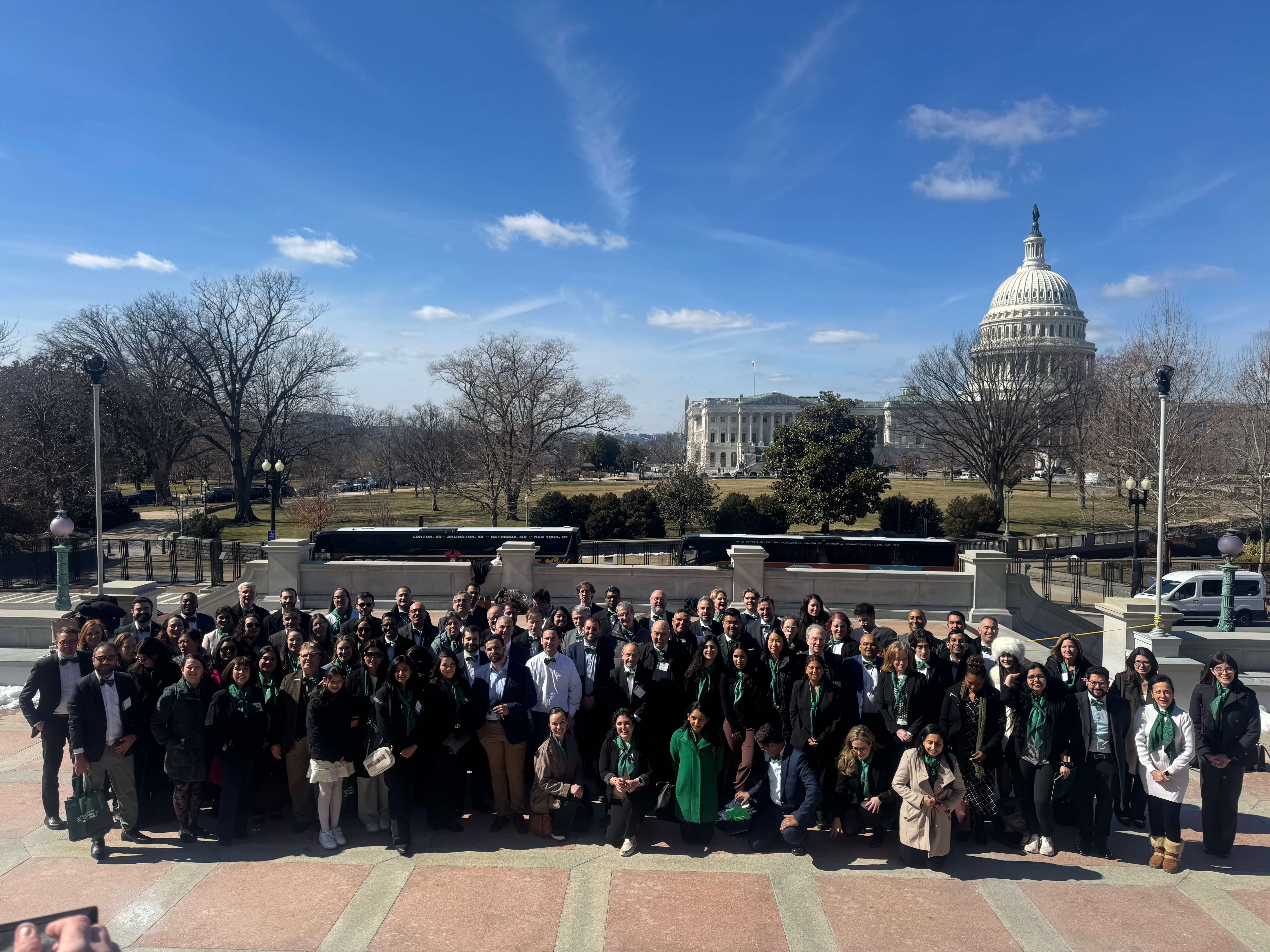
It was a busy day in Washington, DC. A massive group of people—wearing green bowties or scarves to show their united spirit—waited to enter the US Capitol building, crossing their arms against the cold February air.
“It was a little threatened by some weather in the northeast, but we had a great turnout,” said Lauren Bojarski, DO. “Everyone was happy to come. They fought the weather, they got trains at 4:00 a.m., they booked last-minute flights from all over the country.”
Dr. Bojarski and the rest of the group were all neurologists and other neuroscience professionals. They came from nearly every US state, represented all career stages and subspecialties, and were there for one purpose: to advocate for their field of work and their patients.
The event was Neurology on the Hill, the American Academy of Neurology’s annual advocacy day. It’s an opportunity for neurologists to meet directly with their members of Congress, providing firsthand perspectives on legislation that could help them provide better care to their patients. They had three requests: protect access to telehealth for patients who need it, fix the Medicare payment system, and invest in crucial neurological research.
Protecting Telehealth Access
Dr. Bojarski is a memory care specialist. Many of her patients are people with late-stage Alzheimer’s disease and similar conditions, so it can be difficult or even impossible for them to travel to appointments by themselves. Her location complicates the situation even further.
“I’m in West Virginia, a rural state,” she said. “Some of my patients have to drive four hours to come and see me, because we’re the only specialist in the state doing memory care with some of the newest infusions available for Alzheimer’s.”
Telehealth is very important for people who are located far from their neurologists. But whether you live in a rural area or in the downtown of a major city, this type of care matters for more than just travel time. That’s especially true for people like Dr. Bojarski’s patients.
“When someone is in the end stage of dementia, it can be really difficult for them to even get to the car,” she said. “And their families have to take a day off of work, take the time to drive, have the money for gas, all that, just to see me for a 30-minute visit. It’s not sustainable for anyone. With telehealth, I can see them in their own home. They’re very comfortable. There's less added stress just to get care from their neurologist.”
Despite how useful telehealth is, it has been surprisingly difficult for Medicare recipients to access it. Access began during the COVID-19 pandemic, but despite numerous extensions from Congress, it still isn’t permanent. The problems with this temporary solution became especially clear last year during the record 43-day government shutdown: Because the latest telehealth extension hadn’t been approved, Medicare beneficiaries who rely on telehealth couldn’t see their neurologists. It was an enormous disruption in care—and it could have been avoided if telehealth flexibilities were permanent.
To keep this from happening again, Dr. Bojarski and her fellow Neurology on the Hill participants asked their members of Congress to co-sponsor the CONNECT for Health Act. This legislation would make telehealth flexibilities permanent for the many Medicare recipients who need them.
“We should never allow our patients to go without care for that long if it’s something we can change,” Dr. Bojarski said. “It can be really scary to have a neurological condition. I give people medicines to help them through some of the worst times in their life—and I can do that with telehealth.”
Fixing Medicare Payment
The system for paying physicians for their work with Medicare beneficiaries has unintended consequences for access to care. Whenever a new, lifesaving procedure is added to Medicare, all services must be cut to make up the cost. This creates a constant cycle of cuts to physician pay—made even worse by rising inflation. According to the American Medical Association, Medicare payment to physician practices has dropped more than 30 percent since 2001 after adjusting for inflation in practice costs, which makes it harder for neurologists to deliver needed care to their communities.
These challenges for neurologists extend to their patients. Many neurology practices find themselves struggling to stay in business, let alone hire the additional staff that can help them see more patients. A pair of recent studies in Neurology®, the American Academy of Neurology’s journal, found that nearly one in five Medicare recipients travel 50 miles or more one way to receive neurological care, and that the median wait time for Medicare recipients to see a neurologist was more than a month.
“This is a huge thing affecting patient access,” said Brittany M. Kasturiarachi, DO, a neurointensivist—a type of neurologist who treats critically ill patients—in Cincinnati who participated in Neurology on the Hill. “If neurologists in the clinic have long wait times because their overhead is higher, they can’t see their patients on time, and those patients get sicker. Then they end up in the hospital seeing neurologists like me.”
There’s a real, human cost to the outdated Medicare payment system, and Dr. Kasturiarachi and her fellow participants are passionate about getting their patients the care they need. Fixing the system doesn’t just help physicians—it enables them to see more patients and provide better care.
With this aim in mind, participants asked Congress to support an annual update tied to the Medicare Economic Index, which tracks inflation’s impact on the cost of running a physician practice. This would help physician payments keep up with rising costs, making it easier for practices to stay open and see patients. They also asked Congress to support an update to how physicians are paid under Medicare to prevent the cycle of cuts.
Neurological Research
The neurologists’ final request was to maintain funding for the BRAIN Initiative, a longtime program at the National Institutes of Health. It works to fund and promote a wide range of research into something important but not completely understood: the functions of the brain. That research goes on to help find new treatments and cures for people with neurological conditions, and even a temporary dip in funding has real consequences for researchers’ ability to do their work.
Unfortunately, a major funding gap is right around the corner. The BRAIN Initiative receives part of its funding from the 21st Century Cures Act, a 2016 law meant to accelerate innovation in health care. That funding expires this year.
“Basic research funding helps us learn more about the brain and how it works, so we can keep getting these awesome new medications and devices that help people thrive with neurological conditions,” Dr. Bojarski said. “It’s essential that we keep moving forward with the advancements we have—to keep building on the shoulders of giants to help our patients, nationwide and even worldwide.”
The neurologists asked Congress to provide $468 million in base funding for the BRAIN Initiative in fiscal year 2027. This number—representing the highest amount of base funding Congress has provided for the program—won’t fully make up for the loss of the Cures Act dollars, but it will give researchers the chance to continue their groundbreaking research.
Advocacy Matters
Neurologists treat patients every day—and they’re invested in how federal legislation affects them. Neurology on the Hill is one of many ways they show up for their patients outside the clinic. This year, participants held 266 meetings with senators, representatives, and their staffers. They came prepared with statistics, solutions, and real-life perspectives—and left with strong hopes for the future.
“Every single meeting I had was a very good conversation,” Dr. Kasturiarachi said. “I thought some of the members of Congress would say ‘No, this would be too much spending,’ but I was pleasantly surprised. They saw that maybe we have to invest some money, but these are long-term cost savings—because we’re helping our patients prevent issues down the road.”
They also had support from Brain & Life readers. The American Academy of Neurology sent out an email to subscribers, asking them to amplify Neurology on the Hill’s impact by contacting their representatives about telehealth and the BRAIN Initiative—and more than 3,500 did! It’s too early to say what impact this year’s event had, but senators and representatives for people across the country now have more information to consider when making calls that affect neurological care. Brain & Life readers should watch for future advocacy emails to add their voices.
“That just happens when you get us all in a room,” Dr. Bojarski said. “We just can’t help ourselves. Doing what’s best for our patients, learning more, and showing up. It’s a really exciting time to be in neurology, for sure!”