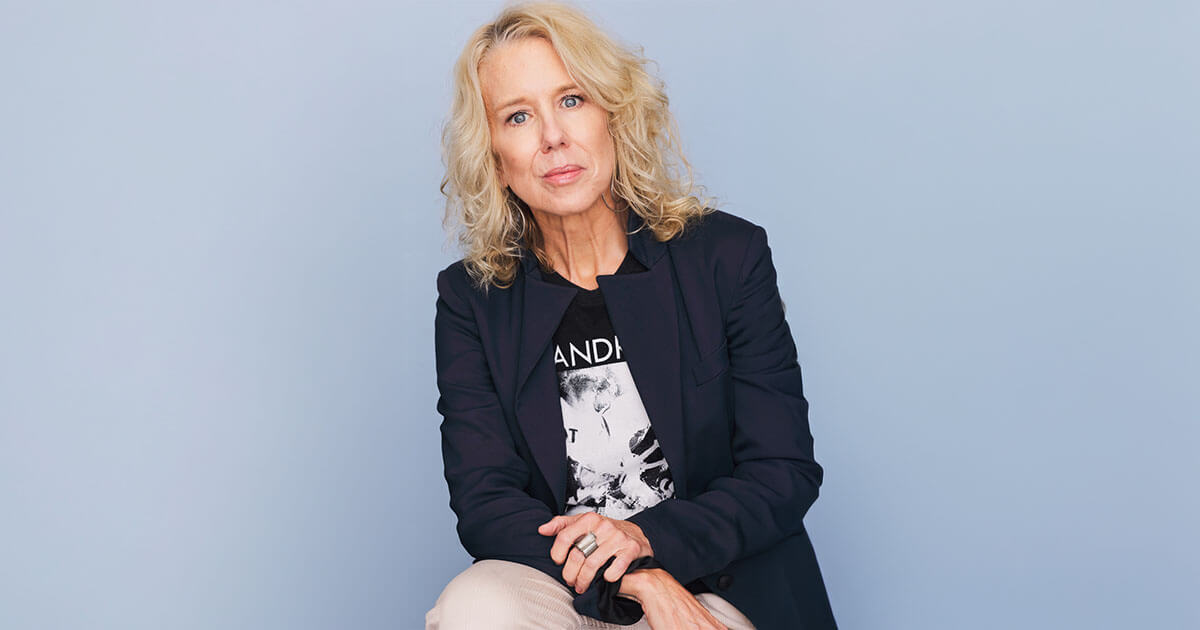
Trapped. That's how former U.S. representative from Arizona Gabrielle Giffords felt when she regained consciousness in Tucson's University Medical Center after being shot in the head during a gathering with constituents at a grocery store on January 8, 2011. “I knew right away something was wrong. It was jarring to realize I couldn't verbalize what I was thinking, but the magnitude of it didn't really hit me until later,” she says. “I had so many questions and things I wanted to say to my doctors and to my husband, Mark, but in that moment, when I needed it the most, I wasn't able to communicate.”
The gunman's bullet had torn a path just over Giffords' left eye and through the left hemisphere of her brain, which largely controls language and the ability to speak. (Six people were killed in the shooting and another 12 injured.) As a result, Giffords has aphasia, a disorder of speech and language that affects many stroke and traumatic brain injury survivors. Aphasia generally does not affect intelligence: Giffords was still “Gabby,” the charming, determined leader who had flipped a Republican district to Democratic when she first ran for Congress in 2006. But the complex connections between the neurons that turn her thoughts into speech had been severely damaged.
Speech therapy is vital to regaining the ability to communicate, and the sooner it starts the better. For Giffords, therapy began just 20 days after the shooting, shortly after she was moved from the Tucson hospital to a rehabilitation facility at Houston's Memorial Hermann–Texas Medical Center. A new documentary about her life, Gabby Giffords Won't Back Down, directed by Betsy West and Julie Cohen and executive produced by CNN Films and TIME Studios, shows Giffords in the first of many speech therapy sessions, when she was unable to draw enough breath to blow a tissue in front of her face. “The film showcases what it's like to live with aphasia, in all its challenges and moments of joy,” Giffords says. (The documentary airs on CNN in mid-November.)
At times, the challenges could feel overwhelming. “I was relearning how to talk,” Giffords says. “Even after hours of hard work, sometimes the only word that would pop out of my mouth was ‘chicken.’” She soon discovered that singing came more easily. “It was hard to articulate my thoughts, but I could sing my favorite songs. Even when I struggled with basic words, I could sing bits of ‘American Pie,’ a tune that will always have a special place in my heart,” she says. “I never would have guessed how important singing would be in my recovery—and that's powerful when you've lost much of your language.”
With the help of speech therapists, Giffords learned to use techniques to make the most of music's ability to bring out language. Researchers theorize that because music crosses the hemispheres of the brain, it creates new neural pathways for language. Also, repetitions and patterns in music help with memory. “When I'm having trouble getting a sentence out, sometimes I'll think of a song line that uses the same words and latch on to the sound of that music,” she says. “It's just easier for me to get it out that way. Even if I'm not singing, thinking about familiar music can quiet the stress that comes with struggling to get out a word or a sentence that's particularly tricky. And calming down helps me focus.”
In June 2011, Giffords was discharged from the hospital and eventually returned home to Tucson, where she continued her intensive speech and physical therapy. She also resumed some of the activities she loved before she was shot—like biking around town and playing the French horn.
She took up the instrument as a teenager but stopped playing it after college when life got too busy. “After the shooting, I decided to pick it up again, even knowing it would be harder than before. But practicing and making music has been so rewarding,” she says. “Every time I was able to master a new piece, it gave me confidence that I could push my way through obstacles. Working on an instrument like that after an injury made every improvement feel like a huge victory.”
After cellist Yo-Yo Ma saw a television report about Giffords' French horn playing, he reached out to suggest they play together. Last March, the two were featured on PBS NewsHour playing Simon and Garfunkel's “The Sound of Silence,” in memory of lives lost to gun violence.
“Playing the notes comes easily now,” she says. “Sometimes reading music is hard—but reading music was hard when I was a teenager, too! And there's so much that goes into making music. Anyone can read notes on a page. But finding tone, pitch, playing with the rhythm—all that uses different parts of the brain. So every time I'm practicing, I'm working those connections in my brain.”
Almost every day, Giffords has sessions with her speech pathologist, Fabiane Hirsch Kruse, PhD, or practices on her own—or both. “Homework, homework, homework!” she declares. “My recovery is tied to how much work I put into it, and I'm determined to continue striving. And I can work on my recovery while enjoying some of my favorite hobbies. My daily therapy feels less like a chore and more like a way to enjoy living life to the fullest. It's one way to ‘get better,’ both in a medical sense and a psychological one.”
When asked who has been most important to her continued recovery, Giffords doesn't hesitate. “Without a doubt, my husband, Mark. He's my best friend, and his care for me is unmatched. He's never lost hope, and he always manages to make me laugh—with him, not at him,” she says. “A big part of recovering is realizing that some days are going to be harder than others—that's normal. And Mark recognizes that. He also understands me better than anyone; I don't have to worry about struggling through a sentence if I can't get it out, because he can read my facial expressions. I can communicate with a smile, or a hand gesture, and he knows what I mean.”
Over time, Giffords has gotten better at talking to people without preparation. “Even if my answers are short, I'm still able to convey my thoughts and feelings,” she says. “For my speeches, like at the Democratic National Convention, I spent months prepping to make sure I nailed them. But when I can't get a word out, the best thing I can do is pause and take a breath. It'll come eventually.”
Nearly three years after she was shot and in response to the killing of 20 first-grade students and six teachers at Sandy Hook Elementary School in Newtown, CT, Giffords established an organization dedicated to gun reform. Now known simply as Giffords, it includes a nonprofit arm that mobilizes lawmakers and their constituents in support of gun safety; the Giffords PAC, which supports elected officials working for the cause; and the Giffords Law Center, which writes laws and policies aimed at reducing gun violence.
In 2022, the Giffords Law Center was a key driver behind the enactment of the bipartisan Safer Communities Act, the first gun legislation passed in almost 30 years. “That's one I'm proudest of,” Giffords says. Her organization continues to push for universal background checks and other reforms. “Much like my own recovery, gains are incremental and come with setbacks.”
With Dr. Hirsch Kruse, Giffords co-founded another organization, Friends of Aphasia, which spreads awareness of the condition and supports people living with aphasia. “There are a lot of misconceptions about what aphasia is and isn't. For example, aphasia doesn't change the way people think,” Giffords says. “It doesn't affect intelligence. Just because I can't always get the words out doesn't mean I don't understand what's going on.”
Both causes keep her going even when she feels discouraged. “When survivors of gun violence reach out to me to share their own stories, I'm motivated and inspired to keep moving forward. And we have proven that progress is possible,” she says. “As for aphasia, I think that since it isn't often talked about or understood, it can be a tough issue to advocate for. But I want to increase awareness so others can feel the same sense of hope and strength that I do every day.”
Giffords urges people who have aphasia not to let it define them or stop them from doing what they love. “It might be tempting to withdraw from your relationships and your life. When you have to learn to talk again, it can feel impossible to move forward,” she says. “But instead, focus on human connection and nonverbal communication. Pursue things you love, to remind yourself that you're more than your injury. Even if it makes it harder for you to communicate with the rest of the world, aphasia doesn't change who you are or what you're passionate about.”
Read More