Christine Ebersole on Love, Brain Surgery, and Learning to Adapt After Her Husband’s Diagnosis
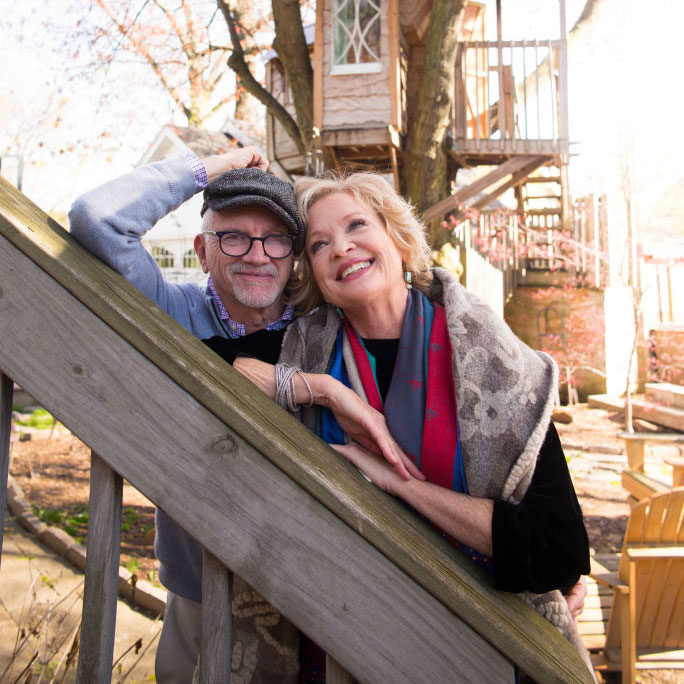
Tony-winning actress Christine Ebersole reflects on 35 years of love, humor, and life reimagined with Bill Moloney after his vestibular schwannoma diagnosis only three years into their marriage.
Photo by Phil Penman/Contour by Getty Images
When acclaimed actress Christine Ebersole and her husband, musician Bill Moloney, said their wedding vows in August 1988, they could hardly have expected the “in sickness” part of those promises to be fulfilled so soon. Less than three years later, the couple faced a daunting medical challenge that came out of nowhere: Moloney was diagnosed with an acoustic neuroma (now referred to as a vestibular schwannoma), a non-malignant tumor that develops on the main nerve leading from the inner ear to the brain. Although they are benign, these tumors cause hearing loss, affect balance and facial movement, and can be potentially life-threatening if they compress the brain stem.
From the comfort of her home in Maplewood, New Jersey—where she and Moloney have lived for 27 years, surrounded by the couple’s menagerie of animals (a cockatiel, two tuxedo cats and an orange tabby, two dachshunds and a puggle)—Ebersole recalls the first signs of a condition that would change the couple’s lives.
“It was late 1990, and Bill was having trouble with his hearing and his audio processing. And it was just coming from one side,” Ebersole shares. “Everyone thought it was because of all those years playing in nightclubs as a drummer.” The couple had met on the set of the sitcom The Cavanaughs, where she played showgirl Kit Cavanaugh, and he was one of the composers of the show’s music.
With Christmas approaching, Moloney asked Ebersole what she wanted for the holiday. “I said, ‘I want you to get a hearing aid!’” she recalls. “Because it was like he couldn’t understand what I was saying.”
On Valentine’s Day of 1991, Moloney sought help from the House Ear Institute (now the House Institute Foundation), a world-renowned center in Los Angeles dedicated to the diagnosis and treatment of ear pathologies and hearing disorders. An MRI finally provided answers. “The doctor said, ‘There’s a tumor.’ He was pointing to it, and it was about the size of a half dollar,” Ebersole said. “And he basically said, ‘You have to get it out, otherwise you could die.’ So that was it. We found out on Valentine’s Day, and then April 1—April Fool’s Day—was Bill’s surgery.”
The term Moloney’s doctors used in 1991, “acoustic neuroma,” is one that neurologists are trying to stop using. “Vestibular schwannoma is the more correct medical term,” explains Jasmin Jo, MD, associate professor of neurology at the University of Virginia in Charlottesville. “When we say neuroma, that refers to tumors that arise from nerve cells themselves. But these tumors actually arise from what we call Schwann cells—cells that protect the coating around the nerve, like insulation around electrical wires. And they don’t grow from the acoustic (hearing) part of the nerve but from the vestibular (balance) part.”
About three to five people per 100,000 are diagnosed with vestibular schwannomas each year, and over a lifetime, more than one in 500 people will develop this type of tumor. “They are most common in patients in their 50s through 70s. The vast majority arise spontaneously, with no identifiable cause,” says Dr. Jo. Hearing loss on the affected side is the presenting symptom in more than 90 percent of patients. Ringing in the ear and balance problems are also common, and because symptoms develop gradually, the average time from first symptoms to diagnosis is about a year.
What to Expect After Vestibular Schwannoma Surgery
Moloney’s tumor was too large to approach through the ear canal and required a seven-hour surgery to drill through the skull and remove it. “Afterward, he had to learn to walk and talk again. He couldn’t pucker; he couldn’t smile. It was as if he had a stroke,” Ebersole says.
That’s not uncommon because of the anatomy of this type of tumor. “It is located in an area we call the cerebellopontine angle,” Dr. Jo explains. It includes the facial nerve, which controls the movement of the facial muscles, and several cranial nerves that control the throat and the voice box. “Patients can have problems swallowing or speaking if those nerves are involved.” For larger tumors, the cerebellum itself can be compressed, affecting the coordination of movement in the limbs, adds Justin T. Jordan, MD, MPH, FAAN, associate professor of neurology and head of neuro-oncology at UT Southwestern Medical Center in Dallas, TX.
When Ebersole went into the ICU after the surgery, “His eyeballs were literally vibrating. I’d never seen anything like it,” she shares. “He said it was like having this terrible feeling of being drunk, but you can’t get any relief. Because sometimes when you’re drunk, you feel so off balance and you have to lie down to feel better. But with this, even lying down there was just a constant nausea and no sense of balance.”
The vibrating eye movement Ebersole observed is called nystagmus, and it is a hallmark of acute vestibular injury, arising because the brain has suddenly lost its balanced input from both inner ears and cannot stabilize its gaze. “Sometimes my patients will talk about it as if they’re on a ship,” says Katy Peters, MD, PhD, FAAN, a professor of neurology and neurosurgery at the Preston Robert Tisch Brain Tumor Center at Duke University in Durham, NC. “It’s like a constant rocking, because that part of the brain’s balance system has been disrupted.”
Learning to Walk Again, in Circles
Formal vestibular rehabilitation was not routinely prescribed in 1991, so Ebersole became his self-appointed nurse and Moloney became his own physical therapist. “He would get a walking stick and walk around the backyard in circles,” she says.
He had unknowingly devised his own vestibular habituation: the repeated exposure to movement that forces the brain’s impaired balance system to adapt. “He created his own rehab for his vestibular system,” says Dr. Peters.
Today, vestibular rehabilitation is a formalized specialty. “The brain relearns how to rely on our vision, our body position, and the balance information from the other healthy ear,” Dr. Jo says. It involves eye and head movement exercises, and balance training that begins with standing still and progresses to walking on varied surfaces while turning the head. “The earlier patients start rehabilitation, the better the outcome.”
Moloney also had to wear a clear plastic eye patch. “He couldn’t blink,” Ebersole says. “He still really can’t, after 35 years.” The inability to blink is a consequence of facial nerve injury and is taken seriously by clinicians; without the protective reflex of blinking, the cornea is at risk of injury or infection.
Eventually, Moloney did relearn how to walk and talk. His smile never fully returned—“kind of like Bell’s palsy,” Ebersole says. The other thing that did not return, sadly, was his career.
Listen Now!
On theBrain & Life Podcast, Christine shares a deeply personal side of her story—how caring for her husband during his recovery from an acoustic neuroma changed her life and her craft.
“If you put your finger in your ear, that’s how he was hearing. Not in stereo. It’s mono,” Ebersole says. “He also wasn’t getting the signals to his arms and legs, which is a big part of drumming. He said it felt like he was underneath a wet army blanket.”
Dr. Jordan, who has treated several musicians with this tumor, reflects on what that loss means. “It’s a particularly sensitive profession to have a hearing nerve tumor. And with a very large tumor, you can have challenges with coordinating movements in the limbs as well.”
In the 34 years since the surgery, Ebersole says her husband has adapted. “He’ll say, ‘I’m deaf on the left side, so if you want to say something to me, just poke me with a fork,’” she says with a laugh. But she is also careful about the word recovery. “Recovery seems like it’s a return to what it was before. But I think this is more of an adaptation. He adapted to the limits that were imposed on him with the surgery and did beautifully.”
Vestibular Schwannoma Treatment
Moloney’s surgery was the only real option available to him in 1991. But it’s very different today, especially for the many patients diagnosed earlier, or with smaller tumors. “Studies show that only 22 to 50 percent of these tumors actually grow during two to seven years of monitoring. Many patients, especially older patients with small tumors found incidentally, may not even need treatment,” Dr. Jo says.
Dr. Jordan agrees that continuous monitoring is often underappreciated. “If you find a small tumor in a patient who’s functionally well, when you consider the potential risks of surgery, active surveillance can be a very reasonable strategy.”
For tumors that do require treatment, radiation has become a major alternative to open surgery. Stereotactic radiosurgery focuses high-dose radiation precisely on the tumor while largely sparing the surrounding tissue. “This form of treatment can control the tumor in over 90 percent of cases,” Dr. Jo says, “and the risk of facial paralysis is significantly lower compared to surgery.” For larger tumors, fractionated radiation—smaller doses delivered over several weeks—is another option, often used in combination with surgery.
For patients who do require surgery, the experience has improved considerably since 1991. “Surgeons now use continuous electrical monitoring of the nerves in real time during surgery to reduce the risk of nerve injury,” Dr. Jordan says.
Procedures to restore movement after facial nerve damage, known as facial reanimation techniques, have also advanced significantly. “The facial weakness obviously can affect speech, the ability to chew and swallow, and also the ability to blink,” says Dr. Jordan. “We’ve got some wonderful surgeons who have a variety of techniques to bring movement back into the face.”
The Marriage That Held
Many young marriages, Ebersole acknowledges, may not survive a health crisis of this magnitude so early on. “But we’ve been together 38 years. It’s really a testament to dedication, hard work, and genuine love for this person. There’s a mysterious factor that goes into it that you really can’t understand or explain. I mean, ‘for better, for worse.’ Those are very serious vows, and we meant them.” She also credits humor as essential. “Bill is really funny. We genuinely make each other laugh, without even trying. And Bill is kind of like the Maypole, and I’m one of the streamers flying out from the pole. I’ve been running around the world, and he’s just standing there at the center. Never faltered,” reflects the multi-talented actress, whose five-decade career spans film, television, and stage, from her movie debut in Tootsie, to sitcoms like Ugly Betty and Will and Grace, to the Broadway roles in 42nd Street and Grey Gardens that won her two Tonys for Best Actress in a Musical.
The surgery also reshaped the structure of their family. They adopted three children and Moloney became the stabilizing presence at home while Ebersole’s career took her around the world. “It’s not the general way,” she says. “Usually, it’s the mother in the home. But it really worked out beautifully.”
The experience of watching her husband navigate the aftermath of his surgery proved useful when Ebersole was cast in the CBS sitcom Bob Hearts Abishola, playing Bob’s mother Dottie Wheeler, who experiences a stroke. There are several parallels between the two conditions, including facial paralysis, impaired speech, and disrupted movement on one side. “I decided that Dottie’s stroke should be on the left side, the same side as Bill’s. I was careful to make it funny without making fun of it,” she says.
These days, Ebersole is deliberately slowing down. “I’m taking a step back a little bit,” she says. “There are things here and there. But I feel like now, at my age, I don’t have to chase anymore. And that’s a good thing; it’s less stressful.”
Now she chooses projects only when the time feels right, for the sheer fun of it, like performing in a reading of Suddenly Last Summer at the Tennessee Williams festival in New Orleans. And she is singing at private events, practicing with help from her cockatiel. “We FaceTime,” she says. “He keeps my voice in shape.”
Through all of it, Moloney is still the Maypole, still the center. “Now at this stage in my life, I’m so grateful that I have someone by my side,” she says. “That’s such a rare gift.”