Amy Grant Reflects on Her Recovery After a Life-Changing Bike Accident
The musician opens up about healing from a traumatic brain injury, sharing lessons on strength, patience, and gratitude.
The musician opens up about healing from a traumatic brain injury, sharing lessons on strength, patience, and gratitude.

“What if this is all I get?” Amy Grant asked her husband, Vince Gill, a few months after the July 2022 bike accident that caused her traumatic brain injury. The seemingly slow recovery pace frustrated Grant. Her balance was off; she held on to people or things while walking. Her emotions were unpredictable. She couldn’t remember the words to her own songs and struggled to recall once-cherished memories.
Gill’s answer, as she remembers it, went something like this: “Amy, a virtuoso instrumentalist can have a stroke and lose their ability to play. One day, they’re okay and the next day, they can’t pick up the instrument they love. All we have in a day is what we have.”
It was a reminder she needed to be patient and give herself grace; a reminder that no one knew what the future held, but whatever it was, it would be enough.
“I think the real lesson in all this is to live with gratitude. When you live with gratitude, no matter what comes, you are more apt to welcome it and say, ‘I don’t see it right now, but I know there’s goodness in this,’” the six-time Grammy Award-winning artist recalls.
On the Brain & Life Podcast, Amy shares what it took to find her way back after her traumatic brain injury.
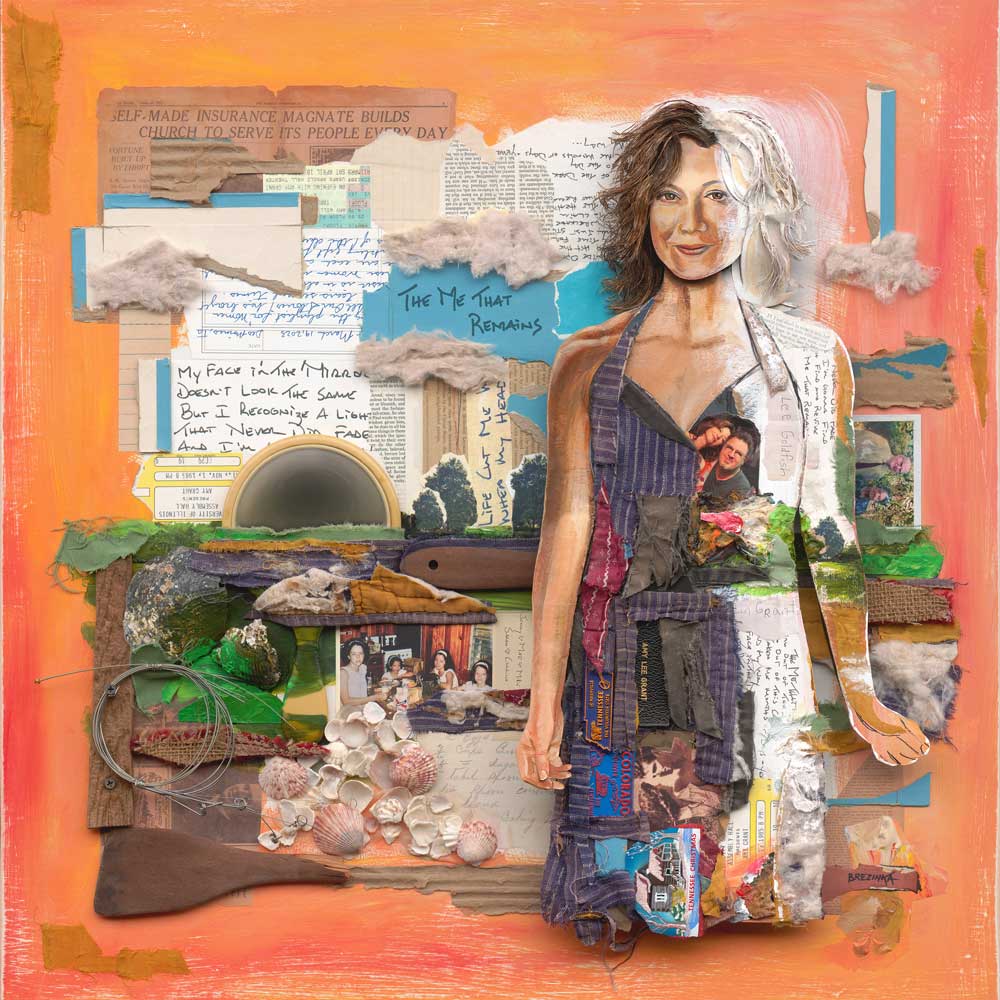
Grant started her career as a contemporary Christian singer, releasing her first album in 1977, and also found success on the pop charts with hits including “Baby, Baby” and “Every Heartbeat.” Before the crash, Grant hadn’t composed a song in years. But soon after the accident she started writing again. Her newly released album, The Me That Remains, is her first collection of original music in 13 years. The first verse of the title track references the bike accident. The chorus could be an empowerment mantra:
Coming out of the dark
Coming out of this cave
It's taken me months of days and years
To find my way
My face in the mirror doesn't look the same
But I recognize a light in my eyes
That never did fade.
And I'm gonna find
Yeah, find and revive
The me that remains
“That lyric is just a celebration of the uniqueness of all of us,” says Grant. “Time has a way of kind of distilling everything own.”
Grant doesn’t remember the details of the accident or its immediate aftermath. She was riding her bike near her Nashville home, a friend pedaling just ahead of her. They were traveling downhill at a fast speed. Grant didn’t see the deep pothole ahead.
Despite wearing a helmet, she hit the ground so hard that she was unconscious for more than 10 minutes. An ambulance rushed her to a nearby hospital. Her public relations team issued a statement after the crash saying Grant had sustained cuts, abrasions, and minor injuries. As with many traumatic brain injuries, the extent of Grant’s wasn’t known until much later.
She canceled concerts planned for late summer and early fall. She stayed close to home having a “quiet recovery,” as she says it. In December of that year, she performed a few holiday concerts, but “I didn’t feel like myself. I would start crying during soundcheck and couldn’t stop,” Grant says.
Nicole D. Reams, MD, FAAN, a sports neurologist at Endeavor Health—who did not treat Grant but was provided details of her accident—says the nature of Grant’s accident, its force, and her loss of consciousness were early indicators she had suffered a traumatic brain injury. In some cases, there is a delayed onset of symptoms or a worsening of early symptoms.
“Traumatic brain injury is an evolving syndrome due to the pathophysiology underlying the injury. That means that following the initial injury, there is a complex process that occurs within the brain that involves inflammation, neurochemical change, blood flow change, and activation of different types of nerve cells… and this process occurs over time,” says Dr. Reams. Notably, the Centers for Medicare & Medicaid Services now recognize traumatic brain injury as a chronic health condition.
Michael Ebbert, DO, a sports neurologist at West Virginia University—who did not treat Grant but was provided details of her accident—explains that the term “traumatic brain injury” encompasses a wide spectrum of injury and clinical presentations. The same injury can affect different individuals in different ways. Hypothetically, “If two individuals sustain a concussion from a fall, one of them may recover within the week while the other may have months of ongoing symptoms,” he says. “The recovery timeline is dynamic and can range from weeks to years.”
Grant tried to move forward. Friends told her they saw progress, but she was frustrated by how slowly her brain seemed to be working at times. During conversations with friends, she sometimes struggled to find words. “I was not going to come out with a one-liner, the funny thing, because it wasn’t going to occur to me until 10 minutes later,” says Grant.
This type of cognitive dysfunction that Grant experienced is common after a traumatic brain injury, says Dr. Reams. It is sometimes described as short-term memory difficulties, word finding or recall difficulties, concentration or attention deficit, foggy or cloudy thinking, slowed processing speed, or forgetfulness.
There is no established timeline for recovery from a traumatic brain injury, meaning it could take anywhere from weeks to years. It depends on the severity of the injury, the age of the person, the treatments and therapies after the incident, and the support system the person has. Dr. Reams says she’s seen her patients make the most progress toward recovery in the first three to six months after the injury. However, some patients continue to improve 10 years after the injury.
“Some persistent symptoms may be secondary to modifiable and treatable conditions that are related or unrelated to the injury such as exacerbated or posttraumatic migraine, worsened or new-onset obstructive sleep apnea, or worsened or new-onset mood disorder,” Dr. Reams says. “Identifying and treating these factors is paramount for an individual's recovery.”
Grant’s doctors have always been encouraging, and that’s important. Dr. Reams says caregivers should “celebrate every gain made in therapy and highlight opportunities for continued recovery to motivate recovery.” One way to do this is to set small, individualized goals, she says.
That’s exactly what Grant did and continues to do. She went from writing a single poem that turned into a song that resulted in her first new album of original music in more than a decade. As Grant told her doctors, “I don’t believe I’m done. I don’t believe this is my permanent resting place.”

Recovery doesn’t have to be complete to be successful. It’s been four years since Grant’s accident. She does things differently now, but notes that change—in how we look and how we act—is inevitable as we age.
Still, she feels she’s continuing to gain skills she thought were lost. Last year, she set a physical challenge for herself: For 100 days, she would perform seven simple exercises or movements—like touching her toes or standing on one foot—100 times a day. She did 25 repetitions when she woke up, 25 repetitions before going to bed, and two other sets of 25 repetitions at some point during the day.
She struggled through some of the movements in the beginning, “but after a few weeks, a few months into it, I was not stumbling anymore.” Ultimately, she believes the exercises help her feel calm and focused. They’ve become part of her healing routine. “If I’m feeling overwhelmed by something or especially scattered, [they] put my mind back in alignment with my body,” Grant says.
Dr. Reams says exercise after a traumatic brain injury can help the brain heal because it releases chemicals that support recovery. Exercise can also improve sleep, reduce pain, and help regulate mood. “Evidence shows that early introduction of [gentle] aerobic exercise does not worsen symptoms or prolong recovery and can actually reduce symptom duration.”
Dr. Ebbert agrees, adding, “Early introduction of light aerobic physical activity has been shown to help expedite both physical and psychological recovery.”
Grant has also developed habits that help her fill in the gaps in her memory. She keeps a detailed calendar of appointments. She sets alarms on her phone as reminders. She has a teleprompter to use during concerts—but, so do friends who haven’t had a traumatic brain injury, she says. Dr. Reams says it is important patients don’t attribute all their post-injury experiences to the traumatic brain injury.
“We’re not static in life, and all kinds of things change us,” Grant says. “At every chapter, we just have to figure out the systems that help us accomplish what matters most.”
In the immediate aftermath of her accident, Grant often took a “fake it until you make it” mindset when she didn’t recognize someone or recall a story. Now she’s confident enough to ask for help recalling information. “If I’m talking with friends and they say, ‘Remember when we took that trip to so-and-so?’ and [if] I don't remember, I’ll say, ‘Keep talking about it. Let me see if I can find it,’” she says.
Or, when she sees someone and can’t remember their name, she’ll say something like, “Don’t take it personally [but] you’re going to have to tell me your name, probably three times…I know we’ve got history, but I guess those synapses snapped when I got that clonk on the head.”
Her Christian faith, too, plays a part in her healing. Grant says she recites the Lord’s Prayer and the 23rd Psalm every day. But a person doesn’t have to believe in a higher power to have hope for a better future, she says.
“I've asked myself, ‘If there were no words, do you trust that what [supports] all of life is good?’ And I do feel that. I feel goodness [supports] everything,” she says. “You can’t see a sunrise, you can’t hear a bird sing, and not [say], ‘We are all part of a bigger design that is infinite.’”
And, of course, there’s music and its incredible power to connect, explain, soothe, and heal. Dr. Ebbert says music can aid in recovery from a traumatic brain injury and he says it’s very likely that Grant’s musical inclinations have played a part in her recovery. “In the patients I have treated with musical experience, their gusto served as a beacon to help drive their individual rehabilitation and quality of life.”
Grant saw this not only with herself, but also while she was caring for her aging parents. Both had dementia, she says, and music was the last parts of their memory to fade. “My father could not remember a lyric, but there were some old church hymns that had beautiful, kind of complicated melodies. I would start humming one of those and he could do all the intervals,” she remembers. “It was in there.”
Writing new music, and sharing her story with the world, has also helped her process all she’s been through. The first verse of her new album’s title track shows both her vulnerability and her strength:
Life cut me wide open
When my head hit the ground
Wasn’t my time for dying
Guess my soul just stuck around
And out of this wreckage
I’m beginning to claim
The gifts in the healing
And the me that remains.
It’s a relatable story, she says, because “everybody's always recovering from something.”
And while you can’t control what happens, you can control how you handle trying events. Imagine, Grant says, standing on a road. If you turn in one direction, you see destruction and darkness. If you look in the other direction, you see beauty and possibility. “You have not actually changed your position on the map one inch, but it’s just where you’re allowing your gaze to land,” Grant says. “We have so much power and choice in our response to everything.”
While in the hospital, Grant remembers a neurologist picking up the bike helmet she’d been wearing and saying, “If she hadn’t had this helmet, she would have been in the morgue.”
About a year ago, Grant was searching her cabinets and closets for a kitchen gadget when she found the bike helmet. She didn’t know how or why she’d kept it. She buckled it on her head in that moment.
“That really beautiful, heavy-duty plastic had gravel dents all over it,” she recalls. “And I [said out loud], ‘Oh my gosh. This thing protected me.’ And [then] I thought, ‘Go easy on yourself.’”
Grant didn’t climb on a bike again until March 2026. When she did, she was wearing a new helmet.