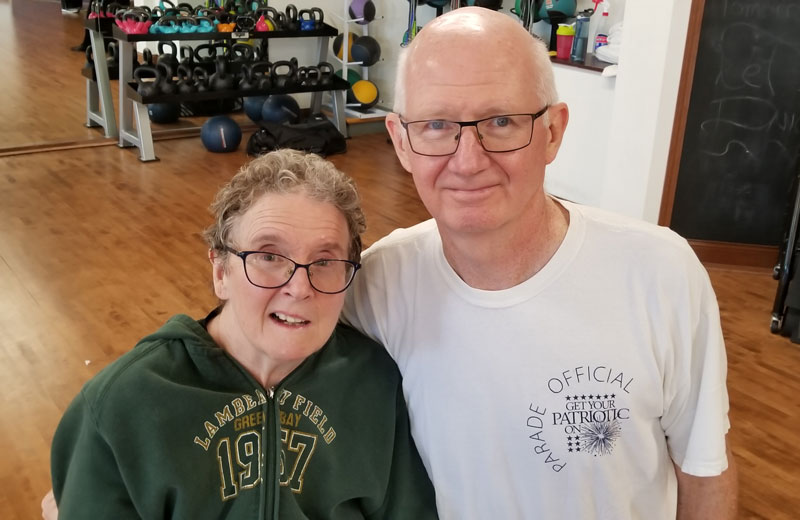
My wife, Rosemary, and I met almost 46 years ago in the Marquette University chorus. For the past 30 years, we’ve been navigating her Parkinson’s disease. In that time, Ro, as everyone calls her, has weathered a failed deep brain stimulation (DBS) surgery and permanent deactivation of the device, a stroke, seizures, knee surgery, and acute care and rehabilitative hospital stays. Three years ago, Ro’s disease had progressed to the point where she needed full-time care. I retired early from my job as vice president of a health care consulting firm to do just that.
Before the pandemic, I used to spend my days driving her to doctor’s appointments, boxing classes, choir practice, and group speech therapy, among other activities. Now, Ro regularly attends virtual boxing classes, and I find comfort in virtual support group meetings. We both keep in touch with friends from our church choir through videoconference calls.
Over the years, people have often asked me how I avoid burning out. While I continue to learn how to do that, these strategies help me be the best care partner I can:
- Schedule regular breaks. I cannot be a good caregiver to my wife if I don’t take care of myself. Ro can be left alone for an hour or so, and until recently I was able to get away for a day or so if I found a backup caregiver. Before the pandemic, I volunteered with Rock Steady Boxing and played the occasional round of golf. Since the pandemic, I’ve attended more virtual support group meetings. Ro and I also sing together at home during virtual choir socials, go for drives, and take walks wearing our masks.
- Manage stress. It is physically and mentally exhausting to be a care partner, so I find ways to unwind. I exercise at home and socialize virtually with people who support me. Ro has encouraged us to attend the Parkinson’s Foundation Wellness Wednesdays as part of their PD Health @ Home The class includes meditation that helps me feel calmer.
- Reach out for support. The people we’ve met through our choir community are some of our closest friends. I also get support from my wife’s health care team, including her physician, nurse, social worker, and other therapists and counselors. I also rely on family, friends, neighbors, our faith community, and online resources, including the Parkinson’s Foundation (org) and its toll-free helpline (800-4PD-INFO).
Tom Manak lives in Chicago, where he is an advocate on the Parkinson’s Foundation People with Parkinson’s Advisory Council and a committee member for the Parkinson’s Foundation biannual Care Partner Summit. He also volunteers and is a board member for a local Rock Steady Boxing affiliate, assists staff and attendees of the Loud Crowd Parkinson’s disease speech therapy, and remains active in church—always alongside Ro.