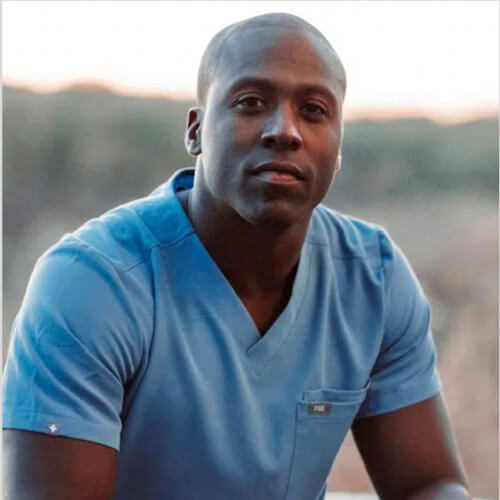
In this episode of the Brain & Life Podcast, host Dr. Daniel Correa is joined by Dr. Elvis Francois, a spine surgeon known for integrating music into his practice. They discuss the intersection of music and medicine, common spine conditions, and the importance of human connection in health care. Dr. Elvis shares his journey from being a young musician to a surgeon and how music can enhance patient care and emotional well-being.
Follow and subscribe wherever you get your podcasts!
Apple Podcasts Spotify Libsyn
Additional Resources
- How Spinal Surgery Helped Gloria Gaynor Beat Chronic Pain and Return to the Stage
- What is Spinal Cord Injury?
- The Growing Role of Music Therapy in Health Care
Other Brain & Life Episodes on this Topic
- Answering Your Spinal Cord Injury Questions with Dr. Shelly Hsieh
- “Roll with Cole & Charisma" On Building a Life Together as an Interabled Couple
- How Disability Advocate Wesley Hamilton Became Empowered by Adversity
Follow us!
- Guest: Dr. Elvis Francois @Dr.Elvis.Francois
- Hosts: Dr. Daniel Correa @NeuroDrCorrea; Dr. Katy Peters @KatyPetersMDPhD
- X: @BrainandLifeMag
- Instagram: @BrainandLifeMag
- Facebook: Brain & Life Magazine
We want to hear from you!
Have a question or want to hear a topic featured on the Brain & Life Podcast?
Record a voicemail at 612-928-6206, or email us at BLpodcast@brainandlife.org.
Episode Transcript
Dr. Correa:
From the American Academy of Neurology, I'm Dr. Daniel Correa.
Dr. Peters:
And I am Dr. Katy Peters, and this is the Brain & Life podcast.
Dr. Correa:
Welcome back and saludos. I'm so glad you're joining us again here for the Brain & Life podcast. Now, Katy, what kinds of things help decrease for you or for the people that you work with, the stress of the hospital setting and even when there's a context of difficult conversations that you have with people and their families?
Dr. Peters:
Daniel, this is a real tough one. When I think about in the context of it being stressful for those people in the hospital and their loved ones, the hospital is a very disorienting place, a very confusing place. There's a lot of activity that's going on, lots of sirens and sounds and people coming into your room that you don't know. I think that it's best when you're having those challenging conversations to have a better venue than right over the bed. It also is sort of awkward when a patient's laying there and you're standing over them. I think it's very important to be on someone's level, your body posture. Sit down or bend over. You don't want to be just staring over someone. So I think having a comfortable room or office to discuss those types of issues with maybe a loved one's family or friends and really be at the same sort of physical level when you have those kind of challenging situations.
Dr. Correa:
Yeah. I mean, I think that the context of even the setting is so helpful and the kinds of things around the setting with the sounds, trying to decrease how many of the beeps there are if you're not in the ICU. And what is the kind of other sound and music that's around? I also think about how we start conversations. And sometimes there's such a pressure and limitation and time, but I like to try and take the stress level of the hospital setting down some and take a moment and discussing what matters to them, the person that is living with the condition, their family, things that are important to them, that they're thinking about, or maybe even hopefully we can talk about things that they're excited about and looking forward to. We're right now in the times of holidays, but other things that they have that they're thinking about, maybe a celebration or a graduation in their family.
And without forcing it, if we are connecting hopefully in that more just normal way and acknowledging we're all beyond just wearing the tie, the suit, the white coat and the hospital gown, we're all just people in our community. I like to just share thoughts and talk about good food locally, recommendations about community businesses and music venues and just kind of things that we share as we are finding the space for the actual challenging conversation that we might get to.
So beyond the stress relief that you might get in these ways in these challenging moments, after a long day on your feet at the hospital or working in a chair in your office, what do you try and do for your back and joint health?
Dr. Peters:
So I'm really embracing this really cool daily Pilates ritual that I'm doing. I look forward to the activity and I try to do it... Sometimes I do squeeze it in the middle of the day. I feel like I have a nice window, but I actually look forward to the activity and I like to time it between sort of the transition from work to my second job, which is cooking dinner for my husband. It's a great activity and I like that I know some of the exercises, but then another one will be a new exercise. And I'm feeling much more limber, which I think range of motion is something we can't forget about for that back and joint health.
And then as you know, I have four cats. Oh my gosh, yes, we have four cats now. So I actually like to actively play with my cats. They're very enjoyable. So we like to run around and run and go up the stairs. I call it chase, but they love that. And then we play a game called paw ball. So it keeps them in shape. It keeps me in shape. How about you?
Dr. Correa:
Now, did the cats think of the name paw ball?
Dr. Peters:
Actually, my husband thought of that.
Dr. Correa:
Yeah.
Dr. Peters:
We have one cat that especially has very large paws. She's very good at that. Go, Lucy.
Dr. Correa:
That's so cute. I'm just imagining this video. Yeah. I mean, I completely agree. We need some regular types of exercise and movement. I have a few days a week that I'll actually go do set things, maybe go to a class or I go on a run, or I specifically go to the gym and do a set of exercises that someone has given me or I find online to help benefit the other things I'm doing. But even on the other days, if not, then I try and I like your idea of having some daily routine. I've been using the Apple Fitness exercise little classes and segments.
Dr. Peters:
Go, you.
Dr. Correa:
So if nothing else, I'll try to do 10 minutes of maybe it's a yoga or a core exercise. They have Pilates on there too. Or I find a video online. Sometimes if I'm at work after a while, I'm getting a little soreness in my back, maybe I'll find a video for some chair yoga or do some stretches and take a little 10-minute break, but maybe I'll have to find out more about your specific Pilates routine because I like that as a transition at the end of the days. That's a nice thing because sometimes just going from standing or sitting in the chair and then getting in the car to being in traffic, it's a lot of added stress.
Dr. Peters:
Oh, yes.
Dr. Correa:
I also find, and for me, over the last few years, and I will say maybe I think of it as I've been improving my awareness about health. It may also be that thing that I'm also doing called aging, but I talk to my primary care doctor, not just about my blood pressure and screening things, but also, okay, like how my knees and joints and back doing. And most of us, our insurance will cover physical therapy several times a year. And so if I don't have something else or even a specific injury or something that I'm working on, then I ask them for a referral so I can follow back up with the physical therapist and work on the joint that's been aching me a little bit or a back and review with them the exercises I've been doing. I go to them for a few sessions and they help me kind of tune up and it gives me a list of activities to go back to.
Almost ends up being kind of like a healthcare supported work with a physical trainer. And it feels less intimidating to me than signing up for physical training at the gym, but each person finds their way.
Dr. Peters:
I think that's a great idea and I've recommended that for patients, but I love that you're doing it and you're so proactive. Go, you.
Dr. Correa:
Yeah. I guess it's also that I just get antsy from not doing things. So I will totally admit that.
So in this episode, we get an opportunity to weave together two different stories, a very practical discussion on kind of the basics and important aspects about spine health and questions many people carry like, when is back pain urgent? How do you know when you need surgery? And the deeper story of music and creativity and how different physicians might use this at the bedside and how it might improve connections and greater trust, calm, resilience, and hope in individuals in their community. We hope this clears up some common confusions also about what are neurologists, neurosurgeons, and ortho spine surgeons. And we do this together with Dr. Elvis Francois, and he shares his perspective on different types of spine specialists where they fit in. And it's important because when symptoms show up for our back, anywhere from our neck all the way down to the bottom, knowing when and where to get to the right care team can be a helpful thing that can make all the difference.
Welcome back to the Brain & Life Podcast. So today we're exploring something that sits right at that intersection between science and humanity, how we heal bodies and how various doctors care for people. Our guest, Dr. Elvis Francois, is a spine surgeon, known to many as the singing surgeon. He's a fellowship trained spine surgeon who pairs surgical precision with a deep love of music and the arts. He completed an orthopedic surgery residency at Mayo Clinic and advanced spine training later at Harvard. And then earlier he did his training in medical school at Meharry and Oberlin College. And during and since the COVID-19 area, interestingly, he has used the tool of bringing music into hospitals and communities, not as an arts gimmick, but as a way to build connections, reduce fear, and remind patients, families, his colleagues, and communities they're more than a diagnosis. Elvis, thank you so much for joining us.
Dr. Elvis Francois:
I'm deeply honored and happy to join you as well. Thank you so much for the good words and the great intro, but a joy to be able to chat with you here today.
Dr. Correa:
Yeah. So I wanted to get a sense, and of course, just to start off, not making any assumptions, where did the name Elvis come from? Did your parents name you after the doctor that delivered you?
Dr. Elvis Francois:
It's funny you should ask that. I remember growing up, I never really understood why people would just laugh whenever they heard my name. But later on in life, I asked my mom, I was like, "Hey, why Elvis? Where did that come from?" And so I'm the son of a Haitian immigrants and my mother, a few weeks before I was born, she was initially going to name me Gregory. But the family story is that about three or four weeks before I was born, she was always been an Elvis Presley fan and she was watching television and there was an Elvis Presley marathon on. So she was like, "Oh, that's pretty cool." And a week later, she gets to the hospital for a checkup and there's another Elvis Presley marathon on and she's like, "This must be a sign." And then apparently two days before I was born or a few days before, she had a dream that she was at an Elvis Presley concert with her unborn baby, me.
And the story goes that she convinced my father that this was a great idea to name me Elvis. So I always joke and tell people, "Thank God that she wasn't a Bon Jovi fan," because Bon Jovi Francois might be a little bit of a different life that I would be living today.
Dr. Correa:
Who knows what directions it would take you? And it's funny in our families and heritage, how many things come out of dreams. There are stories about the dreams my mom had when I was growing up, how she knew I was a boy. It's just funny.
Dr. Elvis Francois:
No, it is amazing. And the great thing is every mother has a similar story of sorts. So it's always a good conversation for Christmas, the holidays and so on and so forth when people make fun of my name.
Dr. Correa:
And when people meet you, they often learn that you're both a surgeon and a musician. So what came first for you, music or medicine and how did you realize where the two fit in your life?
Dr. Elvis Francois:
Yeah, great question. I think we all in life have this amalgamation or beautiful pot of things that we're interested in and things that we are naturally good at or just we gravitate towards. And as life sort of progresses, we get pulled in certain directions. For me, from the youngest age that I could remember, I've always had an interest with working with my hands and medicine in general. My parents are Haitian. So in Haitian culture, parents always tell you you're going to either be a teacher, a lawyer, or a doctor. And that's always like every Caribbean parent, and I'm sure many parents across the world and country. So I've always had an interest and passion to go into medicine from the early days.
Music was fascinating because no one in my family is a musician, trained musician, but my father, he would always love to sing. So growing up, I would always remember he would always sing songs and we'd go to church, he'd sing religious songs. But the funny thing is he has a terrible singing voice. So the family and friends alike, we'd always laugh at him because he's very tone-deaf, but he sings with this rich passion. So music for me was always just something I enjoyed doing. And over the years as life sort of pushes you and pulls you in different directions, I found myself in training and medical school, and while you get entrenched in your studies, music was always my reminder of the humanity and what we're actually here to do, which is to take care of a person. And so it just allowed me to have a very patient focused or person first focused approach to medicine. So that's been my journey of meshing and melding music and medicine together.
Dr. Correa:
Yeah. So I come from a Puerto Rican heritage and whether or not someone can actually sing or even dance, they always say that everyone carries the stain of the plantain and the rhythm of the music in their blood.
Dr. Elvis Francois:
Oh, I actually haven't heard that one. I'm going to use that, the stain of the plantain. I love that. I love that.
Dr. Correa:
[Spanish 00:14:17], yeah.
Dr. Elvis Francois:
[Spanish 00:14:18]. I love it.
Dr. Correa:
So you've described before how in the hospital room music can change the air. Can you share a moment when you saw music lower fear or open trust for a person and their family?
Dr. Elvis Francois:
It's been such an eye-opening and for me, a transformative part of what it is to be a doctor. And it really ties into what's the purpose of having a conversation with a person who's in pain or who's having difficulty. And it really is just looking at the humanity of the situation and in that setting that you're talking to someone who's a person first.
And so for me, I vividly remember this because it really changed the rest of my life. It was one of those moments where you make a left turn and there's a butterfly effect for the rest of your life. We were at the Mayo Clinic where I trained and did my residency, my orthopedic surgery residency. There are pianos across the entire hospital. And so after a call day, one of my co-residents, his name is William Robinson. He's an orthopedic surgeon now in Dallas, a spine surgeon as well. He was playing the piano and I sat down and I just started singing.
And this was in 2018 and it was just like a light bulb moment for me because it transformed the space of patients walking by, nurses walking by, colleagues of mine and medical students alike and just people, the staff of the hospital. People just came by and just started singing with us and we're just impromptu playing the piano. And the entire atmosphere changed from a place that can be a hospital that can feel cold and removed. But at the moment, there was definitely a connection. And for me, it was like a light bulb moment that I realized that surgery and medicine can go so far, but music has this special property of really touching a person in ways that the scientists are unable in many ways.
Dr. Correa:
Absolutely. Now, I imagine, especially from my experience as a neurologist seeing patients who have different spine conditions, that a lot of your patients are dealing with pain, weakness, and a lot of uncertainty about what might be going on in their future with their spine condition. So I'd love to hear some more about what types of conditions you treat.
Dr. Elvis Francois:
I'm an orthopedic surgeon first, which is my fellowship. So I see patients who have general orthopedic concerns, but the vast majority of my practice is spine focused. So as a fellowship trained orthopedic spine surgeon. So for me, patients that I'll see, I operate on, and I focus on delivering care from the occiput down to the sacrum. So generally, most patients that I see are coming in with neck pain or radiating arm pain, and then also low back pain and radiating leg pain. Generally speaking, that probably constitutes maybe 80 to 90% of my practice.
Most patients who come in, I will talk to them about what their symptoms are. And then the goal is to help is to provide care that's as little as possible to provide the maximum amount of relief. So for me, that ranges from injections, referring patients for physical therapy, and mostly listening first before I come up with a treatment plan, and also identifying patients who may benefit from surgery. And typically for me, it's cervical or neck pain and cervical surgery, lumbar surgery, and occasionally thoracic surgery, but the full gamut of spine surgery constitutes my practice.
Dr. Correa:
And surgery itself can be a scary concept, especially the idea of spine surgery. Most people, even if they don't fully understand everything about the spine and the spinal cord and the nerves that come out, everyone knows from movies or otherwise how integral it is to so much of what we do, or at least you find out as soon as you start having a spine problem.
Dr. Elvis Francois:
Exactly.
Dr. Correa:
And you mentioned a few, but what are the most common non-surgical tools that you use and help your patients work through? And what's the tipping point to when you decide or suggest surgery is the best option?
Dr. Elvis Francois:
Right. You bring up a good point. The spine is so fascinating because I always describe this to patients. The spine is essentially the highway between what you think and what you do. So any thought that you have that translates into movement. If you're at home right now and you're drinking a cup of coffee, your brain is sending messages along the highway of your spine, down your shoulder to tell your arm to flex here, bend here, bring the coffee cup to your mouth and you take a sip. When it's running smoothly, you don't even think about it. When you're having issues with your spine, that's all you think about. Most patients, the most common things that we'll see, low back pain is probably the most common. It is the most common thing that we'll see. In America, 80 to 90% of Americans at some point in their lives will have low back pain. It's actually one of the top three most common reasons that patients will present to a doctor's office, whether that's primary care or a spine surgeon like myself.
What I tell patients is the vast majority of initial spine concerns are addressed non-surgically. So most patients that I'll see will have some amount of back pain, neck pain, and/or radiating arm or leg pain. When I see patients, what I relay to them is that the vast majority of those symptoms are improved with some amount of physical therapy. So core strength, strengthening the muscles in your abdomen and your low back, strengthening the muscles in your neck, working on range of motion, et cetera, et cetera. So physical therapists, we work with them integrally because they are the arm, so to speak, of what we're able to offer patients. And oftentimes that's the first line treatment.
Second to that, I'd say commonly if patients are presenting with rad nerve pain, maybe a pinched nerve in your neck or a pinched nerve in your back. We often do injections, like epidural steroid injections into the neck or into the back, and that can help with radiating arm pain. So I would say from a non-surgical standpoint, the vast majority of patients benefit from physical therapy. Second to that, for nerve pain, of the vast majority of patients, that's almost the second or third most common thing that we'll recommend for patients.
Dr. Correa:
And let's be real, I mean, the hospital and the healthcare system in the United States and in many places in the world is so complicated and frustrating. We encounter it as doctors. We see it trying to help even our families navigate the system and it's even more challenging for individuals and families who are less familiar with how it works.
One thing that I know is always a frustration and a challenge for some people is where do they end up first? Whether it's the primary care doctor, maybe they really are set. They feel they really have an issue in their neck or their low back or whatever area within the spine. Maybe they get sent by the primary care doctor to see the neurologist first, the neurosurgeon, an orthopedic doctor. Help us talk about some of the possible steps and places and maybe the reasons why people go to one of those other places first and not just always straight to the surgeon and planning next week in the operating room.
Dr. Elvis Francois:
Exactly, exactly. You bring up a good point and you said something earlier that I think I'd love to echo for anyone listening, for those listening, that oftentimes there's this mystique of what spine surgery is or back pain or neck pain or radiating nerve pain or spine pain in general. And oftentimes what you're seeing, these horror stories that you read or these things that we're reading are based in lore. So 10, 15, 20 years ago, if someone had spine surgery, that was a very different place than 2025. I often tell patients, they'll say, "Hey, I had an uncle or aunt who had spine issue and they didn't do so great." And I'd have to remind them that, "Hey, back then we didn't even have iPhones." So it's a very different landscape.
What I would say to patients is the most common causes to see a non-spine surgeon provider for pain is generalized neck or low back pain. So if you're having, say, your back hurts, you're having neck pain, the first person that you should see is your primary care doctor because they could refer you to physical therapists, they can get x-rays, they can start the process of navigating this complex landscape.
The three most common things I would say, "Hey, if you're dealing with this, try to see a spine surgeon or spine specialist right away." It would be severe radiating leg or arm pain, numbness, tingling, shooting up and down your arms or your legs. That's a red flag that you should see a spine surgeon. Another red flag that's not as common, but is a reason to see a spine surgeon and specialist would be any new weakness that you're having in your arms or legs. If that happens, you want to see a spine surgeon right away because that may need something more than some of the non-surgical things that we talked about.
And lastly, most commonly or third most commonly is any changes to your bowel or bladder habits. If you ever notice that, you want to see someone right away. Those three things, if they stay persistent long enough, you can end up in a situation where a simple fix could lead to something more permanent. So what I'd say is the vast majority of folks, primary care doctor for just general neck, back pain, red flag signs, radiating leg pain, weakness, loss of bowel or bladder control, see a spine surgeon right away.
Dr. Correa:
And there's the "see a spine surgeon right away" concept. And sometimes, as we talk about with other healthcare trainees, we talk about those signs for emergency. So when are some of the situations where you'd really tell a family member, "This is not just a right away, this is a go to the hospital now versus ask your primary care doctor that, 'I need to see a surgeon.'"
Dr. Elvis Francois:
Right. And so it's a great thing to discuss. So if you or your loved ones or anyone you know starts to have a loss of bowel or bladder control or any numbness or tingling in your groin area, that is a medical emergency. When you play Monopoly, it's, what is it? Skip, pass go right away. So if that happens, you go straight to the emergency department. You can call your primary care doctor or spine specialist to let them know you're on your way, but you need to be evaluated emergently. If you find yourself or you know someone who has weakness where they can't move an extremity, emergency room right away. Those are generally the most common reasons that someone would go present directly to an emergency department. The majority of other things require seeing someone in clinic emergently. It could be in a day or two, but those two are the most common reasons that I tell a patient, "Hey, I'll meet you at the emergency department."
Dr. Correa:
Yeah, I would agree. As a neurologist, really just any sudden immediate loss of a function that you could do, that strength, weakness, coordination, or control of your bowel or bladder are things that immediately go to the ER. And they might be things related to the spine, but we have a lot of things to consider and work on and that's why it's important that we have all these teams.
And then I wanted to get a sense then from you, tell me more about your coordination and work alongside neurologists or other nerve and muscle specialists like the sports medicine doctors or physical medicine and rehab doctors that specialize in nerve and muscle.
Dr. Elvis Francois:
I'm glad to have this part of the discussion as well, because it's imperative that patients realize that we work as a team. And there's this Swahili proverb that says, "If you want to go fast, go alone. If you want to go far, go together." So when you talk about proper spine care or medical care in general, there are specialists who span a range of specialties and fields of expertise. So for my practice, generally speaking, as we talked about physical therapists, I work closely with them, pain interventionists, if a patient needs an injection or if they need non-surgical interventions, pain management specialists are generally who I'll send patients to. Neurologists, I work very, very closely. In fact, I was in clinic this morning and sent three patients to one of my neurology colleagues here in New York City. Neurologists help in a wide range of spine pathology, but then generally also issues that deal with peripheral nerve disorders.
So there's a process of me, when I see a patient, I examine them and I get the story. And if there are elements to their exam that are concerning that rise to the point where, "Hey, you may need to see a specialist in the field of neurology," I'll generally reach out to one of my neurology colleagues and refer the patient there. But generally, it's a team-based approach and everyone sort of wears their specialty hat. And as a spine surgeon, I help patients with surgery. Outside of that, there's such a wide range of things that I offer patients. But I often tell patients that they should feel comfortable realizing that we all speak together. I can get on the phone with a neurologist and say, "Hey, here are my thoughts. What are you seeing in your field of expertise?" So working closely with specialists across the city is a very effective way to help deal with patients. And anyone listening to this, I hope they realize that we all speak together and we work together to take care of you.
Dr. Correa:
Yeah. And the one thing I would add is that if you're working with a provider and clinician, whether that's the surgeon, your primary care doctor, anyone within the team is wondering or saying something doesn't fit or they're not sure if everything is explained by what's going on with your spine, that's really one of the places where those added individuals, either the neurologist or another specialist who specializes in nerve and muscle conditions, can help make sure and seeing that there's not other issues overlapping.
Dr. Elvis Francois:
Absolutely.
Dr. Correa:
Now there's an overlap also in spine specialties. So we've mentioned that you are an orthopedic trained spine surgeon. Spine surgery can be done by both neurosurgeons and orthopedic spine surgeons. From a patient's perspective, what should they focus on when choosing a surgeon for various spine conditions? And what are the differences between the two specialty trainings?
Dr. Elvis Francois:
Yeah, it's a great question. I get this question quite a bit from patients because you'll see an orthopedic spine surgeon or a neurosurgeon who also specializes in the spine. There are some technical intricacies with specific procedures where the two offer different specific tool sets. One is training, but the one simple way that I like to tell patients is from a bird's eye view, if there's anything that's happening inside of the spinal canal, we call that intradural. So the spine, you should think of the spinal canal is like a balloon. And within that balloon, there's CSF, which is cerebral spinal fluid, and your nerves are traveling inside of that balloon. If there's pressure outside of the balloon, that's extradural or outside of the dura, most neurosurgeons and spine surgeons can help to decompress those nerves or decompress the spine. But if the nerves inside of the actual spinal canal are compromised, or if there's a tumor, so to speak, inside of the dura, that requires opening up the space where the nerves are or opening up the balloon. And typically that would be a neurosurgeon who would perform those specific surgeries.
Generally speaking though, the vast majority of conditions that require spine surgery that are from the occiput or the back of the skull down to the lower aspect of the spine, generally both neurosurgeon and orthopedic spine specialists operate on both of those. But it's always good if a patient has any concern, getting a second opinion is always helpful. So speaking to an orthopedic spine surgeon and a neurosurgeon who's a spine specialist can be helpful depending on the pathology.
Dr. Correa:
And if you were going to pick a surgeon for yourself, for any condition, not specific to spine, are there things that you want to know information about, their training, their case volumes or types of outcomes? What kinds of questions should a person and their family be asking from the surgeon to really understand and pick between the options that they have?
Dr. Elvis Francois:
One of the very common things, and this is for all specialties, is board certification, making sure you're dealing with a board certified provider depending on where they are in their level of training. And also, one of the very salient and important questions to ask any surgeon is how often are they performing these procedures? So you want to go to someone who is a high volume where they're performing these surgeries quite a bit. So asking that question, and most surgeons should be very, very open with that. So if you're getting an ACDF, which is a anterior neck surgery, ask the surgeon, "How many of these are you performing?" And if you generally want to go to someone who is a high volume specialist, because that will generally assure that you're dealing with someone who is facile and comfortable with that specific type of surgery.
Dr. Correa:
And then as we're coming to and come back to music at the bedside or as a tool, how do you help prepare patients emotionally for big decisions and where do you incorporate music into your care for individuals and their families?
Dr. Elvis Francois:
Yeah. Whenever someone comes in and they see me, generally patients, they realize that if they may or may not need surgery, it's a very, very, very weighty conversation. The first and most important thing is to simply listen. So I offer the patient my ears and I offer them my expertise. I ask questions. And I think that when someone knows that you are... They often say people don't really care how much you know until they know how much you care. And so sitting down and listening to a patient is most important. In preparing a patient who may be considering surgery, I generally ask those questions and give them space to sort of vent about what they may be concerned about.
Music, I've always found to be fascinating because almost everyone has a favorite song or a favorite genre. And if I kind of get the feel that, hey, someone might be a little nervous, I'll just start talking to them about life. And since I'm passionate about music, I always ask, "Hey, what's your favorite song?" It ranges from Frank Sinatra to some of my patients who have had many birthdays to Justin Bieber or to Taylor Swift. So it could break the ice, so to speak. And I think oftentimes when people realize that, hey, we're just human beings alike, it demystifies the process of surgery. And so I always incorporate music. Sometimes the morning of surgery, I'll play someone's favorite song. And then after surgery, when I'm rounding the next day, I'll sing with patients. I'll have mini concerts in the atrium of the hospital. And I think it really, really just puts smiles on people's faces and it helps to lower the heart rate a little bit and remind people that, "Hey, we're in this. We can also be human beings and smile while we're dealing with some of the heavier parts of life."
Dr. Correa:
Has it gone the other way? Have you ever had an instance where a person or their family brought music for you?
Dr. Elvis Francois:
Oh, of course. And that's oftentimes one of my favorites. Sometimes patients will wear Elvis Presley shirts on the day of surgery. I often have patients on the morning of surgery. They'll come in with song requests and they'll sing and/or some people they'll write, "Hey, I got lyrics for a song idea." So it's a really cool way. And I think anyone who may or may not be in the field of medicine, if you are, find whatever your hobbies are, your interests, your likes, and share them with patients and listen to what theirs are. And I think it really advances medicine because what I've realized is that when you can take a step back and look at the bigger picture, patients are much more comfortable and the space is a little less stuffy. And in my experience, music has really, really taught that to me and brought more humanity to medicine.
Dr. Correa:
Now to wrap up, I've been sitting for a little bit today. I'm already feeling a little soreness. I probably need to get up and move. Now, if you could leave our listeners with a little bit of a spine health starter pack, what are three practical things people can do today and this week, whether it's movement or key myths to be aware of and what truly makes a difference?
Dr. Elvis Francois:
Yes, absolutely. Great, great question. As I mentioned, 80 to 90% of Americans at some point will have low back pain. The best way to keep yourself from seeing someone like me, other than singing songs, is movement. Movement is life. So whatever you do, incorporate movement into your day-to-day life. Many of us have very sedentary jobs where we're sitting at a desk. So maybe put a timer every 30 minutes, get up and stretch, walk around. So stretching for your low back and moving and continuing to keep the body moving goes a long way.
The second thing that I'd recommend to folks is overall, I tell patients, if you're having low back pain, for every one pound that you take off the front of your abdomen in weight loss, you take off about six to eight pounds of stress off your low back. So even if you lost 10 pounds, that's like taking 50 to 100 pounds of stress off of your low back. So that's the second thing that I'd recommend, keeping good, healthy weight overall.
And then the third thing that many people can always benefit from is core strength. So the stronger your abdomen is, the less stress that you're putting on your low back. So those three things generally will help low back pain. And if you're having discomfort or tightness, those three things will certainly keep you out of a spine surgeon's office.
Dr. Correa:
And if I could ask for one or two more, but in a broadly inclusive context, some people and some of our listeners, because of neurologic conditions or limitations, may have a lot of mobility and movement limitations, maybe they also don't have a whole lot of control over their weight. What other things could they focus on to help their spine health?
Dr. Elvis Francois:
Yeah, so if weight is something that is not necessarily more manageable, so stretching. So typically I tell patients, if you look on YouTube or you could look at McKinsey exercises, there are stretching techniques that you can perform on your cervical and low spine. They don't require a significant amount of mobility for some people, but they can allow dynamic stretching. And those things can help take stress off of your spine in terms of your cervical spine and your low back as well.
Dr. Correa:
That's great. Thank you so much, Elvis, for joining us, for bringing music into all of our lives and into the hospitals. Really appreciate the work that you're doing.
Dr. Elvis Francois:
Oh, thank you so much. It's been an honor to join you. Great questions and thank you for taking care of folks across the country just as well. I look forward to chatting with you and folks again.
Dr. Correa:
Thank you again for joining us today on the Brain & Life Podcast. Follow and subscribe to this podcast so you don't miss our weekly episodes. You can also sign up to receive the Brain & Life Magazine for free at brainandlife.org.
Dr. Peters:
Also, for each episode, you can find out how to connect with our team and our guests along with great resources in our show notes. We love it when we hear your ideas or questions. You can send these in an email to blpodcast@brainandlife.org and leave us a message at 612-928-6206.
Dr. Correa:
You could also find that information in our show notes and you can follow Katy and me and the Brain & Life Magazine on many of your preferred social media channels. We're your hosts, Dr. Daniel Correa, connecting with you from New York City and online @NeuroDoctorCorrea.
Dr. Peters:
And Dr. Katy Peters joining you from Durham, North Carolina and online @KatyPetersMDPhD.
Dr. Correa:
Most importantly, thank you and all of our community members that trust us with their health and everyone living with neurologic conditions.
Dr. Peters:
We hope together we can take steps to better brain health and each thrive with our own abilities every day.
Dr. Correa:
Before you start the next episode, we would appreciate if you could give us five stars and leave a review. This helps others find the Brain & Life podcast. See you next week.