In this episode, Brain & Life Podcast hosts Dr. Daniel Correa and Dr. Katy Peters discuss neurology topics that have been making headlines! They touch on the MIND and Mediterranean diets in relation to Alzheimer’s, Omega-3 fatty acids and ALS, and the importance of both sleep and socializing for brain health.
Follow and subscribe wherever you get your podcasts!
Apple Podcasts Spotify Libsyn
Articles Discussed
- MIND and Mediterranean Diets Associated with Fewer Alzheimer’s Plaques and Tangles
- Omega-3 Fatty Acids Linked to Slower Decline in ALS
- Sleep Problems? You May Have An Increased Risk of Stroke
- Social Isolation Linked to Lower Brain Volume
Other Brain & Life Podcast Episodes on These Topics
- Food and Your Brain: What You Need to Know to Keep Your Brain Healthy
- Food For Thought: How What You Eat Affects Your Mental and Emotional Health
- Sleep Smart: How Sleep Impacts Your Health
- Why Sleep is Important for Brain Health
Follow us!
- Hosts: Dr. Daniel Correa @NeuroDrCorrea; Dr. Katy Peters @KatyPetersMDPhD
- X: @BrainandLifeMag
- Instagram: @BrainandLifeMag
- Facebook: Brain & Life Magazine
We want to hear from you!
Have a question or want to hear a topic featured on the Brain & Life Podcast?
Record a voicemail at 612-928-6206, or email us at BLpodcast@brainandlife.org.
Episode Transcript
Dr. Correa:
From the American Academy of Neurology, I'm Dr. Daniel Correa.
Dr. Peters:
And I am Dr. Katie Peters. And this is the Brain and Life Podcast.
Dr. Correa:
Welcome back to the Brain and Life Podcast. Now, this week we're doing something a little bit different. This last year there's been really important science and articles that have come out in the Neurology Journal. The Neurology Journal is one of the scientific journals that is produced by the American Academy of Neurology. And Dr. Katie Peters, and I wanted to discuss some of the science and how it's changed either what we're learning about our brains, what we're thinking about for ourselves or our families, or maybe even how it impacts some of what we discuss with the patients and families we support in our care systems. Katie, what are you thinking?
Dr. Peters:
Well, I'm thinking that we see a lot in regards to our health actions and our diet, and I think this is very important because patients will often come into clinic and say, what can I do? And their families are saying, what can we do for our loved one that's been diagnosed? So I think for our patients and their care partners, these are common questions and we can really detail this information for them and put them in the right direction towards it.
Dr. Correa:
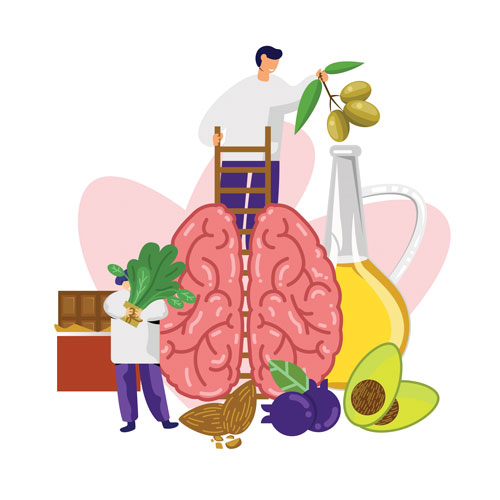
We all want something to be able to do. And frustratingly sometimes some of the science that comes out, it doesn't exactly speak to each of our own situations, but we can learn from that and try to make healthy choices for ourselves. Now, one of these articles builds on some of the things we've talked in different episodes, which is that our nutrition and diet. So there's two different types of diets that were studied in this article that was published last March in 2023. They studied the mind diet and the Mediterranean diet, and they were looking at how it was associated with the changes that occur in the brain in Alzheimer's. Now these diets basically look at how much people are eating green leafy vegetables, other types of vegetables, fruits, whole grains, olive oil, beans, nuts and fish, and trying to see if they're eating less of poultry, like chicken and red meats and more full fat dairy items.
Dr. Peters:
So Daniel, I knew about the Mediterranean diet. I've heard about it for years, but it was really fascinating to learn about the mind diet and how it really differs. With the Mediterranean diet, there's a focus getting on the vegetables and fruits and then also fish, but the mind diet is a little bit more, I guess, veggie focused. They're sort of pushing those green leafy vegetables like spinach and kale and collard greens. I love that it also prioritizes berries. I think that it is so neat and other fruits, but it did also encourage some people to eat more vegetables. So I think that's just to a lower quantity, and then they looked at a series of participants in the study. I will say for the investigators and for all of our patients and caregivers, it's hard to do a dietary study and remember what you ate. I don't know if I remember what I ate for breakfast, but you know what you ate because we're not giving prescriptive diets necessarily to patients. It's a lot of recall about what they ate in various food categories.
Dr. Correa:
Yeah, it's an important consideration in this limitation. Okay. They worked with 581, different people, all elderly who they weren't necessarily tracking and videotaping what they're eating all year for the years of the study. They interviewed them once a year and they talked to them about the different types of food categories, and tried to get a score from them as to how much or how little that they had of each of those. So it can be a challenge. It's much more of an assessment of their recollection of the pattern of the types of things that they're eating. But I think what's important to that is it's not like today this one thing that the ice cream you had last night all of a sudden throws everything completely off. It's much more about finding a pattern of consistency and trying to regularly go back to make these healthy choices and make them easier.
So one of the things they were looking at the Mediterranean and the mind diet, they each, since they're a little bit different, they got different scoring. But what was most important is that even after they took a look at the people's age, their sex, education, all kinds of other things that might impact the progression or the impact of Alzheimer's on their brains, that after they adjusted for those things, the people who scored higher and higher being how well they were at consistently eating these diets and making choices consistent with the mind diet or the Mediterranean diet, had substantially less impacts or the tangles and plaques that occur in Alzheimer's in their brains compared to people who didn't. What's really interesting is that sometimes even a single food choice could be associated in one case in the mind diet, that one point in that scoring that they did was associated with a brain looking 4.25 years younger.
Dr. Peters:
Oh my gosh, I want a younger brain. I think that's great and it's nice that they were able to look at these patients' brains and look for the plaques and tangles. And we know that looking at for other scientific experiments and also research studies, that the development of these plaques and tangles are associated with inflammation. And there are some diets that are thought to be less inflammatory in the brain. So I wonder if this is something that the authors could have posited, and I think it does point that if we have healthier habits, we might have a healthier brain, and these were better habits particularly for both diets, but the mind diet in particularly.
Dr. Correa:
And I think we all wonder what's the most important food category, and of the ones that they looked at in both diets, it seemed to be that people who ate the highest amounts of green leafy vegetables, so green leafy, not too hard to figure out. Around seven or more times a week had a plaque amount in their brain that looked 19 years younger than the other people who ate the fewest amount of green leafy vegetables, or really only once a week or less often, which is just an incredibly impressive finding.
Dr. Peters:
As a fan of those green leafy vegetables, I'm excited about that. And this is again, things like spinach and kale. You think of all your green leafy greens like tatsoi, bok choy along those lines. I think there's a lot across many different cuisines. So just because it says Mediterranean doesn't mean you have to be eating Mediterranean food. You could incorporate these greens into multiple different cuisines. So it isn't just one cuisine, it is just using those green leafy vegetables. I had kale last night, so I guess I'm good check.
Dr. Correa:
Once for the week. Now you need to get up to seven to get that 19 years younger. Now, I mean it's important all for us to remember as we discussed this study and other studies, most of these studies have the strength that they looked at the findings and the science in people, which is great. We're not talking about the findings in research in animals. We're talking about other findings of life and mice and other things, which sometimes doesn't always cross over. But on the other hand, there are studies that are looking for an association or a correlation. Just whether they're checking something like how often someone eats a certain type of diet and if it's related statistically with the other findings, in this case, what the brains look like after someone passed away. This is not necessarily the situation where they are looking at the cause of the type of diet in the eating that an individual is doing.
That is a very different kind of study. We can't necessarily say that the kale last night is definitely causing something today yet. And another big limitation is this study, in the 581 people that they looked at, was mostly looking at white non-Hispanic individuals. So we don't know necessarily how it completely translates to other populations and groups, and we don't really know the variety of ethnocultural diets and backgrounds that were included. But I think it helps what we've been thinking about with, healthy diets and these diets and how they impact the brain. Katie, does it impact a little bit now you think of your decision making for yourself or some of the things you recommend to your family?
Dr. Peters:
Absolutely. Again, those leafy green vegetables, I love them. I like to share them with my family. I think it's really important to also encourage to look at this from really a global perspective. Not everyone has advantage to go to a supermarket and have this variety of vegetables or fish, so we need to support the continued research of this and that other people can have access, if this truly is beneficial to our patients and their loved ones. But yeah, pro-greens.
Dr. Correa:
Yes, and pro-more research. I think in general I read of this is that it doesn't really change what we've been recommending to our patients. I think we've all been stressing these healthy diet options for a long time. It just gives us a little more information and points to discuss with them, and to show that even small choices about more leafy greens and not necessarily changing all of your dietary pattern may have a significant impact on at least the way our brains are aging. Now Katie, was there another article that caught your eye when you were looking through some of the things that have come out this last year?
Dr. Peters:
So definitely again, along those diet lines and also for another neurodegenerative diseases, there's been a link that was shown in one study. It was a study for patients with ALS that's also been known as Lou Gehrig's disease that the reported increased consumption of omega-3 fatty acids was linked to a slower decline in those patients with ALS. This was looked at a survival of people with ALS over a course of 18 months. It looked at 449 people, and it was published just this June of 2023. And again, what omega-3 fatty acids are. These are what we find in seeds and oils and nuts, walnuts, chia seeds. I'm a big fan of chia seeds and also hemp oil is also one of those too.
Dr. Correa:
Yeah, we've had several episodes where we've discussed and interviewed community members and experts about ALS. And those of you who want to learn more about those, make sure to go back and check out those episodes. In this study, they were looking at 449 individuals living with ALS. It was that progression of their disease, and actually even looking at comparing the difference in the death rate for those whose disease progressed to that point, from people who had higher intake of omega-3 fatty acids, and you mentioned the different sources where we can get omega-3 fatty acids, and it seemed like the ones that were vegetable sources had the highest impact in the lower death rate, whereas there was some effect by the fatty fish and the fish oil didn't necessarily have as much of an impact as the sources from vegetable seeds.
Now, an important aspect is that they did not really separate out whether or not you were getting it from your diet or whether you were getting it from a supplement. And in general, many other studies have shown, mostly it's much better to try to get these things from the whole foods in your diet rather than taking lots of different supplements to somehow catch up with the things that you're not getting in your regular diet. But if that's the only option that may be a benefit. We just don't know as much.
Dr. Peters:
And I completely agree from you. I say go to the source because you know what it is. There've been other studies that actually have shown that if you look at supplements just on a jar, what it says is in there may not be what is in the supplement, and they can actually do genetic testing on the capsules themselves to see if it actually comes from the plant or if it comes from the creature. So I think if you really want to get your omega-3s, first of all, flaxseeds, walnuts and chia seeds are very accessible. They're inexpensive. You can just get them in bulk. One of my favorite recipes is a chia seed pudding that I make with almond milk and I put some berries on it, so I put a little mind diet.
Dr. Correa:
Exactly. I think the other thing is if we're getting these things from Whole Foods sources, it feeds back to the concepts that we talked about with the other one where you're getting even more servings of those vegetables and dietary intake for these types of fatty acids in ways that also help you support getting the number of servings that you need from either a mine diet or a Mediterranean diet perspective. Again, this study, while it wasn't humans is an association study, so we don't know really the cause scientifically, it's interesting. I think this one expands what has been theorized about impacts of omega-3 fatty acids on some neurodegenerative conditions. There hasn't been as many studies showing that there really is a clear association with changing. They're decreasing the progression of some conditions. So this is great to see more confirmatory data coming out in this area, but it's not necessarily changing completely our understanding of it, but it is an important step in the direction of understanding ALS and potential impact for other neurodegenerative conditions.
Dr. Peters:
I agree with you. This is a completely associational study. They did not give patients these omega-3 fatty acids and were randomized in a controlled placebo-controlled fashion. But I think because there is a link of omega-3 fatty acids to brain development, it's a common addition to prenatal vitamins for pregnant patients. That because there's that consistent strain that maybe there is something that is good for our nervous system, this does make sense, and it just needs to be again, accessible to patients. If we know that these natural foods and true foods are important, then it's even more important that we don't have food deserts, and that our patients and the general populace can get these types of ingredients to enjoy and thrive with.
Dr. Correa:
Another one that I saw that came out this last July 2023, and this one really touched me, was a study of social isolation and how it can be linked with lower brain volume. So among older individuals who had smaller social networks and less social contact, they were found to have smaller overall brain volume in studies looking at their brains with MRIs and then confirmed on the scans that they had of their brains with MRIs. And this was looking at over 8,000 people, and not necessarily having dementia. So these were individuals who'd already been screened and confirmed they didn't have dementia, and yet when they got interviews to find out the frequency of them talking with relatives and friends and their social networks and how many times a week they were seeing people within their social network, they found those who had fewer social connections and smaller social networks had findings that really suggested that they had smaller brain volumes. I think this was particularly concerning and emphasizes for me the importance of staying in contact with all the people we love and our friends, and especially members of our families.
Dr. Peters:
It's so important, as we start to gather for the holidays, and with the Covid pandemic and us having to really isolate for a different type of reason that was needed for the infectious concerns, I think that this really highlights how do we engage our loved ones? How do we engage communities? Because what you see here is it's really about community. Do you have groups of individuals that you can get together with? And communities can be many different functions. It could be family, maybe if you're in a senior living facility, being involved with activities within that community. For me, it's a lot of my work life friends that I interact with and colleagues. I'm starting to get all those holiday party invitations and also my colleagues sort of at a larger things going to conferences now.
I think that even though this was done in the average age was around 73 years old. So these are patients at the other age spectrum, not younger patients. But it really brings home that those connections are important. And I always encourage my patients in clinic to try to engage with others, maybe engage with groups like advocacy groups. We do so much about advocacy on this podcast. I would encourage our patients, maybe if you are feeling alone, you have a neurologic disorder, listen to the Brain Life podcast. Maybe you'll find an advocacy group that you could interact with. That's why they're sharing their voice to get to know you. And I think with this study, because they were able to look at people's brains and the volumes that there was an interesting connection. But again, it is also associational, but I think that it encourages a lot to form connections in groups.
Dr. Correa:
And you could find connections and resources to many of these patient and community advocacy groups also on the Brain and Life website, and you can go and look at the website by condition. So if there's a specific condition you're wondering about, you can go there and under that area you'll find some more information for other resources. For me, this expands the understanding that we have of just the importance of social networks. I think it builds on some of the suspected science from before, but really giving us clear impacts or clear associations with the impact potentially on our brains. It highlights the importance of support for people to help them start and maintain connections with others that could be essential within our families and society and may help in preventing brain atrophy and the development of dementia later in life.
Dr. Peters:
I would love for this to be studied sort of across the age continuum, because we do have a lot of kids that can have loneliness and we can have teenagers that have loneliness and even challenges with people being very focused on using their gadgets and their devices, and not necessarily engaging with each other in a community-like aspect. Maybe there are some of those communities as AI communities. I'm not on those, but I think that it would be definitely beneficial to see this across the age continuum.
Dr. Correa:
I totally agree, and actually, I know some researchers who work in the neuroimaging space that are actually looking at some similar ideas within kids. So I'm looking forward to their science, and as it comes out and see if it's consistent with these findings in elderly adults. There was another article that we highlighted that seemed to stress the importance of sleep and made me think about going and taking a nap.
Dr. Peters:
I did not sleep last night. I was on call. So for our listeners, Dr. Correa and I, in addition to being your great co-hosts on this podcast, we're also working doctors. So we have to see patients, which we love. We have to be on call and sometimes those nights are long. So last night was a little bit of a broken sleep. I'd say usually my sleep dysfunction is due to my three cats, but I do try to get those Zs.
Dr. Correa:
Unfortunately, a lot of our sleep gets thrown off by the time changes, and there's some really great articles and information about that on the Brain and Life website. So we'll encourage our listeners to go and check out that if they're looking to understand some more about how the time changes impact their sleep cycle and some of the opinions and even advocacy of the AAN on the reasons why we shouldn't necessarily have that time change pattern.
But this article that was published April in 2023 looked at how different disruptions in sleep and sleep problems may have an increased risk of stroke. Now that's important because it's not just they said, oh, someone who has a sleep disorder causing them to snore, which is I think the one that many people would think about. This actually study looked at people who get too much, and it may be even too little sleep and maybe having increased rates of stroke, showing an association, again, not necessarily the cause of a bad night of sleep or a few nights, but really that there was an association with having one of these problems and limitations in how their sleep patterns are.
And interestingly, that includes sometimes people that for some reason this wasn't looking at the causes of it, but for some reason, some people may sleep more than 9 or 10 hours, which may point to disordered sleep problem or another problem with the sleep during those hours that they do get. And these problems seem to be associated with higher rates of stroke. Similarly, also, people who got less than five hours of sleep were three times more likely to have a stroke than those who get seven hours of sleep. I think that right off the bat is telling me to really focus on those days where I can optimize and get those seven hours as much as possible.
Dr. Peters:
I thought this was an interesting study because it wasn't just a dichotomy of too little sleep.
Dr. Correa:
Or the right amount per se. Yeah.
Dr. Peters:
Yeah. It was like sort of what is this little dosage in the sweet spot of what you should be doing for yourself. And I think that it's important to really point out that obstructive sleep apnea is associated with the development of high blood pressure. It is, but associated with cardiac risk factors and also the development of stroke and other cerebral vascular conditions and cardiovascular conditions. So you can see, for those patients that are having disruptions, but then start to have more sleep problems during the day because they're not sleeping at night.
So if you do have some sleep dysfunction like snoring or sleep apnea, you should really be assessed and look into this. I think learning how to use a pressure device such as CPAP machine or other interventions could be really beneficial if you are having those problems. So definitely look into it. And if you're having disrupted sleep, tell your primary care physician. There are sleep specialists, and you can be evaluated. I've diagnosed, in my clinic, just alone by just asking probing questions, narcolepsy and pretty large number of patients, because of just their sleep history and then sending them to sleep experts in getting back that information. So definitely for our listeners, talk to your doctors about sleep and your sleep behaviors.
Dr. Correa:
And Katie, like you stressed, we have known for a longer period of time, a direct tie of obstructive sleep apnea and sleep disordered breathing with stroke risk and cardiovascular disease. This study, while being consistent with our impressions in that area, it further extends our understanding of the potential impacts of sleep disorders across various types of disordered sleeping on stroke risk.
Dr. Peters:
Now you're in NYC. I always hear noises in the background and I'm sure that doesn't just occur while we're taping these podcasts. I would love to know some of your sleep hygiene tips. Because I bet you they're different than mine. Are you somebody who needs that white noise to help you go to sleep? Do you use a sound machine? What sort of tips do you use?
Dr. Correa:
Yeah, we don't use it consistently, but we have that option when if there's a night that things are loud or in the summers in the city, there's just lots of music and people out on the streets, which is great when you're there and enjoying it. But when you need to fall asleep, sometimes adding in some white noise and we have an air filter that we can put in the room that creates a fan noise, that can be very helpful. And then as much as I can, depending on the cost of energy, I try to lower the temperature of the apartment at night, so that way kind of get that cool chilly feel so you stay comfortable and in your bed and helps you kind of get into sleep. And that's something that scientifically has also been shown to help with your sleep patterns.
Dr. Peters:
Yeah, I'm a fan of the cooling sheets, definitely number one. I really like the clocks that have a light monitor that go down at night and then come up in the morning like a sunrise, and you can do that and you can just set your alarm. So tomorrow I'll be waking up with the sunrise, even though it'll be dark outside.
Dr. Correa:
That's true. That reminds me, one thing I've changed in the last year is with one of the iPhone software updates, they made it so you could make these sleep alarms. And instead of having a jarring sound, which I think sometimes I would even wake up either very disrupted or wake up right before and be anxious that my alarm was going to go off. There's a bird's and nature sound alarm now that I have, and it slowly raises the volume and often even just a very low volume where I'm not very disrupted and my wife's not very disruptive, I wake up a little more naturally, a little more comfortably and can turn it off before it's waking up everybody in the house.
Dr. Peters:
Those are great tips.
Dr. Correa:
Well, I hope everyone enjoyed these updates of important news from the Neurology Journal in this last year. There's so many other things that come out every year. It can be a challenge even for all the doctors to keep up with it. So you can get more information on updated science from the Brain and Life website. And if you're interested in really diving into some of these articles, you can also find some of these articles publicly available through the American Academy of Neurology's Journal.
Dr. Peters:
And remember what we reviewed were really some behaviors, our diet, our sleep, and our ability to interact with others. So I would just encourage our listeners, don't be nervous or worried to change a behavior. Get some correct information out there, get some safe information and make some positive resolutions perhaps even maybe for the new year.
Dr. Correa:
Thank you again for joining us today on the Brain and Life Podcast. Follow and subscribe to this podcast so you don't miss our weekly episodes. You can also sign up to receive the Brain and Life Magazine for free at brainandlife.org. Don't forget about Brain and Life en Español.
Dr. Peters:
Also, for each episode, you can find out how to connect with our team and our guests along with great resources in our show notes. We love it when we hear your ideas or questions. You can send these in an email to Blpodcast@brainandlife.org, and leave us a message at 612-928-6206.
Dr. Correa:
You can also find that information in our show notes, and you can follow Katie and me and the Brain and Life Magazine on many of your preferred social media channels. We are your hosts, Dr. Daniel Correa, connecting with you from New York City and online @NeuroDrCorrea.
Dr. Peters:
And Dr. Katie Peters, joining you from Durham, North Carolina and online @KatiePetersMDPhD.
Dr. Correa:
Most importantly, thank you and all of our community members that trust us with their health and everyone living with neurologic conditions.
Dr. Peters:
We hope together we can take steps to better brain health and each thrive with our own abilities every day.
Dr. Correa:
Before you start the next episode, we would appreciate if you could give us five stars and leave a review. This helps others find a Brain and Life podcast. See you next week.