In this week’s episode, Brain & Life Podcast co-hosts Dr. Daniel Correa and Dr. Katy Peters introduce their pets and answer a listener question about ALS. Then, Dr. Katy Peters discusses neurologic disorders in pets with Dr. Ann Tilton. With more than 30 years of experience as a pediatric neurologist, Dr. Ann Tilton is a Professor of Neurology and Pediatrics at LSU Health New Orleans. She has also loaned her expertise to other species! She tells stories from her time diagnosing pangolins and monkeys at the zoo and shares her insights and experiences with neurologic disorders in pets.
Follow and subscribe wherever you get your podcasts!
Apple Podcasts Spotify Libsyn
Additional Resources
- Can Pets Have Neurologic Disorders?
- Pets May Be Good for Brain Health
- Phineas the Cat Spreads Awareness of a Rare Neurologic Disorder
- I am ALS
Other Brain & Life Podcast Episodes on These Topics
- Finding Strength in ALS Advocacy with Podcaster Lorri Carey
- Hop on a Cure for ALS with John Driskell Hopkins
- The Campaign to Cure ALS with Brian Wallach and Sandra Abrevaya
Follow us!
- Hosts: Dr. Daniel Correa @NeuroDrCorrea; Dr. Katy Peters @KatyPetersMDPhD
- X: @BrainandLifeMag
- Instagram: @BrainandLifeMag
- Facebook: Brain & Life Magazine
We want to hear from you!
Have a question or want to hear a topic featured on the Brain & Life Podcast?
Record a voicemail at 612-928-6206, or email us at BLpodcast@brainandlife.org.
Episode Transcript
Dr. Daniel Correa:
From the American Academy of Neurology, I'm Dr. Daniel Correa.
Dr. Katy Peters:
And I am Dr. Katy Peters. And this is The Brain & Life Podcast.
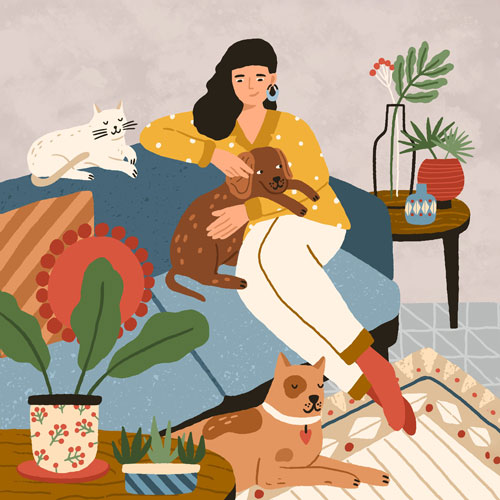
Hello Brain & Life podcast listeners. Today I've been thinking about our pets and how they hold a significant importance in our lives. They provide us with companionship day to day. They also have positive impacts on our health. They can include stress reduction. Also, they've been associated with improving mental and physical health. They can also be service animals that can provide resources for patients with different types of neurologic conditions. What I think is even cool is even the simple act of petting a dog or cat can release those feel-good chemicals like oxytocin and serotonin to make you feel good. So Daniel, I know you have pets. Do you mind, can you introduce your pets to our listeners?
Dr. Daniel Correa:
Of course. Yeah. We have a full furry family household. My wife and I live with or alongside three pets. We have our older cat, Tula, and then our new young little kitten cat Sailor. And we also have our puppy who's now about three years old, Cookie. So two small cats who just cuddle and keep his company throughout the day and in some ways we really kind of see them as the landlords. And then Cookie is a great companion and she even joins me on little runs. She's a long-haired chihuahua mix. So we go on short runs together and explore the city. They're a big part of just that stress relief and enjoying my time. Each day. You kind of see them as an example for mindfulness and being present. They're there and with it all the time. Sometimes it's because they're mindfully aware that they want a treat.
Dr. Katy Peters:
I think treats are a great reason for our pets to pay attention to us and to give us love and companionship. It sounds like you've got quite a crew. It must be busy at your house.
Dr. Daniel Correa:
Those meal times can be quite busy, especially organizing so they're not all attacking each other's dishes.
Dr. Katy Peters:
It sounds like a lot of fun. And just like humans, our pets have birthdays and I just want to say happy birthday to my two little baby kittens. I guess they're one today. Their names are Bo and Lucy. They're two little tabby cats. They are just gems. They give me so much joy. Definitely love just playing with them and petting them and being with them. They do have an older sister named Amber. She's also a tabby cat. So I have quite a tabby trio. But they are so super and give me so much to my life.
Dr. Daniel Correa:
Like every other good pet parent, for our listeners, if you want to see our pets, you could probably find photos, or too many photos, of them on our Instagram and social media.
Dr. Katy Peters:
I just posted today a birthday message for Bo and Lucy to check them out. Please check them out. They're very photogenic to say the least. And similar to humans, pets can have neurologic issues. Did you know that?
Dr. Daniel Correa:
Totally. Yeah. Actually, Cookie has a medical condition that's unique to dogs called caudal occipital malformation. It's a little bit like some of the occipital malformations that can occur in people and adults. We haven't really talked about them here, so I don't want to introduce too many complex words.
Dr. Katy Peters:
I hope Cookie's okay.
Dr. Daniel Correa:
She, she takes her medication each day and is able to just do well and run along with me and have a fun time.
Dr. Katy Peters:
Did Cookie have to see a pet neurologist?
Dr. Daniel Correa:
She did, which was the wildest thing. And being an adult neurologist, going to a pet neurologist, it was just one of those very trippy, sort of weird behind the scenes kind of moments.
Dr. Katy Peters:
Yeah. So again, our pets may have to see a veterinarian, maybe they see a specialist, like you mentioned. Sometimes places can't find a veterinarian specialist. So I had a great conversation with a human neurologist, Dr. Ann Tilton, who's a pediatric neurologist. She has experience not only in evaluating our little humans with neurologic conditions, but also pets and other exotic animals, including animals at the zoo in New Orleans.
Dr. Daniel Correa:
I have heard some of her stories and they are great. So I'm looking forward to hearing this podcast. Now, we have a little bit of time here. Should we take one of our listener questions?
Dr. Katy Peters:
Of course.
Dr. Daniel Correa:
So we heard from Caitlin R. and she asked us, "I have a friend who was diagnosed with ALS recently. I'm wondering if you have any tips or pointers on how to support them. I know it takes a village and I want to be there for them as much as possible with resources and general support. Thank you." Thank you, Caitlin. And I think a great place to start is to go to the local organizations and chapters that support the community living with ALS, the ALS Association, also its national chapters. They have support groups, not just for the individuals living with ALS, but their families and other people within the community. They may have also resources that may suggest to you on how to help and something even as simple as if you have a pet and they don't, giving them some opportunities for time with another loving creature can be great.
We've had previous episodes and discussions with people with ALS, and that probably would also help you get a greater and broader understanding of what it is to live with ALS. I interviewed Lorri Carey, who also has her own podcast about living with ALS, the musician, John Driskell Hopkins about his diagnosis and the fundraising he's been doing for ALS. And a major advocate and fundraiser towards science and improvement, who also himself was diagnosed with ALS and started an organization called I Am ALS, Brian Wallach. So make sure to check out those episodes. Maybe that helps start a conversation with your friend and their family about ways that you can be there for them. Let us know about any more topics or resources about ALS that you want to hear about.
Dr. Katy Peters:
Hello, Brain & Life listeners. I just wanted to say in full disclosure that my co-host and I, Dr. Daniel Correa, are huge animal fans. We're both pet parents. Dr. Correa has two cats, Tula and Sailor, and a puppy dog named Cookie. And of course I've got my tabby tribe of my three tabby cats, Ember, Lucy and Bo. And the reason why I'm bringing this up is we're here today to discuss neurologic disorders and pets similarities and differences. And I couldn't be more delighted than to introduce our guest, Dr. Ann Tilton.
With more than 30 years of experience as a pediatric neurologist, Dr. Tilton is a professor of neurology and pediatrics at LSU Health in New Orleans. Dr. Tilton was certified by the American Board of Pediatrics, the American Board of Psychiatry and Neurology, with special qualifications in child neurology and the American Board of Psychiatric Neurology in clinical neurophysiology. Dr. Tilton has combined a broad clinical and academic interests with a strong devotion to studying and implementing in the practice, the diagnosis and management of heritable or acquired developmental disabilities. Particularly cerebral palsy, which we've had some discussions on this podcast. So today she's going to share her insights and experience, not necessarily with her human patients, but with the neurologic disorders in our furry friends. Yes, we are discussing and learning about neurologic disorders in our pets. Dr. Tilton, welcome to the Brain & Life Podcast.
Dr. Ann Tilton:
Thank you so much. I'm excited to be here.
Dr. Katy Peters:
Wonderful. Now, before we go into really the pet issues or the pet neurologic disorders, can you please just describe your daytime job as a child neurologist?
Dr. Ann Tilton:
Excuse me. I'm a child neurologist at Children's Hospital in New Orleans and at LSU or Louisiana State University Health Science Center here in New Orleans. I direct the rehab center as well. So my daily activities include seeing human patients species, my primary species, and also taking care of administrative things and doing other things as the chief.
Dr. Katy Peters:
So now today's episode is really on neurologic disorders in our pets, and I've heard that you've been consulted by the zoo. Can you share your experience with our zoo friends? I mean, neurologic disorders?
Dr. Ann Tilton:
I have to say, I got a phone call on a middle of clinic one day, and as a child neurologist, we don't hear this all the time and sometimes take a deep breath when they say, "I know you don't do adults." So we're like, "Okay," because some of my children that I take care of are in their thirties. I mean, please. But at any rate they go, "But it's an adult pangolin." And I went, "Pangolin? From Pangolia? What's pangolin? I mean, what is a pangolin?" They said, "Well, it's a Chinese ant eater. It's an adult Chinese ant eater, and we were hoping maybe you could come over and see them because we think they might have Guillain-Barré." And I went, "Well drop everything else. I'll be right over."
So I called the consults that were pending and they all went, "Oh, go immediately." So over I went and then I had to figure out what a pangolin looked like, which was rolled up in a ball, like a soccer ball with all the shielding on them and kind of like an armadillo, I guess. They had an X-ray of it and this, and apparently she was really ataxic but the funny thing was when I unrolled her, she had knees. I went, "Oh, perfect." So I tapped on her knees and she had reflexes. I said, "Well, it's not Guillain-Barré." And they said, "Then what is it?" And then the trouble began. I'm going, "What the world does a pangolin get?"
It turned out that when I was in Dallas, we had a vet neurologist who came to Grand Rounds. And so I got on the phone, called them, started asking questions and so on and so forth. But any rate, so that was my first sort of venture into it. And then they called me, actually, she had cryptococcal meningitis unfortunately. But I said, "Well, we need to do a spinal tap to double check these things." And they said, "Well, she has armor. We can't tap her." So I was like, "Oh gosh, what are you going to do?" Anyway, so the second event I got called for a hedgehog with a head tilt, and so I had to go see the hedgehog. Anyway, so of course I said, "Oh, it must be meningitis." No, it wasn't. And then it just kept going.
One of the more interesting adventures was I got called over to see a howler monkey that was ataxic, and it became concerning because the lemurs next to her had some brain flukes, and so they wanted to know if she might have a brain fluke. And I'm like, "Well, I don't know." So we walked into this room and she was holding onto walls and everything else tried. I said, "Well, yeah, I think she is ataxic." And her son was sitting there with tail wrapped and sitting perfectly fine. And I started to approach and they went, "Oh my God, no, don't do that." I'm like, "Well, why?" They said, Howler monkeys are the loudest monkeys in the jungle, and if you approach her, she'll scream and you'll be deaf." And I went, "Oh, thank you." So I backed up and said, "Yeah, she's ataxic."
But the rest of the story is that they needed to find out if she had the same brain problem. So they sedated her and brought her over in a pink blanket to the hospital to get a scan. So anyway, so they brought her. But the funny thing was she was waiting in the waiting room all wrapped up in a pink blanket and sedated, and her tail fell out in the waiting room. It was like... Anyway, back tucked in. Everything was fine. She didn't have it and she got well. So anyway, that's just three of the first stories.
Dr. Katy Peters:
Just three of the first? That is so amazing. I guess when you go to the zoo, you're interacting, the caregivers are very different than a caregiver, these are the zookeepers, correct?
Dr. Ann Tilton:
Yes, yes.
Dr. Katy Peters:
It sounds like they know what they care for very well.
Dr. Ann Tilton:
They know them. They know what they're like. They know their personalities and they know when they get sick. So they were very, very concerned about these little ones. I mean, the history that followed included a silverback gorilla, which had a cardiac problem. So then we got the cardiologist involved and they were doing echos and that has some funny stories too because the gorilla started waking up, which is not what you want. And then a Komodo dragon, none of these were back in the hospital with us. Anyway, it's fun because it's so different than what you usually do. And yet it uses similar neurologic localizations and they have reflexes or they don't. Some of them you can't get close to decide. But anyway, it was very interesting.
Dr. Katy Peters:
I love looking for actually the knee to do the reflex. I think that's wonderful. Absolutely. So one of the disorders that I know about that can happen in pets is seizures. One of my neighbors actually has a seeing eye dog, and his dog unfortunately developed a seizure disorder. How similar are neurologic disorders in pets and, I guess, people?
Dr. Ann Tilton:
Actually, they're similar and similar medications and we can talk some more about that in a minute. But yes, I mean, when you start saying, "What sort of symptoms would a seizure look like?" You just reflect back on the things we think about for people. I guess they can stare, for sure, but they often will have a generalized tonic-clonic seizure as the initiation of it or hemiclonic or something else to look like an actual seizure.
Dr. Katy Peters:
Fascinating. Even though there are those similarities, again, we don't have armor, so we can get spinal taps, but how would those neurologic musicians sort of manifest differently? Do you notice little subtleties that are in pets that are different than people?
Dr. Ann Tilton:
I think so. I mean, also if you watch an animal sleep, how about one of your cats? They're always twitching and jumping and moving, and it's kind of like, what was that? Do that again. And so I think it's fairly similar. In fact, if you look at the neurologic disorders that animals get, it's right down pretty much the line seizures, brain tumors, neurodegenerative disorders, wobble cat and all these other, and then spinal cord injuries. Often they're more vulnerable for a number of reasons. I mean, think of a dog that is a dachshund or some of the other ones that have vulnerabilities because of their orthopedic potential of having compressions and other things along with all the other disorders that they can often get.
Dr. Katy Peters:
And we can see that from what I learned from my neighbor when their dog actually had seizures, the dog went on Keppra, which is a very common anti-seizure medicine. I give it for my patients with seizures and brain tumors. Can you sort of elaborate on how we have similar medicines for pets and people and sort of point out when it's maybe the similarities aren't there?
Dr. Ann Tilton:
Well, as we were talking about doing this, I looked up to see what seizure medicines they use because I was curious, and they do use Keppra and phenobarb, as we know. But what else is interesting, they use bromides. Which, good grief, those aren't that easy to use and Zonegran. Those are ones that are acceptable. But there are other medications, particularly pain medicines that can be lethal in animals. For instance, Motrin and Tylenol, those actually could very much be lethal and they use Ultram for pain. So it is a bit different.
They in fact use a fair amount of gabapentin because of pain. However, it can't be the liquid formulation because the formulation could be lethal to a dog. So it has to be the tablet. I mean, there's some things. So you can't directly say, "Oh, it's gabapentin. I've got some liquid. Let me just do it for my animal." You have to really work through talking to a veterinarian about it. Plus the flip is the medicines are FDA approved, they're in the veterinary group, but they're different and they can cause some problems because of impurities and concentrations, and they're not tested exactly the same way. So this idea of taking an animal's medicine is a really bad idea too.
Dr. Katy Peters:
I agree with you. During the COVID pandemic, some people, because there were medication shortages, they were reaching to their pet's medication. I would really, I agree with you. I would not recommend for our human patients to take their pet's medication. So we want to definitely disclose that.
Dr. Ann Tilton:
I was surprised too, because of the concentrations and the dosing is very different, sometimes much higher in an animal than it is in humans, not that we're not animals. In fact, I was looking at something about veterinarians and it says it can take care of every species but human. Which I thought was really funny. We are a species after all, but it is very different.
Okay, so here's the story. So my daughter's dog was known to bite, this is bad. This has got to stop. So she's gone. I've got the dog. And the dog is terrorizing things. Not us, luckily, but others. So I called the vet finally and I said, "Okay, what can I do? I've got to do something. I want the senior vet got the senior vet, what can I do?" And he said, "Well, there are three things." I said, "Oh good." "Well, the first one is to dog whisper." I went, "We are so past whispering. This is not going to work." "Well, then we can take out all his teeth." I went, "Oh, I can't return a dog to my daughter with no teeth." And he said, "There's Prozac." And I said, "So what's the dose?" Because we're going to put him on Prozac. It's FDA approved for animal anxiety, separation anxiety.
So here's the thing that's so interesting. This is a little Shih Tzu sort of dog. Only, I think he's a Lhasa because he was a guard dog. But at any rate, he weighed about 25 pounds. He said, "30 milligrams to start." And I went, "30?" I said, "I can't poison my poor little dog." But anyway, it was actually miraculous what it did. But it's one per kilo. So a bigger dog will take 90 milligrams of Prozac where the human dosing is so much smaller. If you look at large animals, because they have to give such high doses and things, you can't take one of theirs. It might be three, four, five plus times the maximum human dose. So when I looked at that, it sort of brought out, this is really a different world of what we're treating and how we're treating it.
Dr. Katy Peters:
I guess as a pediatric neurologist or child neurologist about weight-based dosing. Because definitely that exists more in the child world than it does in the adult world. So I guess you have more of an understanding of that than I do.
Dr. Ann Tilton:
What's interesting is the kid's doses, now humans, the kid's doses all of a sudden stop at an adult maximum when they're not that big because if you do it weight-based, it hits a max, which is the human max. But if you did it for someone who weighed 70 kilos, then all of a sudden the doses would be astronomical. So there are certain kind of limitations, but yes is the answer. It was pretty informative.
Dr. Katy Peters:
Yeah. One of the things in doing research for this in regards to neurologic disorders in our pets, I came across the cat Phineas. He has cerebellar hypoplasia, #PhineasTheCat. And what I thought was really neat, he's on TikTok, he's on Instagram. I don't know, have you seen Phineas? Have you heard about him?
Dr. Ann Tilton:
I saw the same TikTok Instagram kind of things. I looked it up too because you had mentioned it. And Phineas is interesting.
Dr. Katy Peters:
I love that he actually sells merchandise and proceeds that go to charity for cerebral palsy and also Christianson syndrome. And so I thought that was just a really cool story. I love that his parents, his cat parents are neuroscientists.
Dr. Ann Tilton:
Yes. And because the Christianson syndrome, they're very interested in what Phineas has, which is the cerebellar hypoplasia. His is on an infectious reason that mama cat had an infection and this particular disorder apparently causes atrophy or absence of the cerebellum. So this cat, I think I'm going to use them in my lectures because it is like the ultimate cerebellar absence. And Phineas is happy as he can be and yet you would wonder because he's falling and putting his face in the middle of the food bowl, but he's rocking along, happy as he can be.
Dr. Katy Peters:
Yeah. And don't you think that with putting it out on TikTok and Instagram and showing that animals can have disorders just like humans and human children, it does allow us to have more compassion and more insight into conditions like cerebral palsy or Christianson syndrome?
Dr. Ann Tilton:
Yes. It is interesting that sometimes people will relate quite well to an animal outside of us and be very, very sympathetic and I think maybe they can extrapolate that more to realize that. No more than the kitten or the cat has innate control over what's going on and can have a very meaningful life and enjoy his treats and whatever else, same with the people. I take care of a lot of kids with cerebral palsy, and there's a lot of joy with what they do and how they do it and all the other things.
Dr. Katy Peters:
Well, it has been a joy today to chat with you about this. This is a fascinating topic, but it also is, I would say, very humanizing to know that we all can have neurologic conditions, but they can all have a great doctor like you to take care of us. So I really appreciate it.
Dr. Ann Tilton:
Thank you. It's been wonderful.
Dr. Katy Peters:
Your insights and experience will no doubt help our listeners. And again, thank you. And I want to thank our listeners, and I wish you brain wellness.
Dr. Daniel Correa:
Thank you again for joining us today on the Brain & Life Podcast. Follow and subscribe to this podcast so you don't miss our episodes. You can also sign up to receive the Brain and Life Magazine for free at brainandlife.org. Don't forget about Brain & Life in Español.
Dr. Katy Peters:
Also, for each episode, you can find out how to connect with our team and our guests along with great resources in our show notes. We love it when we hear your ideas or questions. You can send these in an email to BLpodcast@brainandlife.org and leave us a message at (612) 928-6206.
Dr. Daniel Correa:
You can also find that information in our show notes, and you can follow Katy and me and the Brain and Life Magazine on many of your preferred social media channels. We are your hosts, Dr. Daniel Correa, connecting with you from New York City and online @NeuroDrCorrea.
Dr. Katy Peters:
And Dr. Katy Peters joining you from Durham, North Carolina and online @KatyPetersMDPhD.
Dr. Daniel Correa:
Most importantly, thank you and all of our community members that trust us with their health and everyone living with neurologic conditions.
Dr. Katy Peters:
We hope together we can take steps to better brain health and each thrive with our own abilities every day.
Dr. Daniel Correa:
Before you start the next episode, we would appreciate if you could give us five stars and leave a review. This helps others find the Brain & Life podcast. See you next week.