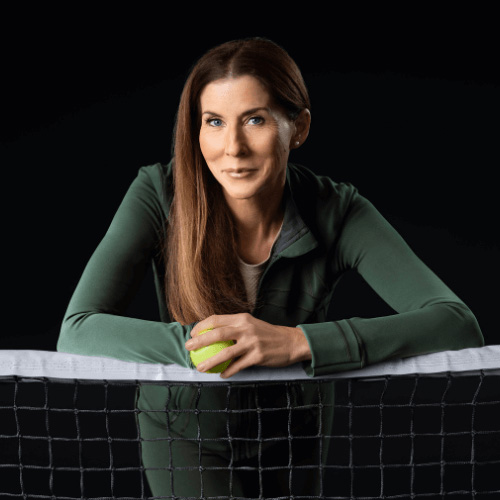
In this episode of the Brain & Life Podcast, co-host Dr. Katy Peters is joined by tennis legend Monica Seles. They discuss Monica's iconic career, the life lessons she learned from tennis, her experience with Myasthenia Gravis, and the importance of advocacy for health awareness. Dr. Peters is then joined by Dr. Andrea Markl Corse, Professor of Neurology and Director of the Myasthenia Gravis Clinic at The University of North Carolina School of Medicine. Dr. Corse explains what Myasthenia Gravis is and why advocacy makes a difference.
Follow and subscribe wherever you get your podcasts!
Apple Podcasts Spotify Libsyn
Additional Resources
- Physical Activity Helps Manage Myasthenia Gravis
- Myasthenia Gravis Foundation of America
- What is Myasthenia Gravis?
Other Brain & Life Episodes on this Topic
- Recovery Through Rhythm: Jazz Musician John Stein’s Myasthenia Gravis Journey
- Ashley Brooks on Advocating for Herself and Others with Myasthenia Gravis
- Soap Opera Star Suzanne Rogers Brings Awareness to Myasthenia Gravis
Follow us!
- Guest: Monica Seles @MonicasSeles10s ; Dr. Andrea Corse @Unc_Neurology
- Hosts: Dr. Daniel Correa @NeuroDrCorrea; Dr. Katy Peters @KatyPetersMDPhD
- X: @BrainandLifeMag
- Instagram: @BrainandLifeMag
- Facebook: Brain & Life Magazine
We want to hear from you!
Have a question or want to hear a topic featured on the Brain & Life Podcast?
Record a voicemail at 612-928-6206, or email us at BLpodcast@brainandlife.org.
Episode Transcript
Dr. Correa:
From the American Academy of Neurology, I'm Dr. Daniel Correa.
Dr. Peters:
And I am Dr. Katie Peters, and this is the Brain and Life podcast.
So. I'm sure our listeners have noticed that recently on the Brain and Life podcast, we've just had so many athletes. We're gearing up for the Winter Olympics, we've had athletes like Eleanor Taylor Myers, we've had athletes like Colby Stevenson. I know you've talked to some athletes too, right, Daniel?
Dr. Correa:
Yeah. I mean, over the years, we've had athletes from the NFL, and soccer athletes, and Olympians. And we'll be highlighting and bringing up some of those episodes and links for those of you who want to go back. But I'm really looking forward to this upcoming Winter Olympics. I really enjoy watching all these cold sports that I don't really necessarily want to do myself. It just looks like amazing and fun adventures. And they do things that I just didn't even think were possible.
Dr. Peters:
Well, I'm going to challenge you to curling, because there's a curling club of the triangle in North Carolina. I've been actually now three times, curling efficient. I'm pretty good.
Dr. Correa:
All right.
Dr. Peters:
I can curl.
Dr. Correa:
Well, I'll do some holiday ice skating. I've been wanting to try cross country skiing, because it just seems like that would be a beautiful thing to do. I used to ski when I was younger, but I'm not tempting the fate of my knee now at this point. So, maybe I'll see if I can find ... I'm sure in New York City where there is everything, there must be a curling crew.
Dr. Peters:
Yeah, yeah. And honestly, I've just enjoyed watching sports lately. I mean, right now, my focus has been on football, everything NFL, college basketball is heating up. And what I noticed is that the athletes are just so young. It's like they come in and they play just as freshmen and I'm like, "Wow, I could barely tie my shoes as a freshman." It amazes me that they can accomplish so much when they're so young and then they're really still a teenager. But no one really typifies this more than tennis phenom, Monica Seles. She was just so amazing in the 1990s, and just was the predominant female in women's single tennis. Daniel, do you remember seeing Monica Seles play?
Dr. Correa:
I remember seeing her play, and along with that kind of tennis craze that was coming up, I tried taking tennis in high school. And I was a good athlete in soccer and in wrestling, and I mean, I think I learned to laugh at myself with tennis. I'm just like, "Wow." The level that you need to learn to do tennis, it just felt like I truly could see that I was not just miles, but I think light years away from what those athletes were doing like Monica Seles on TV. And even as an adult, when I've tried to pick up the tennis racket, it just seems like such a threshold to learn.
I've played around with doing pickleball, I think the other 80% of the country. And visiting my father-in-law in Florida, I've tried this new sport that they have called padel, which is fun. But both of them, you can really tell even that the challenge of those sports as padel sports really show you the amazing skill that must be required for the level of tennis that you see at the pro level. I've actually been to the US Open here in New York City, and it's just shocking to see the difference in how they move.
Dr. Peters:
Well, we have tennis great Monica Seles. She actually came to chat with us on the podcast. She talked a lot about her tennis career, sort of how her tennis play has influenced the current tennis athletes that are out there in women's singles. And also she discussed a diagnosis called myasthenia gravis. She came forward with her diagnosis to raise awareness and to highlight really how important it is to advocate for yourself and for others. And then we're going to sort of explore the intricacies of myasthenia gravis with our expert, Dr. Andrea Corse.
Hello, Brain and Life podcast audience. We have a special guest with us today for this podcast. Monica Seles is here with us today. Now, you know Monica, of course, because she dominated the world of tennis in the early 1990s with a level of control that set new standards for the sport of tennis. She reached world number one at a young age, and won nine Grand Slam titles. She was ranked as the world's number one in women's singles by the Women's Tennis Association for 178 weeks, and finished as the year-end number one three times. She entered the International Tennis Hall of Fame in 2009, and she has built a career defined by precision, power, and consistency. You will see her influence in the way that modern players today approach aggressive baseline play, and countless fans like myself admire her for her resilience and strength. Welcome to the Brain and Life podcast, Monica.
Monica Seles:
Thank you so much, Katie. And I wanted to call you Dr. Peters, but I'm going to call you Katie. So I'm very excited to be on today, and thank you for having me.
Dr. Peters:
Absolutely. So, I just gave a short introduction of your just amazing career highlights, but can you tell us a little more about yourself and where you're joining us from today?
Monica Seles:
Absolutely. I'm in Atlanta right now, and pretty much I started my tennis journey very early on. I turned professional, I was 15 years old. So, I look back and I'm like, "Oh, my gosh," no? But one thing that for me, I love playing tennis. I was very lucky to have really a close-knit family who played tennis. So that was my introduction to the sport. And tennis, most of my dreams came true with it. But as I said, tennis has given me so much. But essentially, where I've just been so lucky is I got to do something that I loved to do, and it wasn't a job for me, it was really a passion. And it really has been an amazing gift in my life.
Dr. Peters:
That's wonderful. And what sort of lessons from tennis guide your life today?
Monica Seles:
Oh, tons, Katie. Really tons. I mean, as a youngster, you gave you a lot of discipline, because in time management, I mean, I went to a regular school. And to do that, trained, and come back and study, then tournaments on the weekends, you just learn how to manage your time very efficiently. And discipline. You grew up much earlier than you had to, maybe. There's some positive and some negatives to that, I guess, into your childhood. But to me, the one that has stayed throughout both my career and my life, I think the resilience that you mentioned earlier on has been huge. I think the other one was just adjusting. I had to adjust so many times in both my life and career, and resetting. Oh gosh, I had some hard resets that I had to do that I didn't expect to have to do at such an early age. And I think those skills that really tennis has helped me learn have not just helped me in my job career, but also in life.
Dr. Peters:
Yeah, I think resilience is so important, and you're such an example of that. And given that you've learned all those wonderful things just by playing tennis and about being resilient, what advice would you give sort of younger players now that you want to grow in tennis or grow in any kind of sport?
Monica Seles:
I think the first one I always, when I talk to really any athletes out there who want to either be a college path or a career, is first you have to love the sport. Because, yes, there's the fame side, the money side, but essentially if you don't love the sport and it's not your passion, you can't wait to go to practice, you love the competition, you want to rise up to challenge, and I think it's better to look somewhere else, because each, I mean, I can just speak for tennis, it's too tough of a sport, and it has a huge chance to break you. But I think if you have that passion, you want to do it. That inner drive has to come with you like anything else in life. And I think, not just that, you're going to be a much happier person, because I think when you're putting in the hours and it takes some family support too, because you can't do tennis on your own, it's a tremendous financial effect on really the whole family. It's a very expensive sport.
And if you enjoy the journey, both the fun part, the tough part, because remember, in tennis, you're out there alone on the court, so it's not a team sport, so it does test your inner resilience tremendously, I think you're on the right path. And enjoy the hard work. I think I look back and I enjoy the hours, countless hours on the tennis court, honing my skills, because I always just wanted to get better, better. And in small steps it happens. I don't think anything happens overnight, I think we all know that.
Dr. Peters:
I couldn't agree with you more. I mean, I do think you have to really love what you do. And I love what I do every day, and so I think that your opinions and those lessons can translate in so many different ways. And just thinking about tennis and sort of the modern game, if you look back, can you look back at how you personally influenced the game today for women in singles tennis?
Monica Seles:
Yeah. I mean, remember, when I grew up, there was really no tennis channel, none of these ESPNs and things like that. So for me growing up, I admired two players who couldn't have been really different in their playing styles, and that was Chrissy Everett and Martina Navratilova. So, I had a poster of Martina in my bedroom growing up, because I just loved the style of play that she played. She took it to the opponent and it was up to her to dictate the point. So back then you had no kids rackets, and I was very small, and that's why I started playing two hands on both sides. But again, being an individual, you got to follow what works for you, because we all can watch a Roger Federer, Novak Djokovic, but there's only one Federer, only one Djokovic, only one Serena Williams. So you have to keep that individuality.
And for me, I think it was just really an amazing thing to pave the way for a lot of players out of Eastern Europe and also to follow their dreams, because essentially, when I came to the US, I had a big dream, but there was no guarantee that that dream would ever come to anything. But again, as I mentioned before, these small steps that you keep putting in, and the passion for whatever craft you're pursuing.
Dr. Peters:
Well, I really appreciate sort of learning all that. And just, again, your amazing career in tennis just rings true, and rings true to your efforts, and to your resilience. Now, another thing we wanted to discuss was sort of a few years ago, you developed a condition called myasthenia gravis, we also call it MG. Can you tell us what were some of your first symptoms?
Monica Seles:
Absolutely. And also, as I mentioned before, in my life, I had to do a couple of hard resets. And this was definitely one of the hard resets. I love playing tennis. So for me, I love working with kids, and helping them realize their dreams, or get the best out. And then I was doing these practices, clinics, I noticed a couple of things that were very unusual. So in my instance, it was extreme leg weakness, and I mean extreme leg weakness. And then the other one was double vision. So I think anybody that plays any racquet sports, these are kind of tough ones to hide under. And this was when I realized something was going on. And I needed to figure out what was happening. So this is how my journey with myasthenia gravis started. And at that point, I had no idea what MG was. Never heard of this disease.
Dr. Peters:
I will tell you just from being a practicing neurologist, it's the kind of illness that where people show up in the emergency room and they're like, "I don't know what's going on." And it can be really important to diagnosis and pick it up. So, how many doctors did you end up visiting, and how long did it take for them to make that diagnosis for you?
Monica Seles:
It took a little bit of time for them to diagnose me correctly. The neurologist that did after running the certain things that, he was a doctor, know better than I do, because I stayed in my lane, I had to have that trust. But one thing I've learned is that to advocate for myself, because I knew these symptoms were not okay. This was affecting my job, it was affecting my day-to-day, that something was going on, something was going on. And for me, when I got the diagnosis of myasthenia gravis, in a way, it was a relief, because I knew I had something. Because can you imagine being an athlete and having extreme leg weakness, then suddenly you're seeing two balls? I mean, these are very scary things to deal with. So for me, when I was finally diagnosed, and as I mentioned, it's so important to be... You're your own best advocate, I think, in today's world, that for me, it was a relief, but there was also huge fear with it.
And this is really truly one of the reasons when I decided to go public with my MG diagnosis, and when this partnership with Argenx came about, is to raise awareness about MG, because when I was diagnosed, okay, you have those short few minutes in your doctor's office, but then you get back in your cart and you're just like numb. "Okay, let me just go on Google," and I don't need to tell you more about that.
Dr. Peters:
Yes. And how important, and thank you so much for publicly sharing your experience, because I think that when people such as yourself come out and say, "This is something that I've had to deal with," then there becomes more awareness. So, can you elucidate really just how important advocacy is in understanding MG?
Monica Seles:
I think it's huge. And MG, it's such a rare, unknown disease, really. We're making progress. And for me, when I originally was diagnosed, I was like, "Oh my gosh, what is this?" You hear about some of the other ones, but I didn't know much about MG. And this is when I said, "Okay, I am now learned to deal with my MG thanks to an amazing community of fellow MG people that have it." And I said, "Okay, now it's time to use my platform. Tennis has given me so much, you know me because of my tennis." And I said, "Okay, it's time to do something about it." And this is when I decided to really share my journey with MG, come out publicly about it, and people know that it's a disease, there's so much unknown with it some days, as I learned to give myself grace when I do events and different things, because it humbled me a couple of times, very much so.
And really just to create this community and also raising awareness, using my platform in a positive way. And for me, I had to learn so much about MG because I knew nothing about it. So if I can cut that nothing to something time for a fellow MG sufferer, like there's a tremendous, fantastic website, mg-united.com that I wish was around what I was originally diagnosed with MG, that can really make you not feel alone, and also give you quite a lot of information, and also tips to day-to-day living with MG.
Dr. Peters:
I love the description of how you had a challenge, and then you had to reset. And I think that that's so important for anybody with any kind of condition, with any kind of challenge, whether it's physical, whether it's mental, to reset. And you heard it here from Monica Seles. So Monica, what is sort of next for the future for you? What's next for you?
Monica Seles:
For me, now that I'm learned to live with MG, it's raising awareness. So fellow MG people know that they're not alone. To me, I really felt very much alone when I was first diagnosed. There really wasn't much on it. And the feedback that so far I have gotten, even just in the few months that have come out from people, "Oh, I've never heard of it. Now I know of it because of you." If I can just keep that momentum going, I go on the website like, anybody that's MG traveling can be challenging in many ways. So, little tips that I learned. Then the community aspect of it. And essentially, trying to lead as normal of a life as I can with MG. I know it's continuously, I hate to use the tennis term here, but it has really helped me. It's like that ball that's bouncing all over, and I'm not quite sure where it's going to land, but I have the tools to manage it. And that for me, if I can just convey that message through my platform to fellow MG, I think I've done the right job.
Dr. Peters:
Well, I think you've hit it out of the park, but no, that's a baseball term. Uh-oh.
Monica Seles:
Yeah. No, that's a good one. But essentially, I think, Katie, your knowledge is power.
Dr. Peters:
Yeah. I agree.
Monica Seles:
And to me, I go back to that.
Dr. Peters:
Absolutely. Well, Monica, thank you so much. I hope you have a wonderful holiday season. You have just been delightful to talk to, and thank you so much for all that you do, for advocacy for myasthenia gravis, and for all that you've done for the tennis world.
Monica Seles:
Thank you for having me on today.
Dr. Correa:
Want to learn more about the conditions discussed in this episode and other factors that could impact your brain health? For the latest on causes, symptoms, diagnosis, treatment, and management of more than 250 of some of the most common and rare neurologic conditions. Please visit brainandlife.org/disorders.
Dr. Peters:
Hello, Brain and Life podcast audience. I'm delighted to have our expert here today, Dr. Andrea Corse, from UNC. She's an expert in myasthenia gravis. She's also a professor of neurology at UNC in Chapel Hill, which is just around the corner from me. She's also the director of the Myasthenia Gravis Clinic at UNC. She's a neuromuscular specialist with expertise in neuromuscular clinical care, neuromuscular clinical pathology, nerve and muscle biopsies, and electrodiagnostic testing. And I used to work with her. She trained me at Hopkins, so I'm just over the moon that she's joining us today. Welcome to the podcast.
Dr. Corse:
Thank you, Katie. I'm honored to be here. Always happy to talk about myasthenia too.
Dr. Peters:
Great. And I give a short introduction. I assume you're in Chapel Hill today.
Dr. Corse:
Yes, I am. I'm at the hospital.
Dr. Peters:
And can you tell us a little more about yourself?
Dr. Corse:
Well, I trained at Hopkins and then I stayed there. As you know, Katie, I was there for about 30 years. And I had the really special opportunity to work with Dr. Trachman. And he was one of the pioneers in this disease. And so it gave me great insight and he shared his enthusiasm and love for trying to decipher many aspects of this disease. He was still working at age 90 when he passed, which was not too long ago. At that time, I then had the opportunity to move here to Chapel Hill to work with Dr. James Howard, who has also been one of the forefathers in the translational clinical trials work with myasthenia. And that was an opportunity that was too good to pass. So then I've been here about 18 months or so, and we're having a lot of fun working together. It's a very large clinical trials program here for myasthenia, so I'm doing exactly what I like to be doing.
Dr. Peters:
Wonderful. And I totally remember Dr. Trachman taking care of his patients. I remember one time he even showed up at 3:00 A.M. to take care of one of his patients that was on the inpatient service. And even at 3:00 A.M., he was teaching, which was just amazing, and it was just great and great working with you when I was at Hopkins. But I'm now excited that you're in North Carolina right next door.
Dr. Corse:
Yeah, I'm loving it. It's beautiful, the people are friendly, the institution is fabulous, and there's a lot of patients here with myasthenia.
Dr. Peters:
So, that's what we're here to talk about today. We talked with Monica Seles, probably one of the top women tennis players ever. She's in the Tennis Hall of Fame. She disclosed that she does have myasthenia gravis and is doing well, but can you give us sort of what is myasthenia gravis?
Dr. Corse:
Sure. Yes. I have a lot of respect for people like Monica who's able to help inform the public based on her own experiences. So, I really admire her for doing that.
So, myasthenia gravis is an autoimmune disease. It's an antibody mediated autoimmune disease. So this means the body is attacking itself, and no one knows exactly why this happens. It can happen to many organs. There's many autoimmune diseases. Maybe some of the more common that we hear about are psoriasis, or lupus. But in myasthenia gravis, the target of the disease is a very specialized portion of the muscle, where the communication from the nerve goes to the muscle. And that transmission is blocked by antibodies. It's actually one of the antibody mediated diseases about which we understand the pathology or the pathogenesis the best. So, understanding myasthenia gives us a lot of information about maybe managing other autoimmune diseases.
It's a disease that can affect any age, interestingly. There are peaks in women under the age of 40 might tend to have it more often, or men over the age of 60, but young toddlers can have it. And then there's a form where if a woman has myasthenia and she delivers a baby, the disease can reside temporarily in the baby. And that's called neonatal myasthenia gravis. And that's because the antibodies are still in the circulation of the baby. The baby's not producing the antibodies, but until those antibodies degenerate, which happens over a matter of weeks, then the baby can be symptomatic with the disease, interestingly.
And then there's very rare forms which are called genetic. That's just genetic diseases related to that same specialized area of the muscle, but those are not autoimmune, and that's really not what we're concerned with here.
Dr. Peters:
And are there particular risk factors for someone to develop myasthenia?
Dr. Corse:
We say autoimmune diseases tend to keep the company of other autoimmune diseases. So, perhaps if there's a lot of autoimmune disease in the family, one might have a risk. You have a slightly higher risk if there's a sibling, for example, that's been diagnosed with myasthenia. If you develop a thymoma, which is an abnormal growth of the thymus gland, then you're at increased risk of developing myasthenia. Anyone can develop a thymoma, but if you do your risk of developing myasthenia slightly higher, that's an organ that produces antibodies, so it makes sense that that might be the case.
Dr. Peters:
And I remember diagnosing these patients, seeing them in the ER, seeing them in your clinic. What are some of the first signs and symptoms that a patient might have?
Dr. Corse:
It can be very variable, but generally, the more common symptoms might be the development of a droopy eyelid that might fluctuate. It could be double vision coming on periodically, trouble with fatigue chewing, or difficulty swallowing, difficulty holding your head up or weakness in your arms and legs. And in some cases, you can have shortness of breath associated with it.
Dr. Peters:
I remember, one of my first patients I diagnosed in the ER, one of her complaints was actually it was from her mother. When she was first on the phone, it would have a phone conversation. And by the end of the phone conversation, she couldn't hear her anymore. Her voice got so low that she couldn't hear her. So, I remember that. So, once you think somebody has myasthenia, how does it get diagnosed?
Dr. Corse:
So, 80% of the patients you can detect it in their blood. So you draw their blood and you look for the presence of an antibody. And that antibody is actually relatively specific, so it can be extraordinarily helpful. And that may be that with the proper clinical setting, like you said, someone developing difficulty swallowing, or slurred speech, or hypophonia, low voice, that really could be enough for you to be confident with the disease. About 20 years ago, a second antibody called the MuSK antibody was recognized to be associated with the disease. So that's about one in 10 patients. So, about 90% of the patients we can actually diagnose based on blood tests. The problem is the blood tests take a matter of days, if not one to two weeks to get back. And then about 10% of the patients are what we call seronegative, meaning we can't detect it in the blood. And those patients require additional diagnostic testing.
Dr. Peters:
And what is a diagnostic testing? Because I know that when I was in your clinic, you did a lot with EMG and nerve conduction studies. Can you talk about what is specialized for myasthenia to detect it?
Dr. Corse:
Yeah. So, the most helpful additional testing is to bring the patient to the EMG laboratory. And we do electrodiagnostic testing, where we administer a shock to a nerve and we record over the muscle, the response. And we see on repetitive stimulation if the response of the muscle drops. Normally, we have a safety factor. We can handle that repetitive stimulation of the nerve and we don't see a decrement. But in these patients, we tend to see a decrement. That's called repetitive nerve stimulation testing. Quite easy to do. Most laboratories, electrodiagnostic laboratories do that. The problem is it's not perfectly sensitive. So, it might pick up six out of 10 cases. So, there still could be a large percentage of patients that have the disease, but have negative repetitive nerve stimulation testing. So then we have to go to a level even more sophisticated called single fiber EMG, and that's not available at many EMG laboratories.
And so there, the patient has about an hour long electrodiagnostic test where a small needle is often put in the forehead, and then we record the reliability of the transmission along the nerve, as it connects to the many muscle fibers that that single nerve will connect to. And there should be a very reliable, repetitive response, but if we see unreliability, we call that jitter. That jitter will be increased above the normal amount of jitter, and that's a very, very helpful test with a sensitivity more picking up maybe nine out of 10 cases of generalized myasthenia.
Dr. Peters:
And you want to diagnose this as soon as you can.
Dr. Corse:
Yes, that's interesting. It's a very rare disease. So in the whole United States, there's probably less than about 80,000 cases. I always think of Arrowhead Stadium, I grew up in Kansas City. And I say to my patients, "You could bring all the myasthenics in the country to Arrowhead Stadium and there'd still be tickets to sell. So you wouldn't even fill up the whole stadium with all the patients in the United States." So yeah, it is very rare.
So when you think about treating it, you think about the medicines that work in a fast period of time, and then those that might take a little longer, and then those that might have a more permanency or a longer duration of effect. So you have to look at the patient with them helping you in a shared decision process to try to understand what are the symptoms that are the most bothersome, and how can we treat those.
So, one of the medicines that works literally within minutes of to 15 to 30 minutes is the cholinesterase inhibitor. And that allows this chemical that the nerve spits out onto the muscle more time to hang around and wait for an opportunity for the antibody to slip out of that parking space, if you will, so that the transmitter can land on the muscle. The downside is this medication is not super powerful, and it also tends to only last about three to four hours. So, it could require you to dose every three to four hours, but it's very safe medication. So that's a medicine that's a weak medicine, but it can be a game changer over a matter of 15 to 30 minutes. There's new drugs being developed that also could work within a matter of minutes to hours. So, that's an exciting area right now of research going on with one clinical trial.
And then most of the other therapies that we talk about have to affect the immune system in some way. Some of those are short term, sort of chasing your tail, but nonetheless, if it's helping your symptoms, that's good. Others are more in sort of turning off the faucet. I tell my patients, "Stopping your body from making this antibody, that's the problem." So some of the quick acting ones that can just impair the antibody, or limit the antibody's deleterious effects, would be intravenous gammaglobulin IVIG, which is used in many autoimmune diseases. It's like a shipment of your immune system arriving. And so yours can kind of sit back and say, "Oh, look what just came. A shipment of an immune system. I'm going to go on vacation and I'll check back in three weeks when that's all worn off, and then I'll come back and I'm going to start making the bad antibody that I need to."
Also, IVIG seems to preoccupy the antibodies that are already there causing the trouble. I feel like it's sort of like putting a nanny on the scene where she's going to hold the hands of all these antibodies so they can stop causing trouble. So, it has some nice quick effects, but again, it's one where it's no permanency to it. Steroids is the traditional medication to try to ramp down your body's ability to make these antibodies, and to allow them to cause their damage. But increasingly, although it's easy to take, it's a pill, it's inexpensive, but it just comes with a lot of side effects. So it can work within a matter of weeks, certainly, and more and more you're on it, but then you start to have the downside of all the side effects. And if a patient has a weight problem, high blood pressure, diabetes, I don't like to even mention steroids, or bring it up in the conversation at all.
And sometimes interestingly, it will totally take away the symptoms of the disease, but they're suffering so much from the side effects they associate those side effects with the disease, and they think those side effects are the disease. And then really I'm treating steroid toxicity instead of myasthenia. So, I think they're being used less and less for that reason.
Dr. Peters:
And I share your opinions on steroids. I mean, it's something that I unfortunately have to give to my patients with brain tumors. And the toxicities definitely occur for our patients. And it can often be worse than some of the symptoms that they're having. And it can be really challenging to get them off. So, I agree. And so what we need is really research to find better treatments. We'd love to have a steroid sparing agent. What are some specifics to myasthenia, what are sort of some of the new exciting areas of research?
Dr. Corse:
And there has been. I mean, in the past eight years, I'd say we have a handful of drugs that have been approved, FDA approved. And this is really a game changer. Before that, we really didn't have medications that were approved specifically for the care of myasthenia. So, there's two classes that have been approved. One is called the FcRn antagonist. Now, this one also works within a matter of really days to weeks. It can be given IV or subq, even self-administered with an injection. These drugs, and there's many of them now remarkably on the market just in the past eight years, they prevent the recycling of that antibody. So your body thinks it's doing a good thing by recycling antibodies, but you think if there's an antibody that's causing trouble, you don't want it to be recycled. And this allows your body to stop recycling the antibodies. And you take the medicine and within a couple of weeks, you're going to feel better.
Now again, your body is still producing the antibodies. So in that sense, you're still chasing your tail. In other words, you need to continue with this medication long-term. The medication can just be given maybe once a week, or there's different treatment paradigms, but it's also relatively safe. So, it's a very exciting medications.
And then the second class of drugs is called the complement inhibitors. So these antibodies need weapons to do their damage. It's sort of like calling together the army, but not giving them weapons. So, it can also work really rapidly within a matter of weeks, one to two weeks, you can see a change with these drugs. Now, your body does use complement to fight to other infections, and you do have an increased risk of certain infections, in particular with this class of drugs.
So patients need to be immunized against meningococcal meningitis. Or if you need to start the drug right away, you need to treat them empirically as though they did have meningitis at the same time, until the vaccinations are in place for a period of time. But that's one downside or inconvenience. And some patients like to avoid immunizations. But these classes are changing the paradigm, because now we really have powerful, effective tools that are relatively safe that we can use. So, we're very, very excited.
Dr. Peters:
That's really funny, because I remember it used to be steroids and CellCept, and we sort of hoped for the best for patients for a lot of times. And really when you want to have change and to make change with these new medications, it comes with advocacy, that it's patients promoting awareness since it is a rare disease. Where do you think advocacy fits to help patients with myasthenia?
Dr. Corse:
I mean, I think educating patients is really, really, really vital for them to understand their disease, for them to help you decide what medicine would help their symptoms that are really bothersome. Sometimes I say, "If I'm a genie and I could take away three of your symptoms, tell me exactly what you would want me to do, and then we can work together to devise how quickly do you need it." "Is there a wedding that's three months away and we got to get something changed in time for that?"
But to also have a long-term strategy to treat your disease. And that's where another exciting area is, in the research, is for these long-term therapies where your body will be, that fossil will be turned off, and your body won't be allowed to make these antibodies. So, I see that the patient advocacy groups like the Myasthenia Gravis Foundation of America has done an amazing job on organizing really an international consortium of patients, and researchers, and clinicians getting together to devise the best informational resources for the patients, support groups.
Patients can learn so much from other patients who've been on steroids or something to maybe watch out for things. I really applaud. I think drug companies do a lot to really help disseminate information to doctors, actually, and to patients. And as you said, Monica Seles, making her challenges with this disease public really brings a lot of attention. I mean, anything, of course, all this work requires a lot of funding, which is important. Private philanthropy, government funding and industry, all that's critical. So, the more people we can get familiar with this disease, it'll lead to a lot of positive benefits.
Dr. Peters:
Well, I just appreciate your time today, your expertise, and sharing everything and really sharing a wonderfully hopeful message for us as we go to 2026. So thank you again, Dr. Corse. We really appreciate it.
Dr. Corse:
Sure. Let me end on a note. We were at the international meeting in May, and one of the final points of discussion is whether we should change the title of the medicine away from myasthenia gravis, because gravis means very serious and grave. And we're starting to feel like that's not the tempo, or not the message that we want to convey. I thought that was a great message to end on for our international meeting.
Dr. Peters:
I think that's wonderful. I love giving you a better name change.
Dr. Corse:
Well, thank you, Katie, for bringing this to a public forum.
Dr. Peters:
Oh, of course.
Dr. Corse:
I appreciate you making time to do that.
Dr. Peters:
Of course. And I just want to say happy holidays to our listeners. Happy holidays to you, Dr. Corse. And everybody have a great day.
Dr. Corse:
Thank you, Katie.
Dr. Correa:
Thank you again for joining us today on the Brain and Life Podcast. Follow and subscribe to this podcast, so you don't miss our weekly episodes. You can also sign up to receive the Brain and Life Magazine for free at brainandlife.org.
Dr. Peters:
Also, for each episode, you can find out how to connect with our team and our guests, along with great resources in our show notes. We love it when we hear your ideas or questions. You can send these in an email to blpodcast@brainandlife.org, and leave us a message at 612-928-6206.
Dr. Correa:
You could also find that information in our show notes, and you can follow Katie and me and the Brain and Life Magazine on many of your preferred social media channels. We're your hosts, Dr. Daniel Correa, connecting with you from New York City and online @neurodoctorcorrea.
Dr. Peters:
And Dr. Katie Peters joining you from Durham, North Carolina, and online @katiepetersmdphd.
Dr. Correa:
Most importantly, thank you and all of our community members that trust us with their health and everyone living with neurologic conditions.
Dr. Peters:
We hope together we can take steps to better brain health and each thrive with our own abilities every day.
Dr. Correa:
Before you start the next episode, we would appreciate if you could give us five stars and leave a review. This helps others find a Brain and Life podcast. See you next week.