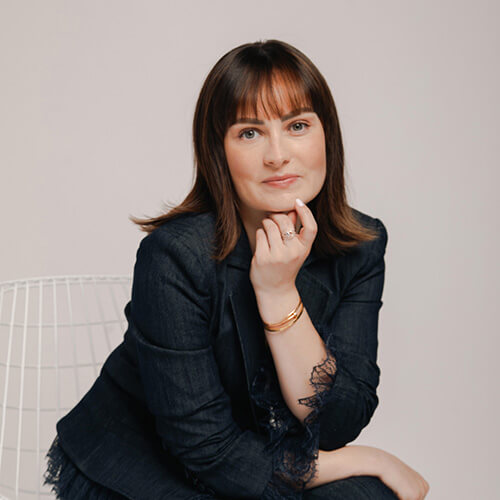
In part two of this two-part episode, Brain & Life Podcast host Dr. Daniel Correa is joined by Molly Burke. Molly shares how her journey of navigating life with retinitis pigmentosa (RP) has led her to create online content and write a book. She shares more about her mental health journey and the importance of finding joy. Dr. Correa is then joined by Dr. Brittni Scruggs, a vitreoretinal surgeon and physician-scientist at Mayo Clinic. Dr. Scruggs dives into the importance of advocacy and exciting research for people living with RP.
Follow and subscribe wherever you get your podcasts!
Apple Podcasts Spotify Libsyn
Additional Resources
- At a glance: Retinitis Pigmentosa
- Customers and Professionals Weigh in on How to Make the Beauty World More Accessible
- What Causes Color Blindness?
- Molly Burke Official
Other Brain & Life Episodes on this Topic
- Exploring Accessibility and the Arts at the Lincoln Center
- Making the Years Count with Brooke Eby, Influencer Living with ALS
- Parenting and Writing While Disabled with Jessica Slice
Follow us!
- Guest: Molly Burke @MollyBurkeOfficial; Dr. Scruggs @MayoClinicEye
- Hosts: Dr. Daniel Correa @NeuroDrCorrea; Dr. Katy Peters @KatyPetersMDPhD
- X: @BrainandLifeMag
- Instagram: @BrainandLifeMag
- Facebook: Brain & Life Magazine
We want to hear from you!
Have a question or want to hear a topic featured on the Brain & Life Podcast?
Record a voicemail at 612-928-6206, or email us at BLpodcast@brainandlife.org.
Episode Transcript
Dr. Correa:
From the American Academy of Neurology, I'm Dr. Daniel Correa.
Dr. Peters:
And I am Dr. Katie Peters, and this is the Brain and Life Podcast.
Dr. Correa:
Saludos, and welcome back to the Brain and Life podcast. So last week we heard from Molly Burke in part one of this episode about her experience as a child and having challenges with vision impairment that are related to her condition, retinitis pigmentosa. So if you didn't hear that episode or don't know about that condition, please go back and check that out. I find her story and those of so many others find their own path to adapting to their environment despite any challenge, physical or otherwise, amazing.
And Katie, for the variety of brain cancer patients that you have supported, what kinds of impairments and disabilities have you seen them rehabilitate and adapt their lives to as they move forward?
Dr. Peters:
That's such a good question. And I've been really enjoying listening to the Molly Burke episode and how she's adapting. And I think where probably the most common thing that our brain tumor patients have to contend with is speech and language challenges, along with cognitive challenges that sort of accompany that. It's quite common just from surgery itself, but also the other treatments. And we're pretty quick to utilize our colleagues in speech therapy, occupational therapy, and neuropsychology to support our patients and their loved ones with these particular issues.
In fact, we have a neuropsychologist actually embedded in our clinic, Dr. Renee Raynor. She's just amazing. And this can be seen in several of the larger brain tumor centers across the country. But I think what's really challenging is if you're in the community or in a more rural area that doesn't have a lot of resources to find the right kind of providers, you really have to take it on the onus for yourself and for those loved ones as caregivers.
Dr. Correa:
Yeah. I mean, I'm so glad that in so many more of the specialized care centers and these specialty centers for brain tumor, epilepsy, other conditions that are out there, they're really thinking about the quality of life and the rehabilitation needs of those individuals along with supporting their families as a key part of that comprehensive care that they're trying to reach. But we have to recognize that a lot of people have limited access sometimes to some of these extra specialized centers. And so that's a big challenge.
And today we're continuing our discussion with Molly and we'll hear about her transition to greater independence as young adults and adapting to a world that's really designed for sighted individuals. And then we'll also continue our discussion with Dr. Brittni Scruggs, our medical expert, to hear about her experience supporting individuals with retinitis pigmentosa and other low vision conditions and some of the research that's going on in that area. We're glad to welcome back Molly Burke again for this part two, and really looking forward to hearing about her experience as she moves through and advocates for others with adaptations.
Before this more recent increase, and I'm sure there's still a lot of a place for growth in representation in vision impairment in the media and the movies and TV and so on, but before there was more of a true depth of perspective on that, what were some of the things that would really frustrate you and others that you know in the community about depictions of myths and misconceptions around impaired vision?
Molly Burke:
I think one of the most frustrating and harmful ones that media has perpetuated time and time again is that there is a certain look to being blind. And the way the media typically portrays that is very darked out sunglasses and/or a milky, foggy, gray appearance to the eyes. And while those two things can be true, some blind people choose to wear dark sunglasses, some blind people do have a condition like cataracts that change the physical appearance of their eyes, there's also so many people whose eyes look completely quote, "normal".
And I am one of those people. I have complete muscle control over where I look and move my eyes. I blink. My eyes can track. My eyes are a blue, gray, green kind of color. And the only difference that you might notice in my eyes, if you look closely, is that I do have nystagmus. So my eyes are constantly moving in a circular motion that is uncontrolled. But as I'm sure you know, you can have nystagmus and have 20/20 vision. So actually, my nystagmus is not necessarily representation of my vision loss. I could have that and I do know people who have it even worse than mine who can drive a car.
So it's frustrating that I hear all the time, "Well, you don't look blind," or even, "You're lying about being blind because your eyes are moving, because your eyes are blue-green." And that's incredibly frustrating and it's a sentiment people in my community hear time and time and time again, and I'm here to say there is no one look to being blind.
Dr. Correa:
And what do you think, at least from your perspective and those that you've interacted with, is the impact of that constant negotiation with others in the community around you about whether or not you look blind or you are faking blind?
Molly Burke:
It's so frustrating to have your identity constantly invalidated by the world because of how you look, which is outside of your control. And I should not have to convince you of my disability because I don't check a box that you think I'm supposed to. It's incredibly harmful rhetoric to believe that there is a certain appearance to disability.
Dr. Correa:
In your book, as you were describing some of the mental health impacts and anxiety over time, you write about how intense anxiety and then learning what's happening in your mind and body and therapy and coping skills and treatment, what do you wish more people understood about how anxiety can show up when you're living with a chronic social stressor?
Molly Burke:
Anxiety for me was incredibly physical. In fact, I kept going to doctors trying to come up with an answer for what was physically wrong with me. I couldn't eat because my stomach was constantly nauseous. I would get diarrhea because I was so filled with anxiety. I would get heart palpitations and I would be sweating in a way that I'm not usually a sweaty person, I'd be sweating profusely. I was having all of these side effects I couldn't sleep and I was like, "Surely there's something wrong with me."
And it turns out the whole time I was just dealing with undiagnosed and untreated complex post-traumatic stress disorder following a workplace accident and kind of the culmination of a lot of trauma and stressors throughout my entire life, which was why it was complex. And so getting that diagnosis and being able to enter cognitive behavior therapy, being able to get on an SSRI, being able to have talk therapy in conjunction with the CBT was really able to help me start to rectify a lot of those physical side effects of my mental health. And that was a really big wake-up call for me to realize that mental health is health.
Dr. Correa:
I know that there are a variety of different conditions within neurology described and titled functional neurologic conditions or disorders that many times are associated with unresolved trauma and mental health issues. Is that somewhere along the lines of some of what you had going on at the time with your physical symptoms?
Molly Burke:
Absolutely. And I had a lot of neurological ones as well. I couldn't follow a sentence through. I would describe it as it would feel like halfway through my sentence, it would just fall off a cliff and I had no idea where I was even going with it. I couldn't type it out. I couldn't write it. I couldn't say it. The thought would disappear. It would be done. And that was really scary to be 20 years old and feeling like I couldn't remember anything, I couldn't think. And I remember when I hit rock bottom just sitting at the top of my stairs in my parents' house holding my head in my hands and saying, "My brain is broken." And I was just rocking back and forth saying, "My brain is broken, my brain is broken." And that really was rock bottom for me where I realized, "Something has to change. Something is very wrong and I need to find a solution and an answer."
And thankfully, the solution and the answer was much more simple than it could have been. It was just untreated trauma. And once I was able to get to the root of that, I came back to life. I was a functioning person again, because I can tell you, I was not at all functional. I was unable to sleep, unable to eat, unable to do my job because I couldn't be a speaker. I couldn't write speeches. I couldn't perform. I could hardly think. I was having up to four panic attacks a day and I couldn't leave the house. None of that was me. My brain was misfiring. And once I understood that and could get to the root of it, it was such a relief to me to know, "Okay, I can understand the mechanics. My brain is firing off missignals, so my body is being flooded with adrenaline when I don't have resources to get rid of it. And if I can go to the source and treat that, I can get my life back." And that was such a gift.
Dr. Correa:
And you mentioned psychiatrists, cognitive behavioral therapy, or what's often broken down as the acronym CBT, and medications, SSRIs in your book. I think in many cases, whether it's a medical condition, a mental health condition, we all always want the one thing that will fix it. But for you, you mentioned a combination of things that you did to help address this. What was that combination and how do you maintain that now?
Molly Burke:
Absolutely. I always say there is unfortunately no fix it all solution. Healing is never linear. It's a journey that I will go on for the rest of my life. I need to be intentional and aware of that. And for me, my healing really started with a joint team effort that included both Eastern and Western modalities, seeking talk therapy, CBT, SSRIs, but also changing my eating habits to eat food that was really fueling my body, eating lots of whole foods that were giving my body nutrition and energy, because I truly believe mental and physical health go hand in hand.
Making sure that I was having good sleep hygiene. A lot of blind people can struggle with sleep, and mental health and sleep often also go hand in hand, so really making sure I was practicing good sleep hygiene, starting a routine an hour before I go to bed so that my brain starts to understand it's supposed to wind down, it's supposed to prepare to sleep. Making sure that I was physically moving my body, which can be more difficult when you can't see. I can't jump on a bike. I can't go for a run, so finding ways like hot yoga where I could move and stretch my body and be active in a way that felt safe for me. All of these things played a role in my healing.
Dr. Correa:
I wanted to go back to earlier. I think we all as adults and the adult children of our parents often have to deal with and reflect back on a lot of the changes and issues in the past. And something you wrote particularly powerfully in the book, and there was a line where you said you redirected blame away from your parents and toward cure culture. I think this can really relate really well to many different neurologic conditions, especially for younger individuals or at later in life that aren't necessarily going to have a cure. How did that reframe and change your relationship with your past, your parents, and yourself?
Molly Burke:
So much of the world runs under the assumption that we need to cure everything. Everybody living with a medical condition or disability needs to be cured, which ultimately means healed, changed, fixed. And so my whole life, I was deeply raised in cure culture and the medical model of disability. And I don't blame my parents for that. They were doing what they thought they needed to do to be good parents to their disabled daughter living with a chronic condition, because that's what the doctors told them, and that's what the charities told them, who they were put in touch with upon my diagnosis.
And ultimately, being filled with that rhetoric, with that mindset, with that sentiment my entire life, well before I could understand my own condition, meant that once I did understand my condition and I was old enough to understand my blindness, I felt deeply broken. I felt that I wasn't enough. I felt that there was no way that I, a blind woman, could live a fulfilling, happy, successful life and be loved if I was disabled. And that led to so much depression. It led to suicidal ideation.
And I really had to go through, and that was a big part of my healing journey, untangling that narrative and finding a new way of believing and viewing myself and my community. And for me, that was leaning into the social model of disability, which is the sentiment that disabled people don't need to change. We are not broken. There's nothing wrong with us. We just live in a world that didn't consider us and that didn't design for us. But if it did, then all of the problems and the hardships we face because of our disability would disappear as well.
And so I stopped blaming myself. I stopped blaming my family and I realized I just need to be a part of advocating for greater inclusivity and universal design. And the best way I can put this is if I go to a restaurant and they hand me a menu in size 12 font, I can't read it. So I'm going to have to ask for help. Somebody will have to read that for me. In that moment, I am disabled. But if you hand me a braille menu, I'm not disabled because I can access that information entirely independently, read it for myself and pick what I want. So is the problem in that situation my blindness or is it inaccessibility? Well, clearly it's inaccessibility.
I live my life every single day not thinking twice about the fact that I'm blind. When I do my makeup by touch without a mirror, I'm not sitting there thinking about the fact that it's so hard that I can't see. I'm just doing my makeup like any other person. When I think about being disabled is when I face inaccessibility in the world around me. So I don't put the barrier of change on myself because at the end of the day, there likely will never be a cure in my lifetime, so why should I bear the burden of guilt and shame when it's not my fault and I can actually advocate for something that is within change? We can see that change in my lifetime. So that's where I choose to put my energy.
Dr. Correa:
I was wondering what your thoughts would be looking forward back at the sort of cure culture context for parents and the healthcare community and the broader social community, how do you think we can adapt or change some of our communication to still make sure that we're focusing when necessary to diagnosis, treatment and management of conditions and their symptoms, but also not making it feel that those who are living that are differently abled feel that somehow they are broken?
Molly Burke:
I think it's a lot in the language that we use, I mean, where it's like suffering from. I'm not suffering from retinitis pigmentosa, I'm living with it. And when we use things like wheelchair bound, when I talk to a lot of my friends in the disability rights movement who use wheelchairs, they're like, "My wheelchair is freedom. I'm not bound to this. This gives me my life. This allows me to move about the world independently and achieve what I want to."
And so when the whole world is talking in these really negative constructs, you embody that and you feel that from a young age when that's all you're ever hearing. When the only thing doctors do is talk about the research and curing and changing us instead of talking about resources to live a full life today, that's really problematic. When we live under the assumption that everybody should want to be changed and healed and fixed and cured, I think that's problematic.
I can wholeheartedly say I live my life to the fullest and I am so happy with who I am. I love who I am. I'm proud of who I am, and that's not in spite of my blindness. It's with my blindness. My blindness is a part of what makes me who I am, what has given me my beautiful life and the community and the purpose and the passion. That's a gift that blindness has given me. Has it taken from me? Absolutely, but it has also given to me, but society only ever focuses on what it takes.
We need to see what these things give, and frankly, what disability gives to the world, right? The curb cut phenomenon. There's so much that non-disabled people benefit from because of disabled people. The curb cut, that slope in the sidewalk when you cross was designed for wheelchair users, but now every parent pushing a stroller, everybody riding a bike, every delivery driver pushing a cart is happy that it exists. And there is so many examples of that in our life. You are benefiting from our existence, so stop trying to eradicate us and stop assuming that our life is miserable.
And in fact, as I said, I think a lot of ableism unfortunately does run deep in the medical community, which is why I love opportunities to speak to the medical world, whether that be doing podcasts like this or being able to speak at conferences and events as a keynote. I love being able to share a different perspective than what they've heard. From my understanding, you don't receive a lot of education on disability when you're in medical school, and I think that's a shame. I think that doctors, when they are in medical school, should hear from disabled people with lived experiences to learn about disability culture and to understand the disability rights movement because it is intertwined with the medical world so much. But I really felt saddened to read recently that there was a statistic that 82% of doctors do not believe people living with moderate to severe disabilities can live a good life. They don't believe we have good quality of life.
Dr. Correa:
I like your description because it really highlights that there's an opportunity for everyone to have joy and celebration and live well now, regardless of your ability and our different abilities. And I think thankfully, many at the medical school I'm at, but many medical schools are incorporating this a lot more now for the next generations. But the reality is we have many of our colleagues are trained in previous generations of medical education where there may have been more or less awareness about the different abilities for the people living with the conditions within their specialty, and that's even if they got exposure to that within their specialty, let alone the variety of conditions that other people may live with. And I like that, I think maybe people who talk about this in this space refer back to the concept about the curb cut, but it's still something that everyone needs to be aware of for all kinds of social adaptations.
Molly Burke:
Absolutely. And I'm never advocating against research and science. I'm not saying, "Screw it, stop looking for treatments and cures." There will always be people in the community who do want it, and I'm happy for them that they may have access because of the research that scientists are doing. But what I'm saying is when we assume that everybody wants that and we speak like that is the only good way to live is to be non-disabled, it harms all of those of us living with disabilities who will never get cured, whether we want to be or not.
Dr. Correa:
So I was wondering, Molly, for our Brain and Life community, patients, people living with neurologic conditions, caregivers, care partners, clinicians and allies, what might be one small concrete change that you want each group or a few of them to try this month to make the world feel less unseen for people with disabilities?
Molly Burke:
Seek out education. There is no reason to not learn when we live in a world where at our fingertips on our phone, you can go to any social media app and watch fun, engaging, entertaining content from people with lived experiences. And I urge you not to just watch content from parents raising children with those conditions, because they unfortunately often continue to perpetuate stereotypes and ableism because they don't live with that condition. Please seek content from people with lived experience sharing their stories. It really is just as entertaining and fun as any other kind of content you find yourself doomscrolling at night. Recipes, beauty, fitness, fashion, travel, the disability community is just as fun and engaging. So learn. Learn, because when you learn, you can be a part of the change we need to see.
Dr. Correa:
And we'll ask you if you can provide maybe a few suggested resources that we'll include in our show notes for our listeners. And I think that is a great bit of homework for us to explore and learn the many ways people navigate and interact true independence in their lives and communities.
So Molly, thank you so much for sharing your story that's not just about vision loss. It's about identity, mental health, and what it takes to build a full and happy life in a world that isn't designed for everyone. Unseen reminds us that the real work isn't asking people to be inspirational. It's removing barriers so we can look and be and belong together. Thank you so much for joining us here on the Brain and Life podcast.
Molly Burke:
Thank you so much for having me.
Dr. Correa:
On the Brain and Life Podcast and online, we share stories from people living with neurologic conditions and the science that helps them navigate everyday life. Behind that progress are researchers working on ideas that could lead to better treatments, better understanding, and better care.
Dr. Peters:
The AAN research program has supported this kind of work for more than 30 years, but each year far more researchers apply for funding than we're able to support.
Dr. Correa:
So if you're someone who values neuroscience that makes a real difference for patients and families and all of our communities, we invite you to join this effort. A donation to the AAN Research Program helps more promising research move forward. Learn more about this at AAN.com/donate.
I hope you really liked the end of that discussion with Molly Burke, and I'm so glad we got to have such a deep and detailed story and conversation with her about her perspective with her condition and advocating for others. And I'm so glad you're joining us as we continue our discussion with our medical expert, Dr. Brittni Scruggs. And now we'll hear and talk with her about research into retinitis pigmentosa and possible regeneration of the retina, along with low vision adaptations and advocacy resources.
You've mentioned gene therapy, we've discussed the idea of regenerative therapies, you mentioned a term, gene agnostic. When people hear some of these things, they could either sound miraculous, like out of a sci-fi movie, or just confusing. So what are the options that are real today, including the rehabilitation, the medical and surgical care that you've mentioned? And then maybe we'll follow that up with some of the developments that are in progress.
Dr. Scruggs:
Yeah. This is an exciting part of my job, and this conversation would be completely different five years ago and it would even be very different a year ago. I would say we're at a point where science is starting to be very exciting and we're starting to really understand the disease to the point of having treatments.
So with that said, Luxturna, which is the first FDA approved gene therapy, it was approved in 2017. I mean, it's been almost 10 years since that approval. So now we have a decade's worth of data and understanding of how gene therapy works in the eye. And I'm a Luxturna surgeon. So there are, at this point, 17 institutions in the United States who deliver Luxturna. And I'm honored and privileged to be one of the surgeons.
But when we do these treatments, it's a big deal. It's a major operation. We often treat both eyes. We go to the operating room, we do one eye, and then usually 10 to 14 days later, do the other eye. We're taking out the jelly, which is called a vitrectomy. We are detaching the retina, so we are putting a needle through the retina and putting the viral solution that has the gene of interest under the retina and literally making a little blister, which we call a bleb. And that blister is the virus. The viral solution is now under the retina, and then the viral solution infects the retina. And once it infects the retina, which we call transduce, it then jumpstarts those cells, right? The cells that were dormant or not functional now have the gene that allows them to have the machinery to do their job of sensing the light.
It's pretty cool. And it does sound like sci-fi, but we've now been doing this for 10 years and it works. I have some patients I've treated and they had no vision or very limited vision and now are living very healthy, well-sighted lives. And I tell my close friends and family this, if that's all I do in my career, just those few patients, it was worth it to go through all of this and that training because it's so amazing to give back to the world in that way. Yeah, it's hard not to get emotional about it.
So in addition to just Luxturna, which is the only FDA approved gene therapy for the eye right now, there are some clinical trials that are really advancing towards that finish line and probably will become commercial products, and those are for different forms of retinal dystrophies, including X-linked retinitis pigmentosa has several phase threes going right now for RPGR is the gene. Stargardt disease started the first in human gene therapy trial just about four weeks ago. And so that's really exciting and I'll be one of the surgeons on that trial.
And yeah, the list goes on, but the gene agnostic approach is very interesting, because that potentially can treat not only patients that don't have a genetic diagnosis, which is a lot of patients, honestly, but it could also potentially help patients who are in an advanced stage. So I think we should stop for a second and talk about that. So with regenerative medicine, you really should not put a patient under the knife and going to the operating room and putting gene therapy in the eye if they're not a good candidate, right? That makes sense.
As surgeons, we have to think all the time, is this person eligible and a good candidate for surgery? If someone has no outer retina, it has succumbed to the disease so much that those retinal cells are not even present, why would I put the patient through a surgery to give them a gene back that the cells aren't even present to be infected? So that would be bad medicine. So those are things that we have to decide as surgeons of who has enough real estate, enough cells present that it would be meaningful for them to get the gene therapy. But that's gene specific gene therapy.
So now we have patients who maybe have no outer retina, but they want something too. They want hope. They want something that's creative. And so that's the gene agnostic approach, and that's called optogenetics. And it's interesting science where the inner retina that's still present and still functional is now being infected and it's producing now a light sensing protein that it normally doesn't produce. So it starts to produce like an oxen. And so it's like the inner retina starts to behave like the outer retina. So in theory, that's pretty amazing, right? It's pretty cool. You can take someone who doesn't have any outer retina and you can make the inner retina sense the light and send the signal because the inner retina, that's what it does. It's just a conduit. It just sends the signal once the outer retina detects the light.
So optogenetics would be something that potentially would bypass that and maybe could treat more advanced patients. And that's already in trials. It's already gone through phase one and phase two, and it's advancing to phase three in this calendar year. I'm excited about that. But like any other clinical trial, these are experiments. These are human experiments and not everyone will be a candidate. Some patients will end up having inflammation or side effects from these surgeries and injections. And that is science. And so the pros and cons of everything need to be explored extensively with every patient.
Dr. Correa:
Yeah. And part of that, I think I wanted to emphasize this point that it is completely fine for someone to think about for themself and for the risks or possible benefits of these different options to decide you don't want one of these treatments, or whether it's participating in a trial or an already established treatment, you yourself can also decide if you're a good candidate.
Dr. Scruggs:
For sure.
Dr. Correa:
And these are all just options to consider. Now, Molly in her book, Unseen, really also explores this tension between, as she's growing up, wanting independence and people's assumptions about her and her safety. In your practice and counseling of individuals and their families, especially teens and young adults, how do you share this discussion around balancing autonomy, mobility, and risk?
Dr. Scruggs:
Yeah. These are hard discussions, and one of the hardest things that we do as ophthalmologists, other than maybe diagnosing a fatal disease, right? That's definitely the worst thing that we do as ophthalmologists. We look in the eyes and they only have an eye disease and we have to tell them that this isn't just an eye disease, this is something that could potentially kill you.
One of the second things that I really, really have a hard time with, but I would say it's one of the most important things that I do as a physician, is to talk about driving. And that sounds maybe weird to some people, but driving is the most dangerous things that we do as human beings. It's a dangerous hobby. And for a lot of patients who are in my clinic, they don't have good vision. They don't have good peripheral vision. They don't have vision that's acceptable when it's raining or when it's cloudy, or maybe even when it's light outside, they have light sensitivity, but we're asking them to come up to all these appointments and they have to transport themselves.
And so when you ask about autonomy, the number one thing that people think about when it comes to independence is being able to navigate the world by themselves. And part of that is driving, part of that is actually navigating with mobility assistance, whether that's a white cane or a guide dog or a guide or just being familiar with the places. But if we aren't talking about these things, if we're not talking about all of these mobility things and transportation, we're doing a disservice to the patient and there will be a day when a patient potentially harms themself or harms someone else. And if I didn't have that hard conversation with them, that's part on me. And so I have these hard conversations all of the time. And my job is not to take independence from people. I absolutely want to give people hope and I want to empower them, but I also want to empower them to make the best decisions for them and for the world, and sometimes we do have to do things that are really, really hard, and taking someone's license is absolutely one of those things.
But to answer the question a little bit fully, this requires grace and time and building rapport, connecting them with people, connecting them with a representative who's going to go to their house, right, who's going to make sure that their house is outfitted perfectly for them, that they have the right lighting in their house, that they have big buttons on their cabinets or they have the right program on their computer, like ZoomText, or whatever they need at their work to have the right accommodations. I write letters all the time as an advocate for my patients for remote work because they can't drive in the winter because it's too dark or maybe they need extra time on tests and they're in college. And this empowers people, right? This gives people the ability to live life in the way that is the most meaning for them. And hopefully that answers the question. There's so much here that we [inaudible 00:37:00]. Yeah.
Dr. Correa:
Well, and along those lines, beyond the medical treatment, some of these tools that you described, what are a few that you feel like make the biggest difference in their day-to-day life that you often discuss with people with low vision?
Dr. Scruggs:
I don't know if patients would agree with me, but I think validation is number one. One thing that I hear from my patients, I love to give my patients chair time. It's one of my favorite parts of being a physician. But one thing that I hear from patients is they've seen other doctors and maybe there wasn't a diagnosis or the genetic testing was inconclusive and they're like, "I don't understand my disease," or, "I was told that there's really nothing we can do," which is never the answer, right? But, "I don't feel like I understand, why am I struggling in the real world, and make sense of that for me." So if you lean in and you listen and you sit and you explore the testing and the diagnosis and the clinical findings and the genetic testing, we're educators, right? We're not just physicians telling them what to do. We're educating them so that they understand, they know they're not alone, they know what's happening to their own bodies.
So I think the validation and the education is 100% the number one thing that I do as a physician. And with that, with that education comes empowerment and being informed to make these decisions, these really hard decisions about, "Well, what should I do with my own life when it comes to mobility? What should I do in terms of support systems? What should I do regarding surgeries and clinical trials? Should I go on this oral agent or should I do a gene therapy, or should I just wait and wait till it's a commercial product when it's safe and effective and it's ready for prime time?" That does not take me telling them, just like you said. This takes me being a partner with them and then they can make their decisions about their own life. But yeah, chair time matters.
Dr. Correa:
Yeah. I think that's such a key point is yeah, someone who actually will acknowledge and listen and share an understanding. And if our listeners wanted to move from empathy into action and be able to share and be there and understanding with those with low vision, are there some things that you would suggest that we can do as community members to be more inclusive and respectful of the dignity of those with low vision and as they manage this world that's really not designed for a low vision state?
Dr. Scruggs:
Yeah, that's true. There are many organizations. If people are wanting to get involved, be advocates, go to our capitols and be that voice. There's a foundation for Fighting Blindness, which is an amazing organization. There's the Helen Keller Foundation and all of these different inherited retinal diseases also have their own foundation, including the Choroideremia Foundation, Stargardt Disease. There's so many opportunities to connect with these people and these groups. And I definitely encourage people to do that. And I'm speaking to myself. I need to absolutely make sure that that's more a part of my life too. And being an advocate and going to the capitol and talking with people who are making decisions.
And also, I think about government and federal government versus local government. Our local government's really important. It's what makes the decisions on a daily basis. But same thing here. Sometimes I realize we're not well-equipped even at Mayo Clinic to handle sometimes these very rare things. I'm doing a project right now with a quality improvement for a very specific problem that I think we just need better education. And yeah, it takes being to listen, to think about the problems and then be creative in your problem solving, and then to not just work together, but to have a team of people to be like, "How can we make this better for deaf, blind people, people who identify as both having not only vision problems, but also having hearing loss?" That is extremely hard to navigate the world, especially if you have nine appointments on the same day. So how can we do that better?
I'm a work in progress. I think our institution's a work in progress, but all it takes is a core group of people who really care and who have that passion, right, that excitement that, you know what, it's not perfect, nothing's perfect, but we can make it better.
Dr. Correa:
Boom. Brittni, thank you for leading with that passion, that humility that we're all a work in progress and your dedication to the community. We really enjoy having you here today.
Dr. Scruggs:
Yeah, thanks for having me.
Dr. Correa:
Thank you again for joining us today on the Brain and Life Podcast. Follow and subscribe to this podcast so you don't miss our weekly episodes. You can also sign up to receive the Brain and Life Magazine for free at brainandlife.org.
Dr. Peters:
Also, for each episode, you can find out how to connect with our team and our guests along with great resources in our show notes. We love it when we hear your ideas or questions. You can send these in an email to blpodcast@brainandlife.org and leave us a message at 612-928-6206.
Dr. Correa:
You can also find that information in our show notes and you can follow Katie and me and the Brain and Life Magazine on many of your preferred social media channels. We're your hosts, Dr. Daniel Correa, connecting with you from New York City and online at neurodoctorcorrea.
Dr. Peters:
And Dr. Katie Peters joining you from Durham, North Carolina and online at katiepetersmdphd.
Dr. Correa:
Most importantly, thank you and all of our community members that trust us with their health and everyone living with neurologic conditions.
Dr. Peters:
We hope together we can take steps to better brain health and each thrive with our own abilities every day.
Dr. Correa:
Before you start the next episode, we would appreciate if you could give us five stars and leave a review. This helps others find the Brain and Life podcast. See you next week.