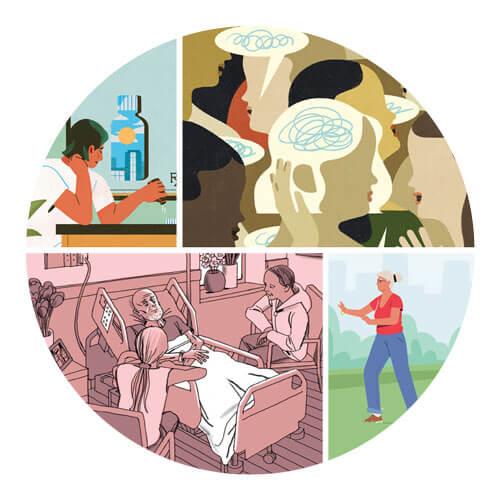
In this week’s episode, Brain & Life Podcast hosts Dr. Daniel Correa and Dr. Katy Peters discuss some of their favorite articles in the most recent edition of Brain & Life Magazine. They discuss the importance of hearing aids for cognitive function, ways to prepare for hospice care, Tai Chi for blood pressure, and more. If you would like to read articles like these, be sure to subscribe to Brain & Life Magazine for free!
Follow and subscribe wherever you get your podcasts!
Apple Podcasts Spotify Libsyn
Additional Resources
Brain & Life Articles Mentioned
- Hearing Aids May Lower the Risk of Cognitive Decline
- Five Ways to Prepare for Hospice Care
- How Medication Shortages Affect Patients
- Tai Chi May Help Lower Blood Pressure Better Than Aerobic Exercise
- How Board Games Helped This Man Recover from a Stroke
- How to Juggle Caring for Children and Aging Parents
Other Brain & Life Podcast Episodes on These Topics
- Peloton Instructor Bradley Rose on Returning to Life After Stroke
- Author Samantha Irby's Journey as a Young Caregiver
Follow us!
- Hosts: Dr. Daniel Correa @NeuroDrCorrea; Dr. Katy Peters @KatyPetersMDPhD
- X: @BrainandLifeMag
- Instagram: @BrainandLifeMag
- Facebook: Brain & Life Magazine
We want to hear from you!
Have a question or want to hear a topic featured on the Brain & Life Podcast?
Record a voicemail at 612-928-6206, or email us at BLpodcast@brainandlife.org.
Episode Transcript
Dr. Correa:
From the American Academy of Neurology, I'm Dr. Daniel Correa.
Dr. Peters:
And I am Dr. Katy Peters, and this is the Brain & Life podcast.
Dr. Correa:
Welcome back to the Brain & Life podcast, and this week we're going to start again with another article highlights. We have the new summer issue of the Brain & Life magazine, so Katy and I are here because we wanted to talk about what's coming up.
Dr. Peters:
So Daniel, have you had a chance to peruse the articles and what did you think?
Dr. Correa:
Yeah, I'm really excited about several of the articles and I want to know what you think about several of them. Some of them overlap with the activities that I like to do, discussions I've had with my own family, and just really key issues that we need to understand about our brain health.
Dr. Peters:
I think the first thing was really the cover. To see Deborah Roberts on the cover, and I know you also got to interview her for a podcast. Can you just give us some exciting highlights on that?
Dr. Correa:
She was just, I mean, totally a pro journalist. It's like, I was humbled by having the discussion with her. She could just very easily roll into her own life story, how she's had migraines and vertigo issues throughout her life, how she manages them, getting on shows and managing the days. I mean, when you're on TV and reporting on some of these early morning shows, the hours and the time can be very challenging. But how much and how clearly she shares her dedication to telling communities and people's stories really was so much fun. And she really shares her own challenges with migraines and vertigo and little ways that she's managed them herself throughout her life, both within her family or at work.
Dr. Peters:
Well, I can't wait to listen to the podcast. I'm a huge fan of hers on 20/20 and I can't wait to listen to it. Now, you-
Dr. Correa:
We had a great time, and we're also, as you mentioned, we recorded the podcast. So the issue will get you a little bit more of a background about her and her story, and later this summer we'll be releasing the podcast episode with both her, Deborah Roberts and a medical expert, Dr. Matt Robbins, who will talk with us about migraine and types of migraines that come with vertigo.
Dr. Peters:
So, one of the other articles touched on how hearing aids may lower the risk of cognitive decline. And I think it is so crucial to maximize our ability to utilize all of our senses, whether it's touch, hearing, vision, smell, everything to get our brain functioning to its fullest potential. And I just had a few days ago in clinic, I was encouraging one of my patients to get his hearing tested because it's a very common problem in our brain tumor population because they receive radiation near their temporal lobe, which is near the temple and hence it's close to the ear. What are your thoughts on it?
Dr. Correa:
I mean, I think it's so important. I saw the article highlights the importance of getting screened and sometimes that screen might be dependent on your age. With age, all of, several of our senses might decline some, and hearing because of its association to our social interactions and many of our brain functions, it's important to get that screened. And what's great to see with these studies is if you get hearing aids, that there is a potential improvement to reducing the risk of cognitive decline in dementia later.
And there might be also things, how you work, where you work, the kinds of sounds you are, maybe what city you live in, if you're in New York with the loud noises on the street often. And unfortunately, part of our digital connections nowadays is we're often wearing headphones or earbuds and we might be listening sometimes to music or things around us at really high volumes. And that whether you're wearing a headphone or playing the music in and around you and all that extra sound stress may potentially impact or reduce your hearing. And so really catching it both, sometimes maybe while you can still do things and make adaptations to how you're listening to music or your sound exposure and wearing ear protection, or even when you need it, getting hearing aids before it starts to affect other functions of our brain.
I've had this discussion, I think we all have a family member who sometimes starts to have a little bit of issues hearing some people's voices or really hearing parts of conversation, but people understandably, they might feel shy about admitting it, wearing the hearing aid or even going to get checked about it and thinking, oh, the concerns of costs. But I think this is a particularly helpful point knowing that it's associated and connected with dementia risk and cognitive decline. As soon as my mom found that out, she was out getting her appointment and getting her hearing aids and feels proud now about using it. My uncle, especially being a Latino man, was also very hesitant and resistant to it and as soon as she pointed it and we pointed out to him, well, that means you might have a higher risk of dementia. Oh, okay, that problem went away really quick.
Dr. Peters:
Well, I'm glad that you had success. I'm here to try to convince some of my elderly family and friends that are having hearing issues. So if you're out there listening with the high volume, consider those hearing aids. And I like some of the older people in the media community like to call their hearing aids, ear candy. So to get over the stigma of having a hearing aid in. So there are some definitely newer hearing aids, there's often some availability of over the counter options that can help you, so, and also the use of your smart device. A lot of these hearing aids are now just controlled through your phone through apps. So I really encourage people to look into it because you want to use all of your senses.
Dr. Correa:
Yeah, and thinking less about it being something you're concerned about, how it looks or wearing it, and more about celebrating what it adds. The quality of sound that you'll get to hear, that music will sound better, you'll hear more things when you are watching TV and can follow conversations. When you go out to dinner with a good hearing aid, that with all the new technology and adaptations, they actually will make it easier to hear each other and be part of the social conversations that we all need.
Dr. Peters:
And we have definitely discussed being part of a society and being part of your group and engaging with others. And if you don't have that hearing, you're going to be, you're going to essentially engage less with others. So I'm a big proponent, let's keep our senses there.
Dr. Correa:
Definitely, definitely. And Katy, one of the other articles I thought was probably something you encounter in discussion all the time. I mean, you take care of many patients with different types of cancer and brain tumor, and this article highlights five ways to prepare for hospice care. And there was another article that goes into more details about hospice care. So both of these really a great example. What did you think, Katy?
Dr. Peters:
Well, I thought they were great articles and I really appreciated while they not only discussed the problem, they also discussed what are those five ways to prepare for hospice care and really broke it down for people. And really, in the day-to-day care of my brain tumor patients, whether it's in the hospital or in the clinic, we have to have goals of care conversations and when our treatment is no longer efficacious and patients need care really in a different form of involving comfort rather than therapeutic care, we do recommend hospice. We are lucky to have a superb nursing staff, social work staff, child life specialists, that really become involved in this transition, and there's even hospice care organizations that also help with that transition.
So once patients and families find out that really hospice is the next appropriate step for them, you want to determine whether they need a skill level that requires inpatient care or whether it can be done in the home. And so you checked out these five steps about preparing for a transition for hospice care and I thought they were really useful. So what did you think of them?
Dr. Correa:
Yeah, I mean, I think the first step is even the thing I check when I'm having a conversation and bringing in the social worker to discuss with the family these options, is really understanding, what's covered with your insurance plan? Is it Medicare, Medicaid, another private insurance company? Are you eligible for some of the other government-supported options? Because we got to be real about the finances. All this extra care will and many times can add a lot of other additional financial stress to families. So helping people understand what their contribution and requirement will be and what they're eligible for really just empowers the families in making choices together with their family member that really meet their goals and what they're comfortable with.
Dr. Peters:
Yeah, and I thought one of the other tips was really to really talk to your doctor, talk to your providers. These are people that know what may happen in the late stage course of a disease with particular needs. Particularly people with ALS, they may need a feeding tube or respiratory support. Some of our patients with brain tumors may have seizures. So there may be specific elements of the hospice experience that need to be directed. So, definitely talk to your neurologist. They're going to know what happens with patient's conditions that have that particular disease or illness, and they can help guide you to provide appropriate accommodations.
Dr. Correa:
And one of the things you can ask for is, what is the certifications that are available by that rehab facility and hospice center? That's something that the social workers and those who are helping you select and look at your options may be able to explain and tell you about. But there's various different certifications for hospice care that are required by Medicare and Medicaid and knowing the places that have that certification, whether you're using Medicare or Medicaid for it, can help you really make sure you're getting a place that is well versed in all the ways to support an individual's comfort.
Dr. Peters:
And you want to really check out that hospice organization, whether it's going to be a home hospice organization, or the patient is going to inpatient hospice. It's a good idea to do an informational visit, whether they're coming to your home to check out the situation and you can check out their services, but if it's also the patient is going to an inpatient facility, to see what that looks like. And I think that this is not just important for the primary designated caregiver, but for that whole extended caregiving family and friends, because you want to have those opportunities to have that patient or that individual be around those friends and family in those type of situations and how that hospice will really accommodate it.
Dr. Correa:
Yeah, and one of, the fifth thing that they mentioned, and I think this is another important aspect, is as you said, not everybody does hospice in the hospital system or at a center. And when you're going to do hospice at home, you want to make sure that the medications that someone is going to need for their comfort or maybe even for some other neurologic conditions that have painful or uncomfortable symptoms that would be treated, if they're going to be covered under the hospice. And so pain management often may be covered, but the nuances of how that medicine is given might affect whether or not it's covered, and sometimes with someone because of the muscle tension or other symptoms of their neurologic disorder, they might need to be on some of the other medicines that typically in hospice they don't always necessarily think about or might get stopped. And so if it's going to be continued to help with that person's movement, their muscle comfort, just knowing whether or not that medicine is going to be covered or whether it can be covered through your insurance and what other ways, and that way you're not surprised with extra bills after all that time that you took to help support your family member.
Dr. Peters:
And on the topic of medications, another article looked at how, and this is something that has impacted so many of our patients with neurologic conditions is, how do medication shortages affect our patients? I know that both from the neurology side of things and the oncology side of things, my brain tumor patients are having a lot of challenges getting their meds. Daniel, have you seen this with your epilepsy patients?
Dr. Correa:
Yeah, I mean, we are regularly having conversations as our epilepsy team and our center, keeping each other updated. We get a regular email from the pharmacy if they find out that a shortage may be coming or even just at our institution because of demand we have seen a shortage, and sometimes we'll hear updates from special patient organizations that they're hearing their patients are having a challenge and we try to keep these things in mind within our team and selecting new medicines or letting patients know that they should be trying to get their refills really on time or a little early because it seems a medicine might be at a shortage.
And I think one of the reasons for this, as I mentioned, is there's unfortunately still an increase in the number of people being diagnosed with various different neurologic conditions, including Alzheimer's, Parkinson's, and epilepsy, and the frequency of brain injuries around the world has continued to go up. So this means that there may be more people, but not only in the United States but worldwide, living with different neurologic conditions and not all the companies are increasing how much of the medicines they're making, that hopefully is catching up. Sometimes the demand puts a stress on parts of the system. What else have you seen that really stood out for you from that?
Dr. Peters:
Well, this goes back to the COVID pandemic. I do think this is not just involving the United States, it's really a global issue and if you get a disruption in the global supply chain like we saw during COVID, this really can strain those shortages and the supply of those medicines and there can be manufacturing delays, transportation restrictions. I remember that even during the COVID pandemic, we had a clinical trial where we got the drug but we couldn't get the tubing that would deliver the drug to the patient. So you have to remember, it's not just the drug itself, it's also the packaging. Does it have to be compounded in a certain way? So, definitely raw materials are so key.
Dr. Correa:
Yeah, and because as you mentioned, it's that all the different parts of the production process. We've seen in crises around the world when something is impacted in the local manufacturing system, that might impact how well medicines can be delivered to that area because sometimes even the companies that make the medicines, they make them, they're shipped to the local areas or parts of the world, and then it might be repackaged into the boxes and everything there. So that just interrupts another part of it.
Dr. Peters:
And I've been recently involved in a clinical trial where we have the drug in the United States but it's not necessarily in other countries. And how other countries get drugs really is dependent on the laws, the regulatory hurdles from country to country, what's required for quality standards from country to country. And I will give you a teaser, Daniel, for a future podcast. We actually talk about it with one of our interviewers, I'll tell you about that later on, but how there just aren't certain drugs in certain countries because they haven't been regulated. And it can be really challenging, particularly if you're a smaller country and maybe not part of a larger group and how they are regulated from a country by country basis, and this can just lead to more shortages for patients really across the world.
Dr. Correa:
Yeah, we've had this as a challenging coordination and discussion sometimes with some of our patients here in New York. New York City is a frequently traveled place or a place where people live part-time and go back and forth to other countries in the world, and sometimes when we're selecting medications that will work best for their epilepsy, we also have to think of, well, if you're going to be spending a significant number of months in a certain island as the Caribbean or in Eastern Europe, let's make sure that you're also going to be able to get your medication at the schedule that you need there. Or, is it financially possible for you to get large amounts of it? Which often means out of pocket before you go on your next four-month or six-month trip back to a country where a family is or where they work. And so these are important aspects that affect decision-making and important for us to have those conversations with our doctors when it impacts us.
And all of that, so what you just brought up, there is just the dollars and cents of it. We brought it up with the hospice. It's something that impacts the demand and the dynamics of just the cost and the market for these medications and that is often something that impacts which medicines are being made, which ones are made at higher volumes, where new medicines and new research gets developed, and that's because these are still companies. The pharmaceutical companies and the device makers are also still companies and so they have to decide based on where they may be able to generate both profit and a greater number of activity. And so sometimes it requires our government support for rare conditions or less common conditions, to make sure they're getting more attention when needed in research or in support when developing new products and new treatments.
Dr. Peters:
Yeah, and there also can be a challenge with just finding, can there be alternatives? And I agree with you, Daniel, if you're traveling to another country, you may be used to taking your home medication, but you may show up and there's just either that medication isn't there, but then there's not alternatives either. And I can think of this as in regards sometimes to infectious disease for certain types of antibiotics, also for even steroids for some of our patients. Our patients will travel and they will not necessarily have access to the type of steroids they were on before. So I, again, always tell people to pack extra medicine, sometimes give them a little, I guess protection medicine when they're traveling to certain areas.
One of my favorite things to ask my patients is I was like, what are you up to? What's going on? What are you planning? So that I can keep them on top of the situation. So I know we provided some tips, but I guess that's my own, I don't know if that was in the magazine, but that would be my personal tip.
Dr. Correa:
Yeah, I mean, this was a regular decision point and something to consider even when I was in the military and soldiers when they would deploy and they had the be on medicines. We had to consider and make sure that we could get it to them either through our system or through the local system when they went. But always taking extra to start off, because even if you're supposed to be able to get it there, you don't want to have to be figuring that out in your first few days of a vacation or a work trip, making sure you have enough while you figure out how you need to get it in the local area.
Dr. Peters:
You're supposed to be on vacation. So before you go, what can you do for these medicine shortages? I would say, you know what? This is where you need to talk to your providers, whether it's your doctor or your pharmacist, definitely chat with them about those challenges. I just want to say a shout-out to our pharmacist, Dr. Malika Patel and our tech, Candice Alford. They definitely keep on top of this for our patients, for both the neurology-based medicines and also those oncology-based medicines that they require.
Dr. Correa:
Yeah, I think those are all great ideas and even more tips in the magazine. So, one of the other articles we talk about and like to bring up all the different ways exercise and different types of exercise can improve and impact our health, not just our brain health but our body's health. And so one of the articles highlights a discussion and several examples of in a research study on how Tai Chi, a movement martial art, has helped lower blood pressure better than even other types of aerobic exercise, which is an exciting alternative I think for some of the people who don't love aerobic exercise.
Dr. Peters:
Well, I'm excited about this because I think I'm going to start doing Tai Chi, because I'm ready to lower my blood pressure and any kind of stress, but this was definitely an intriguing intervention and it was a pretty big study. It was over 300 patients, they're randomly assigned to either do Tai Chi or to do an aerobic exercise, and the Tai Chi group had significant reductions in their blood pressure compared to the aerobic exercise group. And remember, it isn't just about blood pressure, but it's also about preventing stroke. Again, high blood pressure is a risk for stroke and is a risk for also developing dementia, particularly vascular dementia. So I think I'm going to start Tai Chi and I definitely wrote down the resources at the end of this article. There's the Holistic Health Pros and find a pro tool where you can actually find, it's an online locator and it finds different places where they're actually having Tai Chi classes. And there are also some videos online. I don't know if there's any apps, I was about to do that.
Dr. Correa:
There are some apps.
Dr. Peters:
Oh, cool, cool.
Dr. Correa:
I think that give you some guided practice. I've tried some. I like aerobic exercises and I think it highlights what's most important in this is not necessarily, oh, within this group the numbers were a bit better for Tai Chi. I think what's most important is you find an activity that you can be consistent with. There were some differences in how consistent people were able to be between the two activities, and that might be just also how their body is, how they feel. Sometimes people might feel better after doing aerobic exercise activity and so then they might stick with that. Other people might feel sore and not feel well, and so things like Tai Chi and yoga may be alternatives for them. And anything that you can consistently incorporate into your life is going to make a much bigger health impact than something you do once a month.
Dr. Peters:
Yeah, and Daniel, I know that you're a big runner, correct?
Dr. Correa:
Yeah, and I do some yoga and other types of activities to try to keep my body feeling well from all the other exercise that I do with the running.
Dr. Peters:
I like that. Well, I'm back to swimming again because it's summer and there's nothing more I love than to swim in an open pool. So I'm back to swimming, I feel like that does lower my blood pressure, but I agree with you, consistent exercise. I like the fact that this is an accessible, they're trying to make it accessible to the general populace. This is something that we're going to again and again, have discussions with our Brain & Life listeners. Don't you agree?
Dr. Correa:
I agree, and this is an example of a term many people might see out there called integrative medicine. And so integrative medicine is where we talk about all the things that we're regularly used to in practicing western medicine, the medicines, treatments, interventions, procedures and things like that, but integrating that with other alternative and complementary medicines. And whether that's certain martial arts, yoga, acupuncture, and really looking at how you can have a conversation with your doctor to do these things together in ways that you can be consistent, that you feel good with, that impact and improve your health to the best extent.
Dr. Peters:
So the next article, when I first looked at it, I thought it was another article on juggling. I know that we featured that before, but actually it's about juggling the care of caring for children and aging parents. We actually call this, they called it the sandwich caregiver. Have you heard this term before, Daniel?
Dr. Correa:
I have, yeah.
Dr. Peters:
Yeah, so these sandwich caregivers where they're having to care for both children and aging parents, they have to really balance this and it involves dealing with all the tasks involved with taking care of your children, whether it's child rearing, doing homework, organizing things, and then on the flip side, that aging parent, maybe you have to manage medication, organizing care arrangements and it can be really very challenging and it can feel overwhelming because you're being pulled in two different directions.
And remember, these sandwich caregivers are also not only having to care for these two ends of the spectrum, but then they also have to hold down a job. They may require time to take family medical leave, they may require leaves of absences. I know that I was talking to a friend of mine where they're having to drive to another state every weekend to take care of an elderly relative, and then on the flip side, they also are taking care of all their kids' soccer games or swimming matches. I don't know how they do it, but the article actually gives some tips for people in this sandwich caregiver area.
Dr. Correa:
I think it's important to see them, see the ones that resonate for you to read also the article to help understand what other people are going through, if you are not in that position, and to have a little bit better sense and empathy for those in our community who are going through this challenge.
Sometimes it's a privilege to be there and help and support those that we love around us, but we have to acknowledge that it's just a lot to do, to balance caregiving and care supporting people that we love, elderly and other adult individuals or children, and also balance that with all the parenting and the coordination and basketball and soccer games, as you mentioned. I think it's a great topic to regularly highlight resources, tips and just help people consider that one, and feeling that they're not alone and finding a community to connect with because I think that's something that we all need.
And lastly, we'll highlight just a fun topic. We had a profile on a Brain & Life reader, Andrew Bubb, who had a stroke and he has worked his way back from recovery. He's incorporated something. He loves board games.
Dr. Peters:
How cool.
Dr. Correa:
Lots of ways of using fine motor tasks of his hands, the cognitive skills of following and tracking the game. Just a good example of incorporating many of the other activities that we do in our day and the ones that we enjoy, into part of our adaptation and the artistry of our evolution, and not just thinking of it as little annoying recovery tasks with a rubber band or something like that. This was part of his stroke recovery. I was happy to see a highlight of one of my brother-in-law's favorite games, something called Crokinole, it's almost like playing hockey on a wooden board. It's a Canadian game, but Andrew Bubb talks about all kinds of board games that he's incorporated into his recovery.
Katy, do you play board games?
Dr. Peters:
Oh yes, and I love them and I haven't done that one, so I love to always find a good, new game. Yes, definitely. I'm not allowed though to play Risk with any of my family anymore, I've been banned. Actually, one time my husband gave me a Risk game for Christmas and the whole rest of my family were shocked and just looked at him like, what are you doing? So yeah, but I play all types of board games. Love Scrabble, that's a big fan favorite. I'm also a big fan of Domino's. How about you?
Dr. Correa:
Oh yeah, no, I enjoy a lot of the games. I don't get as much of a chance to play them now. I love puzzling. I like playing crosswords, it's not really a board game, but just to throw it in, and when there's opportunities to play with groups of people, I like playing both card games and board games. You brought up how your band play Risk. It reminded me when I was growing up, in high school, we just as a family stopped playing Monopoly because my mom would destroy us. We actually at some point just started calling it, Mom-opoly.
Dr. Peters:
Oh, wow.
Dr. Correa:
And we were just like, we're not playing anymore.
Dr. Peters:
Oh my gosh. I did, I got banned also from playing Trivial Pursuit because I memorized all the cards. So I guess we're going to have to find some kind of game to play.
Dr. Correa:
Well, there's a lot more in the next Brain & Life issue that's out now both online and many of you who have subscribed for a mailing should be getting it and if not, make sure to go to the website. If you want to be getting the print edition of the Brain & Life magazine within the United States, it's a great feature. There is also Brain & Life in Espanol, so if you're interested, make sure to sign up for that. There's so much great content and really, I didn't even get a chance to highlight all the great questions and the editor responses that came out. There's so many resources and interesting stories and inspiring backgrounds that we get from each issue, but I'm really excited for all of you to see it. Send us some of your questions recorded or by email, and we hope to continue that discussion with you.
Dr. Peters:
Thank you all, have a great day.
Dr. Correa:
Thank you again for joining us today on the Brain & Life Podcast. Follow and subscribe to this podcast so you don't miss our weekly episodes. You can also sign up to receive the Brain & Life magazine for free at brainandlife.org. Don't forget about Brain & Life in Espanol.
Dr. Peters:
Also, for each episode, you can find out how to connect with our team and our guests, along with great resources in our show notes. We love it when we hear your ideas or questions. You can send these in an email to Blpodcast@brainandlife.org and leave us a message at 612-928-6206.
Dr. Correa:
You can also find that information in our show notes and you can follow Katy and me and the Brain & Life magazine on many of your preferred social media channels. We are your hosts, Dr. Daniel Correa, connecting with you from New York City and online at Neuro Dr Correa.
Dr. Peters:
And Dr. Katy Peters, joining you from Durham North Carolina and online at Katy Peters MD PhD.
Dr. Correa:
Most importantly, thank you and all of our community members that trust us with their health and everyone living with neurologic conditions.
Dr. Peters:
We hope together, we can take steps to better brain health and each thrive with our own abilities every day.
Dr. Correa:
Before you start the next episode, we would appreciate if you could give us five stars and leave a review. This helps others find The Brain & Life podcast. See you next week.