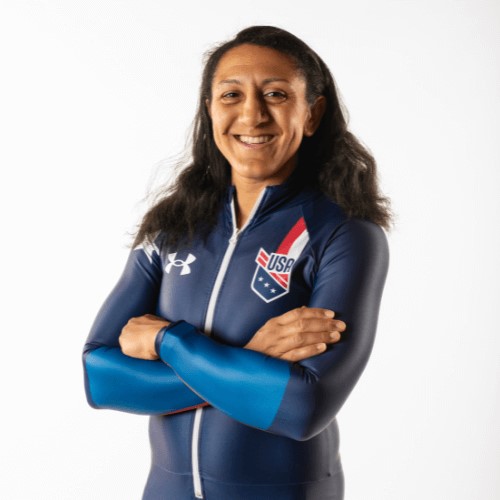
In this episode of the Brain & Life Podcast, co-host Dr. Katy Peters is joined by Elana Meyers Taylor, an accomplished American bobsledder and Olympian. She shares her journey from collegiate softball to becoming a world-renowned bobsledder and her experiences with concussions. Elana also discusses her concussion recovery process and her plans to contribute to concussion research. Dr. Peters is then joined by Dr. Joel Morgenlander, a professor of neurology and orthopedic surgery at Duke University. They discuss concussions in athletes, when it’s safe to return to play, the importance of proper concussion management, and the legal frameworks in place to protect young athletes from severe brain injuries.
Follow and subscribe wherever you get your podcasts!
Apple Podcasts Spotify Libsyn
Additional Resources
- New Brain & Life Book Explores Concussion
- How Sports Neurologists Protect Football Players’ Brains
- Concussion Symptoms Checklist
Other Brain & Life Episodes on this Topic
- U.S. Soccer Legend Briana Scurry on Concussion and Mental Health
- Advocacy and Athleticism with the Pittsburgh Steeler’s Cam Heyward
Follow us!
- Guest: Elana Meyers Taylor @ElanaMeyersTaylor; Dr. Joel Morgenlander @DukeHealth
- Hosts: Dr. Daniel Correa @NeuroDrCorrea; Dr. Katy Peters @KatyPetersMDPhD
- X: @BrainandLifeMag
- Instagram: @BrainandLifeMag
- Facebook: Brain & Life Magazine
We want to hear from you!
Have a question or want to hear a topic featured on the Brain & Life Podcast?
Record a voicemail at 612-928-6206, or email us at BLpodcast@brainandlife.org.
Episode Transcript
Dr. Correa:
From the American Academy of Neurology, Dr. Daniel Correa.
Dr. Peters:
And I am Dr. Katy Peters, and this is the Brain & Life Podcast. Daniel, I'm not allowed to sing on this podcast. We've already covered this, but it's getting cold outside. And next, we'll have the winter holiday season. I promise you, that's the only singing I will do. So we're going to have the winter holiday season and then we'll have snow, and I hate snow, but then the Winter Olympics. Daniel, are you excited about winter, but especially the Winter Olympics in Milan?
Dr. Correa:
I love the fall. I love the transition. I get excited about experiencing the change in the weather and the beauty both in the fall and winter, exploring the parks around New York City. But let's also be real. I come from a Caribbean background, so it's a bit of a shock and a shiver at the beginning, but getting outside a little bit each day, I feel that helps me along with a whole variety of layering.
It takes definitely some mental fortitude for that transition. So the winter itself, it can be a little shock to the system, but I do like that variety in the crisp air. I like the snow as long as it's falling. And out there and looks beautiful and it's there to enjoy and not the brown sludge that's left behind. I'm admiring of those Winter Olympics athletes regularly getting out there in the cold and snow for their training and the amazing things that they do.
I really love watching really both the Winter and the Summer Olympics, but I'm really looking forward to it. And it seems like over the years, the Winter Olympics has continued to add variety to the types of sports. So I'm looking forward to this one in Milan and hopefully the future ones that come to the United States.
Dr. Peters:
Yeah, I think we should go over to Milan and check it out.
Dr. Correa:
On the site reporting. It's so important.
Dr. Peters:
I think it's so key. We can expand our podcast across the pond, but I enjoy watching all the winter sports, even though I'm snow-phobic, skating, snow skiing, curling. I actually have tried curling. Actually it's a great... I'll link the curling club of the Triangle here in North Carolina.
And if you can believe it's a great team building exercise because it's really a team sport. So I would say check out curling. It's much more challenging than you think. You have to be very flexible. Lots of lunging. I've done sledding down a hill in my backyard, but I've never tried bobsledding. Daniel, what are your favorite winter sports?
Dr. Correa:
Well, when it's still possible, I like to run in the winter, even if it takes some winter trail shoes, or make a transition to hiking. A few years ago, and I've been able to go several times, I got to go snowshoeing after there was fresh snow on a hiking trail. Whenever I can get up to Upstate New York, I'd love to do that.
It's such a cool experience, and it changes how you're seeing the forest and the space around you. And I've always wanted to try out cross-country skiing. Just don't really have the tools and haven't really been with someone who knows how. So it's on my list. The downhill ski sports, love watching them. So cool. It makes my knee ache just as I think about it.
Dr. Peters:
Yes, I agree with you. I agree with you. So today we're going to start off our Winter Olympic fever with Elana Meyers Taylor. She's an American Olympic bobsledder and world champion, and she will tell us about the Olympics and bobsledding and share her history with a pretty serious concussion and how she recovered and got back to bobsledding, which is just amazing. And I just want to say, shout out to her. She is going to be heading to Milan as a member of that US Olympic Team.
Dr. Correa:
Wow!
Dr. Peters:
Yay! Good luck to her. And so then we will also talk to one of my favorite team members in neurology at Duke, my home institution, Dr. Joel Morgenlander, who is a big sports fan and expert in sports neurology and concussion.
Hello, Brain & Life Podcast audience, and I am over the moon today to have our guest. And I guess I would say I'm also down a slope through on a bobsled. No, I'm not on a bobsled, but our guest is Elana Meyers Taylor. She's an American bobsledder, American Olympian and world champion. She's won countless accolades as a bobsledder. If you can believe it, her sports career started in softball and she played collegiate softball at George Washington University.
She's here today to tell us all about bobsledding. Maybe we'll learn about the Olympics. It's in Milan. And she also had a concussion, so she's going to talk about that also. So welcome to our Brain & Life podcast, Elana.
Elana Meyers Taylor:
Thanks. Thanks for having me.
Dr. Peters:
Absolutely. So I gave a short introduction about yourself. Can you tell us more and where you're joining us from today?
Elana Meyers Taylor:
Yeah, so I am originally from Douglasville, Georgia. Grew up in Georgia, spent most of my life in Georgia. And then, of course, went to Washington, DC to play collegiate softball at George Washington University. I played there for four years, majored in exercise science with the full intention of just being a softball coach. That was what I was going to do for the rest of my life. I was going to play professional softball, go to the Olympics in softball, and then be a coach forever, but got at other plans.
And so I had an Olympic tryout, got to that stage at least and played professionally and had Olympic tryout for softball, but had the worst tryout in the history of tryouts. It was so terrible, so bad. But everything happens for a reason. Out of that, because I didn't make the Olympic softball team, I still wanted to be Olympian, and my parents had actually seen bobsled on TV and said, "Hey, this is a cool sport. They seem to convert athletes from other sports. Why don't you try this one?"
I was like, "Sure, why not?" I just Googled it, emailed a coach and got invited to Lake Placid, New York, and I've been bobsledding now for almost 20 years. I think we're on year 19 this year. And yeah, it's been an incredible journey. Been blessed to win five Olympic medals. And now I'm doing this full-time, and I have two kids on tow that I take with me. So it's kind of chaos, and we decided to go ahead and give it one last go at this Olympics.
Maybe one last go. My husband thinks I could go longer, but we'll see. So definitely one more try at this game to try and finally win that gold medal. Five medals I have, three silver and two bronze. Not quite yet a gold. So if I got one more opportunity, if I'm healthy and fit and strong, l'd say, "Why not? Let's go."
Dr. Peters:
Oh, we'll all be behind you. We want you to get any kind of medal. Love for it to be gold. And shout out to... It's Douglasville, Georgia. I know Douglasville, Georgia. I'm from Tennessee originally, so just one state above, so I know all about that nick of the woods. That's so amazing that you were able to switch sports. What was that transition like? It sounds like you checked it out and saw that other people were doing the same thing, but you were high level collegiate softball to go to bobsledding. Tell me how that happened.
Elana Meyers Taylor:
It was pretty humbling, but at the same time, it was at a point in my life where I was humbled anyways when you crash out of an Olympic softball tryout. And you feel like your dreams are over because they took softball out of the Olympics at that point, so I knew that was not going to be a pathway for me. So I was just went into bobsled eyes wide open and willing to learn and just was willing to absorb everything I could.
And that's exactly what I had to do because I knew nothing about it. So here I go from being the top of my sport and now I'm at the very, very bottom and having to learn everything from scratch. But fortunately, bobsled is used to... That's what we do. We take athletes usually at a collegiate sport and convert them into bobsledders. I mean, Cool Runnings is a movie for a reason.
I mean, that's how it actually happens. We take people in other sports and convert them. So a lot of track and field athletes, a lot of Southern state athletes and things like that and teach them how to bobsled. So for me, coming off a softball, it's not the natural transition. Most people come from track and field or football or things like that. So I had a lot to learn, but my biggest bonus was that I was a team sport athlete and in bobsled.
In women's bobsled now we have the monobob, which is one person in the sled driving and pushing, and then we have two-man, which is two people on a sled. So the two-man is definitely a team sport. And fortunately, I have the background from team sports to know how to handle all those different dynamics. So like I said, it was a very humbling experience to start bobsled and get into it, but it's been a pleasure and a privilege to be able to represent the US.
Dr. Peters:
Oh, wonderful. And so can you tell us more about what do you do in bobsledding? Because you mentioned there's I guess a one person capsule or sled and a two person sled. Tell us about what the positions are and what it takes to be a bobsledder.
Elana Meyers Taylor:
So my first Olympics, I was a brakeman, which is the person in the back of the sled. Now, they're primarily concerned with the push aspect, although the pilot, the driver, pushes as well. So I started off as a brakeman in the back. Basically you run for about 30 meters, push the sled, and then hop in the sled. And then after that, you keep yourself in a low aerodynamic position. Basically your head are between your knees and you can't see anything.
So your job in the back was just to kind of be dead weight and hang on, not too loose so the sled's flopping around, but not too stiff so it's hard to drive or anything like that. But basically you stay in that low aerodynamic position. And then after you cross the finish line, then you pull the brakes. Now I'm the pilot. I converted to being a pilot in 2010 right after the Vancouver Olympics and got in the front seat, and now I'm actually piloting these sleds.
So most people think we just lean left and right. Actually leaning could cause you to crash. So I am actually piloting the sled. It works like off a pulley system. If you want to go left, you pull what we call a D-ring steering system, you pull your left D-ring towards you. If you want to go right, you pull your right D-ring towards you. And it's a back and forth pulley motion that moves our blades left and right.
Blades are called runners. So you are actually piloting the sled. So every pilot in the world has almost every track in the world memorized, and you memorize as much as you can in order to try and get down the hill as safely and as fast as possible.
Dr. Peters:
And what is the track going to be like in Milan?
Elana Meyers Taylor:
So they just built the track of Milan. It opened for the first time last March. They had pilots going down the first time. I, unfortunately, didn't get to go to that trip, but they had a couple of pilots test it out. So we will see November 4th we head over there to try and get on that track for the first time because we haven't. Other than the video from those test runs, we haven't really seen much of it.
Dr. Peters:
It must be really important to go out there and actually see it and know what it's like. Does it make a big difference about the weather conditions? Because when I think of softball, I think of I guess more nicer weather, warmer, but you're now in the snow and the ice.
Elana Meyers Taylor:
So I hate the cold, number one.
Dr. Peters:
I do too.
Elana Meyers Taylor:
But you do what you got to do for what you love, right? But in terms of the weather in terms of sport, it makes a huge difference. And bobsled is a sport of hundredths of a second. I've lost out on a gold medal by 0.07 of a second, hundredths, seven-hundredths of a second. Over four combined runs total time, over four miles of driving down the ice, I lost out by seven-hundredths of a second, which is a tiny, tiny margin.
So weather plays a huge deal in it. We don't have to have snow or anything, we just need cold enough to have the ice. Every track in the world is different, but basically it's a cement outlay and they put ice on top of it. So it needs to be pretty cold temperatures in order to keep ice on the track. And when you see a bobsled race, one of the biggest things that you may not see is sometimes you'll see two sleds that look like they had identical runs.
And they might've had almost exactly identical runs, but one is dramatically slower or faster. And that's all about choosing the right equipment. So we try to make weather predictions and try to figure out what's the best equipment for that day. But at the end of the day, it's kind of all a guess because you don't know what the weather is actually going to be like on race day.
You're like checking, holding up umbrellas and stuff and trying to figure out, but you don't really know. So it's part sport, that physicality of pushing and running and jumping in the sled, also that part, driving the tracks and like NASCAR, driving down a track and driving this vehicle, but then another part of it is just choosing the right equipment and having the fastest equipment and doing whatever you can to control those things.
Dr. Peters:
And how fast are you actually going? What are you aiming for?
Elana Meyers Taylor:
So we go anywhere from 75 to a hundred miles per hour, and every track in the world is different. So you'll hit different speeds on every track. Right now, I think the predicted speed on the Cortina track, I think it's around 130 kilometers per hour. Sorry, I can't do the conversion right now, but it's around 130. But the guess is that we'll be going faster. I know 140 kilometers per hour is around 90 miles per hour, so that's more of the guess of what I really think we'll be going.
Dr. Peters:
See, I'm almost speechless because I can't believe you're going that fast. I don't even get my car that fast. I can't even imagine. That just is just amazing. Now, you talked about the Olympic, what it meant to be an Olympian, and you weren't able to go as softball, but you were able to go bobsled. What is that Olympic experience and why is that so important to you?
Elana Meyers Taylor:
Oh man, I come from a military family, so it was always important to represent your country and to serve your country in any way you can. Unfortunately, the military wasn't for me. I thought about going to military academy, but my dad and my uncle and my aunt, they went to Naval Academy. And Naval Academy doesn't have a softball team. So if you come from a lineage of Naval Academy grads, you don't go to Army.
And Army was the only school with the team, so that was not going to happen. So after that, it didn't quite work out. Then I was like, well, I want to find another way to serve my country in any way I can. And if I could do it as an Olympian, I felt like that was something really cool and something I could do to represent all Americans and things like that. And that's how I truly feel is putting on that USA, you really are representing all Americans.
You really are going out there and winning a medal for your country. And when I go places and I have my medals, I like to tell people, I was like, "I didn't win these medals in isolation. I did this with all the people cheering back home, all my fans, all my friends, all my family, everyone who supported me along the journey." And people don't even realize they're supporting me when they type a message on Instagram or they type a little quote on X for me or something like that, they don't realize that it really does go a long way to support us.
Dr. Peters:
Well, that's amazing. I will totally be supporting you. I'm a huge fan. Whenever I see the opening ceremonies and all the events, I'm glued to the TV. I'm cheering people on. And I'm scared of snow, but I will watch the Winter Olympics. Now, in 2014, it was January 2014, you suffered a concussion while racing. Can you tell our listeners about what happened?
Elana Meyers Taylor:
Yeah. In that particular race, so I was having a pretty stellar year. Our equipment was running well. I was pushing really well. Everything was going really well. And so it was a track. And during our World Cup races, our normal regular season World Cup races, we have two runs. So it's two runs, total combined time. And so my first run, I broke the track record, which is the fastest time ever down by over a second, which is astronomical.
That is huge. That is a lot faster than anybody's ever gone on that track. So came down, broke the track record, so we were moving really fast. It was a night race too. And I don't have the best vision, so I have a harder time with night races in general, which, fun fact, most of the Olympic races are at night. So just with the artificial lighting and things like that, I have a hard time.
However, this race was at night and we were going faster than ever. And I just came out of one of the major curves and made a slight mistake. It was the equivalent of I should have squeezed my hand a little bit more. That's how slight our steering is. If I would've squeezed my hand a little more, I would've been completely fine. But I missed a steer basically and came out.
And the sled tipped over and I landed head first right into a curve, smashed my head into a curve. The sled then whipped back up. And I think it really was this action of the sled whipping back up that really caused the severity of the concussion. So I got out of the sled. And when I got to the bottom of the sled, the sled was upright. We were in the lead of the race. And even with a crash, we still managed to finish six.
That's how fast we were going, which is kind of incredible. But I got to the bottom of the sled and the lights were too bright. Everything was just overstimulating. And I was nauseous and I was like, I have to go now. I have to leave now. So top six usually is a podium finish, so you have to go on a podium and there's all this ceremonial stuff you had to do, but I had to leave immediately and I knew something was wrong right then.
And it wasn't the first concussion I had had. I had had concussions in softball and things like that, but it definitely turned out to be the most severe, one of the most severe. I've had another one since then that was pretty severe. But yeah, that was of the worst ones.
Dr. Peters:
Oh, I'm so sorry. You said that you had to go right then. Did you have, I guess, team doctors or people that were attending to you? How did that all happen?
Elana Meyers Taylor:
We actually didn't have any team doctors with us, but we did have... One of the German doctors had come to our hotel and saw me and things like that. So the German team was gracious enough to lend their doctor to come check me out and things like that. And back at then, there was still the protocols like, hey, sit in a quiet room and do nothing, don't fall asleep, all those kinds of things that everybody was telling me.
Make sure you just drink plenty of water. So I'm just drinking water, trying to stay awake, even though I am just crazy tired. I just want to go to sleep. And then eventually I would... The next week I'd have the CT scan, I'd have MRI, and all this kind of stuff like that. But initially right after, they were just really trying to make sure. It didn't show signs that I needed to go to ER right away.
Dr. Peters:
Okay. You mentioned that you had a CT a while after and then got an MRI. Did they show anything? What did they do to follow up with you?
Elana Meyers Taylor:
The next week I had a CT and MRI. And unfortunately, for our sport at the time, the protocol was like, hey, if you say you're all right, then you can go back to sport. We had an impact test and we had a SCAT test. But in all my years, I've never failed a SCAT test, I've never failed the impact test, which is crazy because I've had pretty legit concussions and never failed, never shown any decline on those measures.
So those measures just haven't been successful in picking me up. So I pass all that. And of course, in my concussed state of mind, I was set and as an athlete you kind of get in these mindsets that I'm going to decide I'm going to compete. I'm world lead right now. I can't afford to not keep competing. This is the first time I've had this kind of season that I'm world leading. I need to keep going. So of course, the decision was up to me, so I kept racing and that was a terrible idea.
I definitely shouldn't have done that. But at the same time, the measures they had at the time all showed that I was fine. But I think people who knew me knew I wasn't all right. My teammates knew I wasn't all right. The light sensitivity, the sensitivity to noise, it got so bad that I couldn't be in the same car with some of my teammates because the pitch of their voice was so rough for me and I was getting headaches and things like that.
That I had to ride in a truck with the coaches and do different things like that. So there should have been warning signs that, hey, maybe she shouldn't be in the sled. But not only did I pass the impact test and I passed the SCAT exams and everything like that, but also I kept winning. So that was a confusing part to everybody. I have these symptoms off the ice, but I'm still winning. I'm still cognizant enough to race really well. So what is going on? Like I said, in my state, I was determined to keep going, to keep sliding, but I wasn't in the right mind to really be making those decisions in retrospect.
Dr. Peters:
And you mentioned that you had light sensitivity and sound sensitivity and also some headaches. Can you talk more about that? What was a day-to-day like with your symptoms after the concussions?
Elana Meyers Taylor:
So day to day, the light sensitivity was probably the worst. Lots of wearing sunglasses, lots of low lights indoors when... I'm in my room right now or whatever. I would never have the light on full blast. I'd always use a dimmer or things like that. Ever since then, I've always had to use a dimmer on my computer screens too. And some of that kind of stuff I didn't really... A blue light blocker and things like that, some of that stuff I didn't really realize until later.
The light sensitivity to computers I didn't realize until later that summer I had an internship and I was just having a really hard time just sitting at the computer. And I thought, maybe it's just because I'm an athlete, I can't sit all day, or whatever. And no, it turns out it was just the light of the computer, the actual blue light. So once I got a filter, I was absolutely fine and things like that.
But yeah, so keeping the lights dim and trying to manage some of that kind of stuff to prevent the headaches. And then as far as sound sensitivity, it was removing certain sounds and, unfortunately, not being around certain people whose tone of voice was problematic for me and causing those headaches and stuff. There's a lot of sleeping, a lot of just trying to relax and trying to get away from everything.
Dr. Peters:
How long did it take you to have a recovery period? It's hard to stay away from people, especially with their teammates or maybe it's a loved one. How did you reconcile that?
Elana Meyers Taylor:
So I think the hardest thing was that I was... Like I said, I was winning races. I was passing all those SCATs, impact, everything like that. So realistically, my symptoms went on for quite a while, all the way until the next season. So I actually won a world championship that season. So of course, everybody comes off and thinks, "Oh, she's just fine. She's won a world championship. How could there be any problem?"
Finished the season number one overall, won a world championship, one of my best seasons ever. So people weren't really realizing. And then as I mentioned earlier, then I had that internship and was having serious problems, and then things continued and went downhill. One of the things that really happened with me was the mood changes. I'm usually a pretty calm, easygoing person.
And then all of a sudden, I would just start flipping out on people and just have these mood swings that were just wild. Closest thing I was compared to is pregnancy mood swings. Now that I've experienced that, that's what it was like, but I wasn't pregnant, definitely wasn't pregnant. So what ended up happening is I went through the summer, did the internship, and then it wasn't until that next season I start sliding again, and then those symptoms started getting worse and worse and worse. And it got so bad is that it was in a race and I actually blacked out on a curve.
Dr. Peters:
Oh no!
Elana Meyers Taylor:
And at that point, my coaches pulled me off the tour and said, "Hey, enough is enough. We're not going to allow you to do this anymore." And that's when I got pulled off the tour and then I started rehab and therapy at that point.
Dr. Peters:
Okay. And what did you do for rehab and therapy?
Elana Meyers Taylor:
I don't even know if it still exists anymore. I went to the Carrick Institute, and they really did some different things, some visual things, some spatial awareness things. First of all, part of it was also really working on my nutrition and really making sure I was fueling myself adequately. As athletes, a lot of times, especially when you're traveling and things like that, you're just getting on the go and grab what you can and keep it moving.
As much as we want to be as healthy as possible, sometimes just the practicality of going from Switzerland to Germany, you stop at a rest stop and you've got a nine-hour drive and you're just eating whatever's there. And sometimes it's McDonald's. And you're often at a calorie depletion. You're not fueling yourself. And for me too, I'm also in this system where I have to lose weight a lot. So bobsled is a weight controlled sport, so I have to make certain weight.
And I'm naturally a pretty big athlete, so I have to drop weight constantly. And so what that was also doing is depriving my brain of glucose, which is about the worst thing you could do when you have a concussion. Just all these different types of things, high protein, low carbs, things like that were just terrible for any type of recovery. So part of it was just rehydrating and getting back to a state where my brain had the proper fuel.
So really looking at nutrition differently, looking at nutrition as far as brain health, but not necessarily what's going to allow me to lose weight to make this race. So taking the time off of tour to take back and step back and do those things. Also addressing the light sensitivity, the sound sensitivity, and doing different things like that, really working on it, making sure all my nerves were functioning and my nerves were working properly, like vagus nerve stimulation and things like that to really just try and get my body back in balance because everything was just wild.
Dr. Peters:
Yeah. So you took that time off. When did you finally get to come back?
Elana Meyers Taylor:
I took off in about November and I came back to sliding in January in a very, very slow controlled pace. I came back to probably one of the or definitely the smoothest track in the world. We have one track in Switzerland that is on all natural snow and ice. It's built out of snow and ice every year, so it's the smoothest track in the world. So they made sure, my coaches made sure when I came back, I came back to that track.
And if I could handle that track, then they would ease me up to more and more difficult tracks. So they didn't want to start me off that way. And it helped that season two World Championships was in Igls, Austria, which is probably one of the easiest tracks in the world. If I sent you down there right now, if I put you in a bobsled off the top of Igls, you'd get pretty close to making it down.
You might even make it fully down. You'd do pretty good. So that's where World Championships was. So I really was on a program where it was a lot easier of a transition back into sport. And it was kind of like, okay, we don't have any expectations. We're just going to see how you do. And I did well from handling it. My symptoms didn't return in St. Moritz, and then they let me keep progressing throughout the season.
Dr. Peters:
So are there any things in place now to... Because you mentioned you had other concussions. This was probably the most severe one, it sounds like. Are there things that are put in place, guide rails or anything, to help prevent it? Because I mean, ultimately we don't want this to happen at all, right?
Elana Meyers Taylor:
Yeah, yeah. That's a difficult question. There's not much in terms of prevention. I mean, there's always we have our helmets. They have to be DOT certified and things like that. But if anything, our sport has gotten faster. So the sleds have gotten faster, equipment's gotten faster. We're going faster down the track. So in every bobsled ride there's a little bit of vibration, so you're hitting your head a little bit as you go down the track. There's vibrations. There's snow ice and all this kind of stuff.
So I can't say that the sport has gotten much safer. They are testing out some different mouth guards and some different things like that to see if they can have an impact and to kind of try and measure what the forces going through down the track are, what it really is like. But in terms of that, they've added rules where you can add a little bit of padding to your sled and things like that, but nothing to really make it dramatically safer.
I think what they've really started to implement is even like an impact test didn't used to be worldwide requirement. It just was a US thing that we did to make sure our sliders were okay, but now it's a worldwide requirement. You have to take it, and you have to take it before you return to play and things like that. For me, I think the alarming thing was always that I always pass those SCAT.
And any outcome, any physical tests I had always passed. So for me, it's really now about self-reporting. So for me, I understand what's at risk. I understand what could happen. So for me, if I find myself in this situation, it's about taking myself out of the sled. And it's also about taking myself out of the sled before those things happen. It's also about not getting in a sled if I'm not fully mentally prepared.
I think as a younger athlete especially, you just go because you're told to go and you take as many runs as possible and all these types of things, but now I know better. I know that I have to be mentally sharp to make sure I'm prepared. Because if you make a mistake, it could be really bad. So you just try to make sure you're not put in those positions anymore.
Dr. Peters:
That's such good advice. I'm sure that's what you would advise others, right?
Elana Meyers Taylor:
Mm-hmm. Definitely.
Dr. Peters:
To take a step back. Now, you plan to donate your brain to concussion research. I read that somewhere. Is that true and could you share your thoughts on that?
Elana Meyers Taylor:
Yes. I know from the Concussion Legacy Foundation, there's not nearly enough donations of female brains, and women tend to have more concussions, tend to have more incidents of concussions and things like that. So I think it's really important to do genderized studies. As much as it's great that we're able to study more and more brains, most of the brains that go to the Legacy Foundation and then go to Pittsburgh and everything are male brains and are football players.
So I think it's important to have a vast array of sports. And especially in sports like soccer, which I played too growing up, where you do have a high incidence of concussions, and I think it's important to understand, does estrogen affect it? Does the different skull structures of females affect it? What affects it? What's different between men and women, why the incidence is so high? And maybe you know. I don't know all the answers. I just was like, if I could do anything to help those people coming after me, I want to help.
Dr. Peters:
I know there's many, many projects that are happening not just with athletes, but also in the military. And you mentioned the military before. And again, that's been enriched mostly with really male brains to study that or male individuals. And so I completely agree with you. We're learning more day by day. So I just want to thank you so much for sharing all this with us. It was Elana Meyers Taylor. Congratulations, Olympic extraordinaire, bobsledder extraordinaire, and thank you so much for joining us on the podcast.
Elana Meyers Taylor:
Thanks for having me. It was great talking with you.
Dr. Correa:
The American Brain Foundation is the American Academy of Neurology's philanthropic partner. To learn more about how you can help make a difference, please visit AmericanBrainFoundation.org. The American Brain Foundation believes that when we cure one disease, we will cure many.
Dr. Peters:
We're here once again, Brain & Life Podcast audience, to talk to our wonderful neurology experts. I want to thank, first of all, for all of our listeners for joining us today. I am Dr. Katy Peters, your podcast co-host. And today we're really going to delve into concussion, and I'm just delighted to have our medical expert, Dr. Joel Morgenlander. He's a professor of neurology and orthopedic surgery at Duke University Medical Center.
He graduated from the University of Pittsburgh Medical School, and then came to Duke in 1987 as a neurology resident and he has never left. And we are happy he's here. His clinical interest center around the diagnosis and treatment of disorders in general neurology, whether it's outpatient or inpatient, and he has a special interest also in sports neurology and concussion and also educating us all about neurology. Dr. Morgenlander, welcome to the Brain & Life Podcast.
Dr. Morgenlander:
Thanks for having me, Katy.
Dr. Peters:
Absolutely. So I gave a little, tiny introduction about you. Can you tell us a little bit more about yourself and where you're joining us from today?
Dr. Morgenlander:
I'm in Durham, North Carolina at Duke, and I've enjoyed having my practice here all these years, enjoyed my colleagues and the folks we get to train, and most importantly, our patients that we're caring for. I'm happy to be able to talk to you a little bit about concussion and how it affects people and some of the challenges that they face when they've had a concussion.
Dr. Peters:
Yeah. Thank you so much. If you had to define a concussion, exactly what is it?
Dr. Morgenlander:
Concussion is a traumatic brain injury. I think a lot of people get confused because you hear the word traumatic brain injury and you think about skull fractures and maybe more serious injuries, but a concussion is a mild traumatic brain injury. So some type of trauma befalls the patient and it causes disruption of different circuits in the brain. And also there are chemicals and cells in between cells that are supposed to be in certain spaces and the mechanical effects of the trauma cause some of those electrolytes to end up in the wrong place and that causes symptoms.
I think a lot of people get confused thinking that there's some special scan that's going to diagnose the concussion. The concussion is a clinical diagnosis, meaning a provider takes your history and examines you and decides that that's the most likely diagnosis. And you can't see a concussion on a scan because it's a mild cellular effect that's beyond the resolution of the scans. So I think a lot of folks get kind of confused about that. In general, with a mild concussion, we would expect that scans would be normal.
Sometimes if you get a concussion and you end up in the emergency room, the provider may get particularly a CT scan because they want to make sure you don't have any bleeding around the brain or bleeding in the brain or skull fracture, and that's just to protect you from consequences of that type of injury. But more often than not, that scan will be normal and then you'll go on to trying to face the treatment of what your symptoms have resulted in.
Dr. Peters:
Are there different levels of concussion? Is there a severity scale?
Dr. Morgenlander:
Well, people use the Glasgow Coma Scale as a severity scale. Mild concussion is a score of 13 to 15, where 15 is basically normal. But I think for most of the viewers that are going to have a fall or a sports accident or a motor vehicle accident where they have a concussion, they're going to have a bunch of symptoms. They might show up in urgent care or in the emergency room if it's moderately severe, but they're usually going to go home that same day and face the management of those symptoms as an outpatient.
Dr. Peters:
And what are the typical signs and symptoms of a concussion?
Dr. Morgenlander:
One of the things that happens because there's so many areas of the brain that can be affected is it can lead to quite a long list of different symptoms for people. So in each person, the type of symptoms that they struggle with may be different. And also, there are certain factors that can predict that you may have more trouble with certain symptoms. So that people that have pre-concussion history of migraine may have more headaches.
People that have pre-concussion symptoms of depression or anxiety may have more depression and anxiety symptoms afterwards. People with a history of attention deficit disorder may have more trouble attending to things. And so we always ask about some of these factors to know whether that was in the patient's past medical history to help us predict what things might linger the longest or get stirred up by the concussion. But headache is really common.
Headache can be very much like migraine with nausea and light and sound sensitivity. Dizziness is really common. People feel very off balance. Occasionally with the head trauma, you can shake those little crystals loose in your inner ear and get benign positional vertigo and have vertigo spells particularly when you roll over in bed or with head movement that are treated in a different way with vestibular therapy.
Cognitive symptoms are very difficult for some patients. Our society values multitasking so much, but multitasking is the enemy of neurologic brain disease. We want people to be able to do one thing and concentrate on it and do it well. And if you really need to multitask for your work or for school, having concussion symptoms are really going to get in the way with that. People have trouble with their eye movement sometimes and eye sensitivity.
If you think about it, when you read, you have to kind of bring your eyes inward to focus on a target in front of you. We call that convergence. And that's an eye movement that's commonly affected with concussion and can make it very hard for people to read or look at screens or so. Based on computers now, if you do a lot of your work on a computer, both the light from the computer and having to bring your eyes in to read on a computer is going to be difficult. As I mentioned, some patients will have anxiety or depression that gets flared up.
Occasionally, depending on what the event is, it can be a lot of fear. For instance, if you were in a car accident that came out of the blue, sometimes it's hard to get back in a car because you get very frightful of having another accident. And if that doesn't calm down over time, sometimes you need some psychology support to get over that. And obviously particularly with the car injuries and the falls, people end up with a lot of whiplash-type problems and get musculoskeletal pain in their neck, and that can be a big part of the pain, neck pain, headache from neck problems.
So we have to assess all these symptoms when we see a patient in clinic and do some exam with that, and then develop a care plan based on the major symptoms and which providers can help us with rehabbing those symptoms, and are there any medicines that might help us with getting the patient feeling better. And then another thing that we work on a lot in clinic is that particularly for patients that have had symptoms for a number of weeks is you kind of get depressed that is this ever going to get better?
And the reality is is the vast majority of concussions are better in two weeks, but it's really a minority of people that are going to go on and have prolonged symptoms for months. And so you have to take it on faith a little bit that everybody gets better at different rates and you have to hunker down and figure out what your treatment plan is and get back to trying to live life as normally as possible. We know that people that stay closed in for a long period of time actually do worse.
When you have a lot of concussion symptoms and really bad headache immediately after the event, it's pretty reasonable to take a couple of days to do basically nothing and just rest. It's an old wives' tale that you have to wake people up from sleep to make sure they're okay. If you have to wake them up from sleep, they ought to be in the hospital. And it's also incorrect to think that if you didn't lose consciousness, you didn't have a concussion. The minority of people actually lose consciousness when they have a concussion.
Dr. Peters:
That's Interesting.
Dr. Morgenlander:
So sometimes losing consciousness suggests to us maybe a little more serious injury or the mechanism might be a little different, but it's definitely not necessary. So I think a lot of people when I see them are really discouraged because they thought it was going to be... Everybody watches ESPN. The football player got a concussion on Sunday and next week they're playing again. That's not always the way it goes. And so you have to put up with it, have a little patience. And the vast majority of cases, it's going to keep getting better.
Dr. Peters:
I think that's really reassuring to our listeners because I think we've heard from people that may have had a prolonged post-concussive syndrome, but I just think it's reassuring that you're saying that it will get better. Most people get better over time. It's a two-week interval to think about something to go for. So I think that's helpful. The next point that I think you brought up that I think is so critical is the monotasking.
Switching from multitasking to monotasking can really help you focus and let your brain heal if you're in that state. Now, you mentioned loss of consciousness. Is there anything that puts you more likely to be in that more severe symptoms, that post-concussive syndrome that could linger on for a long time? Is there something special about those people?
Dr. Morgenlander:
Yeah. Well, first of all, I think there is something special about those people, but a lot of those factors or some of those factors may be genetic factors that we have no way to ascertain. But there are a few things that can so predict somebody's going to have a rockier course. Sometimes people have more than one injury.
So for instance, if you were somebody in a sport and you got hit in your head, a hockey player gets checked into the wall and hits their head there and then falls and hits their head again on the ice, they actually hit their head twice. Sometimes people through the mechanism of their injury have hit their head multiple times. Unfortunately, we've had patients that got attacked and got hit multiple times.
And so it's definitely more in your favor to only hit your head once than to have it hit multiple times. I think the surface that it hits matters. So for instance, if there's even a little bit of carpet on the ground and your head hits it in the fall, you're more likely to do better than if it's a hardwood floor or a cement floor or something like that. Remember your brain's like thick mashed potatoes swimming in a little fluid against a rock, that's your skull.
And so even if your head's moving in a certain way and you don't injure your skull too bad on the outside, that mashed potatoes is going to hit against the inside of the bone and cause changes in your brain. And so some patients haven't even necessarily hit their head. Some patients have had a serious whiplash injury, but yet have some concussive symptoms. So it can be variable.
I think those that didn't really hit their head hard tend to do better. Now, the other thing that we see, and we're careful about this when we take a concussion history, is we try to list out all the concussions the patient has had and we try to get an idea for in general, from the time of their concussion until the time they were back to school, back to work, back to playing their sport, how much time went by.
If they've had seven concussions and no concussion were they out of whatever they did for more than one to two weeks, that suggests, for whatever reason, their brain is able to put up with it and they're probably going to recover fast. If they've had three concussions and every time they have a concussion they're out for two to three months, that would get us more concerned that, for whatever reason, this is a patient that has slow recovery, maybe is more prone to having symptoms.
And that all becomes particularly important when you're trying to counsel athletes about whether they should continue in their sport. So if they have very prolonged recovery, that's a little bit of a red flag that somebody maybe should start thinking about switching up what sport they're participating in because of concussion risk. But those are the kinds of things that we look at that might predict.
Once again, if you had a prior history, for instance, of migraine and then you get a concussion, we see a lot of patients that most of the other concussion symptoms have improved, but their migraine frequency is much increased from their baseline, and it takes a while for that migraine frequency to get back to what the patient felt like before they had the concussion.
So that's the other thing that kind of plays into the recovery. The last thing that, unfortunately, still happens is that some patients are told to continually do nothing for long periods of time, and we know that that worsens their recovery. In fact, there's good evidence that exercise as soon as you can tolerate it hastens recovery. And exercise generally early on for our patients is low-impact exercise. It's walking. It's an elliptical. It's a stationary bike.
Not the sport they were playing, but something to get your heart rate up above baseline several times a week for a half an hour each time or so really does improve patient's recovery. So that's really important. I'd say the other thing that we have to manage both for students who are taking classes as well as people in jobs is we have to much like there's a return to play protocol, there's kind of a return to learn protocol.
You have to give people extra time. A lot of professionals, we have them go back to work part-time at first. We make sure they take small breaks every hour. We make sure they take a real lunch break that's at least a half hour where they don't have to be reading things and doing things. And then we slowly increase it over time to give your brain a chance to recover.
And the thing that also we try to educate our patients about is if you tried to study or you tried to read and it made you dizzy or it gave you a headache, you're not injuring your brain. It's just your brain's telling you it's not back to normal yet, and you're probably not ready to do things as intensely as you were doing them. But those extra activities that sort of increase your symptoms, that's not injuring the person in any way. It's just telling you things aren't quite right to get back to playing speed yet.
Dr. Peters:
You need to reset first before you go in. This is in the setting of... I was talking to Elana Meyers Taylor, who is now an Olympian. She has been an Olympian. She's a bobsledder. She came back to doing her sport after concussion. Are there guidelines about when to return after concussion to a certain sport? Because I see those football players, they get back on the field, or I see other types of sports where people in professional sports are getting back to their activities.
Dr. Morgenlander:
Well, the general guidelines are a little bit, in some ways, rushed because of some things that I'll explain. But the first key to returning to sport is that we have certain questionnaires we use to talk to our patients to make sure we don't forget any of the common symptoms. And the patient basically needs to not have any symptoms to be able to go through the return to play.
Now, if you're a migraineur and once in a while you're getting a headache that's mild, I don't think we're going to be bothered by that. But in general, all your complaints of headache and dizziness and neck pain to some extent and everything else need to be gone before you return. And then for the athletes working with a trainer, each day they advance their activity a little bit and they have to be asked about the same symptoms.
So first, it's very light exercise, like we're talking about, stationary bike or elliptical. And then they'll advance their exercise. And then they'll get to starting to do sports specific activities, which maybe would not be real easy in bobsledding, but sports specific activities. And then going on to practicing the activity, and then going on to actually training, doing the activity that is what you would do in competition and in your return.
So usually it would take at least six days from when you were feeling fine from your symptoms. There are things like if you think about a bobsledder, the technology for things like helmets has improved and it's gotten a lot better. And one of the problems for a lot of our patients is that helmets are expensive. And so helmets are supposed to fit well. If they get damaged, they're supposed to be replaced.
And for instance, many of our high schools don't have a budget that they can invest a lot of money in new helmets for their players all the time.
Dr. Peters:
Oh my gosh!
Dr. Morgenlander:
So for an Olympic athlete, of course, much like if you ride a bike and you nick up your bike helmet, you got to replace it. For an Olympic level athlete, there's great medical support for them. There's actually a neurologist that's a consultant to the Winter Olympic team who's been doing it for quite a long time, who will travel with them to the Olympics, in addition to a big medical team. And they'll evaluate people on site if they have an accident. And it's very tough.
I think from a provider standpoint, it's a little tricky. If a Duke athlete comes to me with a concussion and it's the starting point guard for the basketball team, I'm a Duke fan, I watch Duke Basketball, but it's really important for me to think about my role as physician. And if my decision leads to Duke losing a basketball game, so be it. I mean, my job is to look out for that particular athlete.
And I think it's good for athletes when in doubt to have physicians they can trust so they can get the right advice. Unfortunately, there's a lot of motivation in athletes to get back to their sport. Because for professional athletes, they could lose their position to somebody and have trouble getting it back. For a bobsledder, there's a bobsled team. There's somebody behind them if they get hurt that can take their place. And you don't want to lose your place.
So it's very difficult because not only for athletes, but also for military service folks that are very dedicated to their work. Much of our diagnosis is based on history, which is based on that individual honestly telling us about their symptoms. I mean, when you go to Brain Tumor Clinic to see your patients, Dr. Peters, they're usually telling you the truth about what their symptoms are because they don't really have specific motivation to not tell you the truth.
Whereas when I go to my concussion clinic, if I'm seeing professional athletes or college level athletes or military servicemen that are dedicated to their work, they have an extra incentive to not necessarily be frankly honest with me. And we have discussions about that and why it's important. The most important time for me as a provider with patients and trying to get them to be honest is with high school age athletes.
And the reason for that is is that particularly in adolescence and some in kids, there's a phenomenon called second impact syndrome where an athlete will get a concussion and return to play before they're asymptomatic and really ready to play and can get a second injury that might be mild. That injury can result in swelling of their brain and actually death. And in every state in this country, there's a law that says there's a process that has to happen for that athlete to be approved to go back to playing their sport.
And unfortunately, all those laws are named for young people who have passed away from brain injury. And that's the worst imaginable outcome for any of us. And so we want to do everything we can to prevent that from happening. And that's why we try to explain to our athletes why it's really, really important that they honestly report their symptoms to us.
And in fact, we know there's data to show that athletes that report their symptoms honestly and get the appropriate care in general get back to playing faster than those that hide it. I would say for a patient population, what they need to know is if they get a mild concussion, the first place to start is with your primary care doctor. Because a lot of them are going to get better and they should be able to handle it.
And if they don't feel like they can handle it, they can refer you on. And not everybody needs a scan. If you're feeling pretty good and it's pretty mild, the primary provider can decide about whether you need to go to the emergency room. I would say the things from my standpoint that suggest you need a scan are really, really severe headache, like worst headache of your life. People that are really confused and not acting right.
People that have any kind of weakness or numbness in their body need to be seen. Or clearly, if somebody has a seizure, they need to be seen. And I'd say for your listening audience, don't go to urgent care. Go to the emergency room, because urgent care doesn't have a CT scanner. And so if you're that sick that you need to be evaluated, you need to make sure that the provider that sees you least has the option to get a CT scan.
Or all that time you waited in the urgent care, you're going to end up waiting the same amount of time in the emergency room. You might as well only wait once. What can you do for your loved one when they're home? You can give them Tylenol for headaches. Don't use non-steroidal, ibuprofen, Aleve because those medications can affect bleeding if there's bleeding in the brain. You can use ice packs on the head. You can try to not feed them too much food in case they're nauseated to try to help with the nausea. Ginger ale actually works well for nausea if you don't have medication.
Dr. Peters:
I love ginger ale.
Dr. Morgenlander:
Yeah. And then just based on how they're doing, make a decision if you think you need to go get checked or can wait it out.
Dr. Peters:
Do you have any other tips for those caregivers about both the recovery road, but also encouraging those caregivers to have the patients be honest about their symptoms?
Dr. Morgenlander:
Yeah. I mean, what I do is if somebody's had severe head symptoms, I'll get a head CT. And if they've had really bad neck pain and are having trouble moving their neck, I'll get a cervical CT. Our therapists are our friends and colleagues in this. They're very important for patient's recovery. Not everything is fixed by a pill. So if somebody has a lot of balance problems or dizziness or neck pain, I'll involve our physical therapists.
There are physical therapists that also specialize in vestibular dysfunction for patients that are dizzy. So I'll get them the right physical therapist to be involved. Our occupational therapists are really helpful in helping with that cognitive problem and helping to coach people on how to get back to work or school. In some places that could be a speech therapist.
In some places that could be an occupational therapist. It depends on access and what people are interested in doing. I think it's important to know who your referral net is to help you take care of these patients. Because outside of the prescribing that I can do, I need a lot of help from my therapy colleagues. And in fact, in our concussion clinic, which is mainly an acute concussion clinic, we have a physical therapist there.
So they see me and then they see the therapist in the same day to try to facilitate things getting going, because I know that they're not just going to get better based on what I do. I need partners to help them, and they're really valuable partners in our practice.
Dr. Peters:
It sounds like you need a big team, just like a football team. Well, we're glad that you're on our team and we appreciate your expertise. So Dr. Morgenlander, thank you very much for everything you've shared with us today and all that we've learned on concussion.
Dr. Morgenlander:
Thank you.
Dr. Correa:
Thank you again for joining us today on the Brain & Life Podcast. Follow and subscribe to this podcast so you don't miss our weekly episodes. You can also sign up to receive the Brain & Life Magazine for free at brainandlife.org.
Dr. Peters:
Also, for each episode, you can find out how to connect with our team and our guests along with great resources in our show notes. We love it when we hear your ideas or questions. You can send these in an email to blpodcast@brainandlife.org and leave us a message at 612-928-6206.
Dr. Correa:
You can also find that information in our show notes, and you can follow Katy and me and the Brain & Life Magazine on many of your preferred social media channels. We're your hosts, Dr. Daniel Correa, connecting with you from New York City and online @NeuroDrCorrea.
Dr. Peters:
And Dr. Katy Peters joining you from Durham, North Carolina and online @KatyPetersMDPhD.
Dr. Correa:
Most importantly, thank you and all of our community members that trust us with their health and everyone living with neurologic conditions.
Dr. Peters:
We hope together we can take steps to better brain health and each thrive with our own abilities every day.
Dr. Correa:
Before you start the next episode, we would appreciate if you could give us five stars and leave a review. This helps others find the Brain & Life Podcast. See you next week.