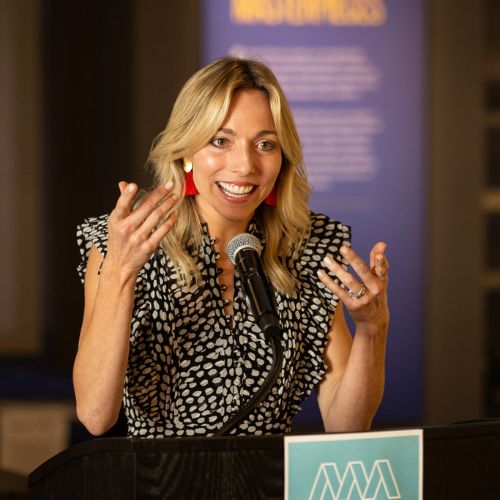
In this episode of the Brain & Life Podcast, host Dr. Daniel Correa is joined by Lilibet Snellings Kyte. Lilibet is an author, speaker, runner, and advocate for people living with multiple sclerosis like herself. Lilibet shares her experiences with getting a diagnosis, reassessing her future plans, and living in the moment. Dr. Correa is then joined by Dr. Riley Bove, an Associate Professor of Neurology at the University of California, San Francisco, neurologist in the UCSF Multiple Sclerosis Center, and a previous guest on the Brain & Life Podcast! Dr. Bove discusses advancements in MS research and family planning considerations for people living with MS.
Follow and subscribe wherever you get your podcasts!
Apple Podcasts Spotify Libsyn
Additional Resources
- Lilibet Snellings Kyte
- Updated Resource: Expert Insights and Practical Tips for Managing Multiple Sclerosis
- How Couples Navigate Multiple Sclerosis
- How Exercise Helps Those with Multiple Sclerosis
Other Brain & Life Episodes on this Topic
- Courtney Platt Dances Through Life with Multiple Sclerosis
- Voices from the Multiple Sclerosis Community
- Advocating for a Multiple Sclerosis Diagnosis with Comedian Kellye Howard
- Colors of Multiple Sclerosis with Artist Lindsey Holcomb
Follow us!
- Guest: Lilibet Snellings Kyte @LeggingItWithLilibet; Dr. Riley Bove @UCFSHealth
- Hosts: Dr. Daniel Correa @NeuroDrCorrea; Dr. Katy Peters @KatyPetersMDPhD
- X: @BrainandLifeMag
- Instagram: @BrainandLifeMag
- Facebook: Brain & Life Magazine
We want to hear from you!
Have a question or want to hear a topic featured on the Brain & Life Podcast?
Record a voicemail at 612-928-6206, or email us at BLpodcast@brainandlife.org.
Episode Transcript
Dr. Daniel Correa:
From the American Academy of Neurology, I'm Dr. Daniel Correa.
Dr. Katy Peters:
And I am Dr. Katy Peters, and this is the Brain & Life Podcast.
Dr. Daniel Correa:
Welcome back or welcome to the Brain & Life Podcast. Katy, this week, I was thinking about this Yogi Bear quote that I always like and just find a chuckle and funny where he says, "When you come to a fork in the road, take it." For me, it's not only just like a cheeky, funny thought, but it represents the opportunities of the twists and turns in our life and continuing to move forward. Have you had any experience for you and in your life where something unexpected or unfortunate direction or surprise ended up actually being a positive future impact or direction for you?
Dr. Katy Peters:
I think this is a great question, and it made me really scratch my head. I was thinking like, "Do I want to reveal something personal or professional?" I like to think I'm a pretty prepared person. I'm a good little soldier. I try to surround myself with good energy and positive people like yourself. So I would say something that was unexpected in my life was actually becoming a co-host with you on this podcast, and it's truly now one of my favorite things that I do. So I wouldn't say it was any way unfortunate, no, not unfortunate, but definitely unexpected, and I'm delighted to be here every week.
Dr. Daniel Correa:
Yeah. I mean, for me, one I reflect on since I work with so many medical students and pathway students that are trying to get to medical school over some time, it's reflecting back and sharing. There was this time during medical school when I scored very poorly on this standardized test that really impacts your steps and direction for medical school, and it felt like the end of the road. I wasn't really sure where my direction would be after that. But as I reevaluated and prepared myself to redo the assessment, it ended up opening doors to learn about myself, see a therapist, learn about my own anxieties that I encountered when preparing for tests or even sitting down to take them, and it connected me with some of the most important mentors I've had in my life. I can see now that we can never really know our good breaks from our bad ones, and it's how we respond and move forward that seems to define us truly later on in life.
Dr. Katy Peters:
I'm so happy for you that you were able to come through that experience because some people can't. I think now that you mentor students and you can say, "You can get to the next step," that things can get better because med school is really, really hard, and it was very humbling. It was very challenging. My first semester, I did horribly. I could not study the way I studied when I was an undergraduate and bring it to the med school. I had to redo it. I had to put a new way of thinking on it. The next semester after that first semester was neuroscience. I'd never taken neuroscience, and I was absolutely terrified. But it turned out, because I focused on changing how I studied and I had great teachers and great mentors, thank you, Dr. Baris, I fell in love with neuroscience, and hence, I became a neurologist.
Dr. Daniel Correa:
Well, I'm so glad.
Dr. Katy Peters:
Yeah. That's why I'm here.
Dr. Daniel Correa:
In studying and sometimes the idea of even very challenging efforts like med school in some ways pale in comparison to the challenges experienced by many members in our community, but we can always learn from each other. Our guest today, I think, is a unique example of these kinds of roads and challenges. Lilibet Kyte shares with us and in her writings the experiences in her life where both running injuries, cancer, motherhood, and her diagnosis of living with multiple sclerosis has thrown curveballs in her life and how those that she loves and this experience have helped turn into, really, deeply rewarding and unique directions for her life.
I'll have to admit, Lilibet is a runner. She was featured in Running Magazine. She writes about running, so yeah, we also geeked out a little bit about running and movement. I know I come back to that topic often, but make sure you also stay tuned to the second part of the episode where we welcome back Dr. Riley Bove to discuss quality of life and living with multiple sclerosis along with some of the family planning considerations for men and women with MS and all the newest treatments.
Welcome back to the Brain & Life Podcast. Yeah. It's been a bit of a run around today, and I'm almost even catching the wits about myself and my breath. But now, we're going to get to a little bit of a different discussion about running, and so we're welcoming to the podcast, Lilibet Snellings Kyte. She's a writer and author. She has written a book and also... But more importantly than that work, she also is a mother, a family member, a person living with multiple sclerosis. We're just so excited to hear from her about some of the lessons learned about her own path and journey, both with her medical condition, but also throughout her life. Thank you so much, Lilibet, for joining us.
Lilibet Snellings Kyte:
Thank you so much for having me.
Dr. Daniel Correa:
So, before all those other things, maybe even before you define yourself as a writer or before any entrance of the diagnosis of multiple sclerosis, how do you describe who is Lilibet Kyte?
Lilibet Snellings Kyte:
Great question. Let's see. Prior to MS, I was 36 when I was diagnosed, but we'll get to that because we're going to get the backstory first. I grew up on the East Coast. My family is Southern from Georgia, but my brother and I moved to Connecticut when I was six and he was nine and went to high school in the Northeast in Connecticut. Then, I went to undergraduate at the University of Colorado where I ran cross-country and track, and then after college, moved to California, lived in Los Angeles where I ended up getting a master's degree at USC in writing.
But it was a circuitous path, which is actually what my first book is about, all of my various odd jobs in LA in my 20s. It's a collection of humorous essays. I was your stereotypical LA-slash, the writer/waitress/nanny/all the other things. So it's a very funny book, but it is funny now looking back at that book thinking, "Gosh, this is someone who didn't realize how lucky they were," which is actually where my second book starts.
After LA, my husband and I moved to Chicago, and we were living in Chicago, had a two-year-old son. As far as who I was, I was someone who was writing, working on a second book while also trying to sell the first book for TV. I was in the prime of my life, a healthy, happy person who had a two-year-old child. We were in the throes of IVF, desperately trying to have a second child through the miserable miracle that is IVF. So that feeds into my diagnosis because initially, I blamed some of my initial symptoms on IVF. So I could tell you about that.
Dr. Daniel Correa:
Well, I was going to go back to a little bit earlier. I was wondering, leaving University of Colorado and running for the Buffaloes, and then going to LA, did you still, at that point, define yourself as an athlete, as a runner, define yourself by the type of movement and activities you did, or was that not one of the slashes?
Lilibet Snellings Kyte:
Well, it's interesting because being a runner, I mean, movement and running has been central to my identity since before I wore deodorant. I don't don't know if you remember the physical fitness challenge?
Dr. Daniel Correa:
Yeah.
Lilibet Snellings Kyte:
Yeah. So one of the things was running the mile, and in fifth grade, I beat everyone in my class, including all the boys in the mile. It's amazing how that positive reinforcement for a child can really... If someone tells you you're good at running, you believe them. So I then went on in high school to run cross-country and track. I was part of an all-American relay team. I was on New England, and it was really just... It was core to who I was. Running, for me, was like... not just high school and then college, but for most of my adult life, it was like brushing my teeth. It wasn't a matter of if I was going to do it that day. It was just a matter of when.
So, at University of Colorado, I ran cross-country and track, and I was a member of the NCAA Division 1 team that won the national championships my freshman year. Now, to be fair, I was not one of the six women on the team that ran in that race, but I would like to point out that I was on the team. Okay? I was still running every mile with these people, still going stride for stride with... Kara Goucher was my captain. Mark Wetmore was the coach. These are names that don't mean a lot maybe to regular people, but in the distance running community, they're a really big deal, so-
Dr. Daniel Correa:
Yeah, and hey, in the NBA, everybody on the team gets a ring, so.
Lilibet Snellings Kyte:
Correct. Thank you. Exactly. It's an excellent analogy. But unfortunately, I got injured. Nothing really MS-related. I just got stress fractures, and up and down bursitis and tendonitis in my knees, and stress fractures up and down my legs, my shins. I ended up quitting after my freshman year. I just got injured and frustrated, which is something now that I deeply regret because looking back, like everything in life, you just assume that you're always going to be able to keep running.
So I wish, of course, that I had stuck with it because many of the women on my team went on to be Olympians, now run professionally. But anyway, yes, when I moved to LA, I still very much thought of myself as a runner. I continued to do a lot of road races, 5Ks, 10Ks, half-marathons. I only did one marathon. Again, I wish I had done more, but I loved it. So, yeah, running was always... It was always like, "Oh, that's a little much. She's a runner." It was just a huge part of who I was.
Dr. Daniel Correa:
Then, as you move forward from LA to Chicago to different stages of your life, was there something else that you learned to integrate so intentionally into who you were as you had with running all your life?
Lilibet Snellings Kyte:
Well, I think writing really filled that. That was the other strand of the braid is that I was a runner and I was also a writer. So my first book was published when I was 31 years old, which was amazing. It's like a lifelong dream at 31. Again, it was a collection of humorous essays. It's very funny. My producing partners and I are actually shopping it for TV as we speak.
Dr. Daniel Correa:
So, wait. I'm still not sure if you were making the suggestion that 31 was old to be fit in writing your first book or young?
Lilibet Snellings Kyte:
I thought it was young.
Dr. Daniel Correa:
To me, I think it was young, right?
Lilibet Snellings Kyte:
Yeah. Totally. I felt like it was very young. I was really thrilled. So I was doing that. Basically, everything was going according to plan. My boyfriend and I got married. We moved to Chicago. Getting pregnant was through IVF, so that is not easy, but it went as easy as IVF can go as far as one egg retrieval, one transfer, and then baby.
Dr. Daniel Correa:
Oh, wow.
Lilibet Snellings Kyte:
Yes. But then, ha-ha, with second child, it was a number of failed transfers, unfruitful egg retrievals. So I was really... and that sets the stage for where I was when I was diagnosed. I was really in the hell that is IVF for years. I mean, I was on three, four, maybe five years of IVF, trying to have a second child. The first time I noticed something was off was... Actually, I was in New York for a baby shower of all things, and I was walking from my hotel to a friend's apartment in Tribeca. So I was walking from Soho to Tribeca.
I remember thinking, I was like, "Am I walking weird?" I was like, "Something... Am I walking right?" Which is a very weird thought to have because walking is breathing, it's involuntary. But there I was willing myself along going, "Okay. Right foot. Left foot. Right foot. Left foot. This is really weird." I thought it was really strange, but I didn't mention it to anyone. But then, I get back to Chicago, and I start having numbness and tingling in my left leg. Again, I thought that... I just attributed it to, excuse me, to IVF. I figured we had hit a nerve.
I was getting as many as three injections per day, so I just figured we had hit a nerve. But then I started to limp, which, obviously, was a bit more concerning. But even then, I chalked it up to... I thought I had a herniated disc. I just thought it was a slipped disc. I thought it was something ordinary, something orthopedic. I was limping around for a while, probably six weeks before I finally went to the doctor. So long that my friends were actually calling me "Peg Leg." We were making jokes about it because, again, we just assumed it was nothing serious.
Like I said, I was a healthy, fit... someone who took care of herself. MS was the last thing anyone would've ever thought of. So, finally, at the urging of one of my friends... Actually, one of my friends who's a therapist. I have an inordinate amount of friends who are therapists. I like to think it's because I'm drawn to empathetic people, but sometimes I think it's because I like free advice. So, anyway. So one of my friends who's a therapist, she finally... after six weeks of me limping around, she was like, "You know, I think you really should get this checked." So I made an with a sports medicine doctor because, again, I'm just thinking of it like an athlete.
Dr. Daniel Correa:
Yeah.
Lilibet Snellings Kyte:
Before that appointment with the sports medicine doctor, that morning, I actually went for a run because I wanted to gather some information and see how much this limp was affecting my ability to run. The reason that I didn't know that is because I really hadn't been running. I was so consumed with IVF that I just had given up on the rest of life. So I went for a run, and I could not get my left foot off the ground. I could not take one meaningful running stride forward. So I thought that was a bit concerning as well. But again-
Dr. Daniel Correa:
Just a bit.
Lilibet Snellings Kyte:
Just a bit. But what is so wild looking back is that I was so naive to the entire constellation of neurological conditions that this could have been. If I had done even the slightest bit of Googling, it would've sent me straight to my diagnosis, but I didn't, and I just figured, as an athlete, that it was something orthopedic. So I go to the sports medicine doctor, and I'm actually joking with the doctor and his interns or fellows about... They have a framed autographed copy of Runner's World in their lobby, and I'm joking with them that they should have my copy of Runner's World because I was on the cover of Runner's World in June 2012 or something.
So it's all very jokey. These are my people. These are my track dorks, which I say with the highest level of affection and adoration. They look just like the guys that I ran alongside in high school and college. So, anyway, it's all very jokey. I tell them, I say, "I'm numb and tingly on my left side. I've also got this weird limp," and I keep repeating. I'm like, "I'm sure it's just a slipped disc. I'm sure it's a herniated disc."
But then, I mention my hand, and I say to them, I go, "Oh," and I just say it offhandedly. No pun intended, but I say, "Oh, yeah, and my hand. Actually, I can't even open a tube of mascara." I don't know why I thought that would be the reference for a room full of men, but my point in saying that was like it's not like I'm saying I can't open a pickle jar. I couldn't even open a tube of mascara, so like, "Oh, yeah, my left hand is super weak. I can barely open."
With that, all of a sudden, things got real serious, and they started talking amongst themselves quietly and almost like speaking in code. The sports medicine doctor said, "You know, I think in addition to getting a spinal MRI, you should also get a brain MRI just to be safe." So that is the beginning of the journey.
Fortunately, I was able to get in for an MRI that night, which is insane. I know that I'm very lucky. So I got in for an MRI that night, and by lunchtime the next day, a neurologist called with the results to tell me I had MS, which is also a crazy story because the neurologist had an accent, and I thought he was saying... I mean, you have to laugh. I thought he was saying I had scoliosis. So I pick up the phone. The first thing out of his mouth is, "Good news, you don't have a brain tumor." So I'm like, "Great." Then, he says, "You have..." The way he's saying it, it's like multiple sclerosis being smooshed together like one word, I thought he was saying scoliosis, so I'm like, "Scoliosis. Sweet. Can I get off the phone now?"
It's interesting because my friend, who is the therapist, had stopped by, and she was like, "Throw it on speakerphone." Her mother, at the time, was dying of Parkinson's disease, so she was a lot more, sadly, a lot more educated on all this stuff. The doctor says it again, and he says, "Multiple scoliosis." I'm like, "What does that mean? Do I have a lot of scoliosis?" Then, he keeps saying it over and over again, and finally, she says, "Do you mean MS?" It wasn't until he said the letters M and S that I got it and-
Dr. Daniel Correa:
That it registered for you?
Lilibet Snellings Kyte:
Yeah, and that's where the beginning of the rest of my life starts.
Dr. Daniel Correa:
At that point, even as there was discussion about what it is, or later on, reflecting back, did you recall that you had any other previous episodes or anything like attacks where you lost some sort of function or sensation for hours or days?
Lilibet Snellings Kyte:
Yes and no. Looking back, in graduate school at USC, I did end up in the office saying, "My left arm is completely numb and tingly," and I was diagnosed with carpal tunnel. They said, "You're stressed. You're writing your thesis." So was that carpal tunnel, or was that MS?" as far back as college. In college, one time, my left leg stopped working. It was the most bizarre thing in the world, and I ended up getting an MRI. I did have a bulge or a herniated disc, so I think that's what that was. But again, that was an odd situation. Sometimes when I would run, when I'd look down, I would have that lightning bolt sensation that people talk about, but I never thought anything of it. I just thought, "Oh, when you're running, sometimes you look down, and it feels weird."
Dr. Daniel Correa:
It's interesting that in each of these things, your recollection and where it really comes out are on these activities that were so integral to a part of your life. To you, walking felt like the most easy thing you shouldn't have to think about at all. But because you're also so used to movement and running, you had an event you're not sure about with that impacted how your running was in college when running was such an integral part of your life. With writing, even as... writing being a key aspect of your life in grad school, working on your thesis. We all come up with reasons why it's occurring at the time. But it's interesting that in each of these instances, it seems most impacting the thing that you do most of your day.
Lilibet Snellings Kyte:
Yeah. It's true.
Dr. Daniel Correa:
Once you had at least a name from that phone call, what did that mean next for you? I'm thinking you're in Chicago at that time?
Lilibet Snellings Kyte:
Yeah, I'm in Chicago at that time, and I mean, I knew nothing about MS. I knew no one who had it. All I knew was just that it was bad. I remember right after that phone call, Melanie left, my husband came home, and obviously, just the volume of tears. It was so overwhelming. We were so shocked. I remember, at one point, my husband suggested I take a shower, which I thought was a really weird suggestion, but it ended up being exactly what I needed some time by myself to fall apart with no one watching.
I remember standing in the shower wondering like... First of all, I was literally out loud repeating, "This is not real. This is not happening." I was punching myself. Really, I was like, "Am I awake? What..." It was so surreal, and then I remember, of course, thinking like I just... Your mind immediately goes to wheelchairs. Your mind goes to, "How am I going to take care of my son who's taking a nap right down the hall?" Of course, my mind went to, "Am I ever going to run again?" So, in my first meeting with my first neurologist, which was a few days later, of course, that was one of my first questions, and he said, "It's not likely." But fortunately, through medicine and physical therapy, I got an Ocrevus, the disease-modifying therapy that many people are on.
After an Ocrevus infusion, after a five-day course of IV steroids, and then a tremendous amount of physical therapy, mental therapy, diet, and lifestyle modifications, acupuncture, we're throwing everything at the problem, I was... About six months later, I was able to run again, which was incredible. So I was able to run again, and then I was even able to race again. I was racing 5 and 10Ks with MS, which was absolutely thrilling. Again, which seems to be the theme in my life, I wish I had known how lucky I was because I think I naively... I felt so good my first four years with MS. I mean, I just had my seven-year anniversary. I felt so good with my first four years of MS, I naively assumed it would always stay that way.
I was running. I really, looking back, had almost absolutely no symptoms, and that's no longer the case. My running slowly declined. At one point, early on, I could run 5 miles without having any kind of foot drop or wonky feeling. Then, that number became three over the years. Then, that number became one. Then, it became like I could run three quarters of a mile, walk a quarter mile, and I would do that over and over again for three miles.
Now, if I'm being perfectly honest, I really can't run. I mean, I can do short spurts on the treadmill, and through the physical therapy hospital where I go here, Sheltering Arms, which is so amazing, they have some great pieces of equipment, like a zero-gravity treadmill that inflates, and lifts you up, and holds you up so you can get the sensation of running without the fear of falling. So I do that, but no. I mean, sadly, I refer to it as a season. I'm like, "I'm in a season of not being able to run because I'm still hopeful that that might change, but I'm also not naive to the fact that it might not," because this disease is unpredictable, and it's progressive no matter what type you have, really, to some degree.
Dr. Daniel Correa:
Are there other movements and exercise activities that you have incorporated where running hasn't fit well for where your movement and physical abilities are right now?
Lilibet Snellings Kyte:
Totally. I'm really embracing yoga, which I love. I actually used to make fun of yoga when I was a distance athlete. I do not anymore. I love it. I take back everything I ever said. Yoga, a lot of stretching. I used to try to attack even my MS like an athlete with more traditional orthopedic physical therapy. Now, I've really embraced a more functional approach doing really simple functional PT that... like marches and hamstring curls, box step-ups, things to... because stairs can be hard for me. So, basically, doing the exercise that mimics the actual real-world activity. I used to think, "Oh, that's not a real workout," and I would brush aside. Now, I really understand how vitally important those really micro movements can be for improving your movement with MS.
Dr. Daniel Correa:
In a way, all these parts of movements that you're working on, and exercise, and activities are, in their own way, a redefinition of your running, and hopefully, you're able to get back to some of... or at least redefine maybe some of the pacing and the type of what that running activity looks like so that you can get back to it.
Lilibet Snellings Kyte:
Yeah, and I think also a huge part of this, a huge part of living with chronic disease is acceptance, of course. With chronic disease, acceptance is a moving target. You have to accept and then re-accept over and over again forever because I would accept my new normal, "Okay. I can do this, but I can't do that. I used to be able to run, but now I can't run. I used to never limp, but now I limp." So it's like, "How do you accept that and just find a way to live with this?" because that's the thing with chronic diseases. It's not going away. There are no MS survivors. You don't get to ring the bell. I won't necessarily die because of this, but I will die with it. So it's, "How can you find other activities or other ways to find joy even as you do lose some of the things that you love?"
Dr. Daniel Correa:
Now, I wanted to go back. So you shared with us that a lot of this came up after years of your IVF treatments and working through that together with your partner. How did you guys decide whether or not to continue IVF after the diagnosis and after you two were already also now dealing with even more questions about health and family?
Lilibet Snellings Kyte:
Yeah. It's a great question and one that... because as you know as a neurologist, MS effects is... Women are four times more likely to be diagnosed with MS than men, so the questions about fertility and having children are real and really affect people with MS. So when I was diagnosed, we had one healthy embryo left, chromosomally normal, genetically tested, et cetera, and it was a long and very difficult decision that, really, took years to decide what to do with that embryo, "Should I carry the embryo or should a surrogate?" because we were worried about... My neurologist was worried about the spike and then the dip in hormones causing an MS exacerbation, exacerbating this problem that we're so frantically trying to fix.
So we did actually decide to use a surrogate, and I've got a second book to sell you. There's many, many more details, but the long and short of it is that we went through an incredible surrogacy agency in Chicago. We were matched with a 27-year-old who's perfectly healthy. She went through all the tests, and embryo was transferred, and it didn't work, and our last and final embryo was gone.
At that point, of course, we could have continued to do egg retrievals, but I just had to say no more because I think with IVF, there becomes diminishing returns after a certain point. It's a tremendous toll emotionally, physically, and financially, and so we just decided... We have a family. Who's to say that a family of three is not a full family? I think there's a lot of societal pressure to have more than one child, and so we decided we weren't going to adopt and we weren't going to continue on with IVF.
I can say now, seven years later, without my voice cracking, without a shadow of a doubt that actually, having one child has been the greatest blessing of our lives. Also, it does make your life easier when you have MS. One child is easier than three or two. So I think God or however you want to look at it works in mysterious ways, and I think this ended up being a blessing.
Dr. Daniel Correa:
For our listeners, in our Expert Discussion, we're going to talk some about the hormones and pregnancy impacts on MS exacerbation, MS treatment, but it's going to be additive to discussion we had in one of our very first episodes with Courtney Platt. So make sure to also to check out that initial episode and our Expert Discussion, and we'll add some more content to that previous conversation.
You talked about earlier that when you and your partner found out about the diagnosis, and you're going through all the questions that come up, one of the first things that came up for you was being a mother and being a partner in your family for your son, Peter, and for your partner. How did that conversation go as you were looking towards the future and you still didn't have a whole lot of information about what kind of treatment options and the direction of things were going to be?
Lilibet Snellings Kyte:
I have to say my husband has been the most incredible partner in this journey. We're built for catastrophe from the moment we got engaged. One Herculean obstacle after the next have been hurled at us. I won't get into all of them, but it has made him... He never flinched is all I can say and just... He's been steadfast in his support. He's six-foot-nine, so I like to say that he's my biggest support system literally and metaphorically.
Dr. Daniel Correa:
Six-foot-nine.
Lilibet Snellings Kyte:
But also, I think with some health struggles and various challenges that we've had in our lives, MS being one of them, it really puts things in perspective, and it really makes you not sweat the small stuff. So, in many ways, having capital P Problems makes you not get in stupid arguments about lowercase P problems, so it's actually been... I'm not going to call it a blessing, but in some ways, MS has taken a lot from me, but it's also given me a tremendous amount of perspective, and it's also given us just a real appreciation for life, like life is for the living. We don't hesitate. We don't wait on taking the trip. We take the trip because we know that life is short and it's precious, so it's like, "Let's enjoy." Living with a fragile health future is a blessing in that it makes you not take for granted the good things or that you enjoy the good days while you feel good enough to enjoy them, and you take advantage of them. So that's something that as a family, we've really... It's been good for us.
Dr. Daniel Correa:
Is there something else that you have found very helpful that you've learned from the rest of the community living with multiple sclerosis along your path?
Lilibet Snellings Kyte:
Oh my gosh. People with MS just inspire me daily. Do you know how much courage it takes to get up and just get out the door and go live your life, not knowing what tomorrow is going to feel like, you know?
Dr. Daniel Correa:
Mm-hmm.
Lilibet Snellings Kyte:
With MS, every day is different. They call it the snowflake disease because no two people really experience it in the same way, and no two days are the same, and even hour to hour, it can be different. So I just think people with MS or ALS, Parkinson's, et cetera, they're so brave. I learn to just be thankful for... I try to approach it from a place of gratitude. I'm very thankful that I have amazing care and access to care. I realize that not everyone is that lucky.
Dr. Daniel Correa:
Well, I really appreciate that. For our listeners, we'll have more information about Lilibet's writing and books in the show notes, but thank you so much for joining us, sharing your story with our listeners, but also, sharing so eloquently a lot of your own challenges, laughters, and joy in your own writing.
Lilibet Snellings Kyte:
Thank you. Thank you so much. It's been great chatting with you.
Dr. Daniel Correa:
We're not just a podcast. Did you know that Brain & Life is also a magazine? Get inspired by news and stories not found anywhere else by visiting brainandlife.org/subscribe today to start receiving your copy. Sign up for free and receive an issue in your mailbox every month or even the Espanol version every three months. The free mailing includes anyone in the United States. But if you don't live in the United States, it's okay. You can always enjoy Brain & Life and Brain & Life in Espanol online at brainandlife.org.
Welcome back to the Brain & Life Podcast. I'm so happy Lilibet really just opened up and shared so much not only about her symptoms in life, but her own family's planning and how she has really just bounced back, and recovered, and fully living her life in her own way together with her family. Today, I'm happy to welcome back Dr. Riley Bove. For our long-time listeners, you may remember her. For our longtime listeners, you may remember her from several of our episodes as a medical expert for multiple sclerosis. But for everyone else, she's an associate professor of neurology at the University of California San Francisco and a neurologist in the UCSF Multiple Sclerosis Center. Thank you so much, Riley, for joining us here today.
Dr. Riley Bove:
It's nice to be back. Thanks for having me.
Dr. Daniel Correa:
Now, this will get us to the point now where we will have released over nine episodes discussing a variety of conditions that affect the myelin in the brain and spinal cord. Many of them, multiple sclerosis, but several others. We started together on our first episode with Courtney Platt, who shared about her diagnosis, pregnancy, MS, and women's health. We've had other episodes talking with community members and about caregiving, an episode with an artist living with MS and how she depicts that in her artistic work. We covered neurosarcoidosis with Karen Duffy. Nancy Davis talked with us about the Race to Erase MS, and fundraising, and research.
Chef Mariana Orozco. We talked about her life with MS, healing, and cooking in both Spanish and English, and with Master Chef Christine Ha, we talked about how she's adapted in her life with neuromyelitis optica. In our most recent episode with Kellye Howard, she shared her efforts to advocate for more awareness with MS within underserved communities, her work doing comedy and fundraising, and her own life, living with her own MS.
Riley, so I wanted to talk about... We've had a few different episodes over the last few years, but we started some of this discussion in March 2022, but a lot of science has kept marching forward thankfully. So what can we summarize for our listeners about the changes and updates in what we understand about multiple sclerosis?
Dr. Riley Bove:
Well, Dan, first of all, that sounds like you've been really comprehensively tackling this subject, especially from the lived experience of individuals, and so this is wonderful. From the medical side, what are some of the updates that have happened keeping with the theme around reproductive health, women's health? I think we've really seen a few key trends. We've shown that proactively managing fertility treatments and pregnancy is key and really makes a difference between keeping women very stable during a period where they're high-risk for relapses and helping them just have a smooth childbearing experience from an MS standpoint.
Another change that we've seen is announced last year at the International European Meeting on MS or ECTRIMS was a new class of medications, the Bruton Tyrosine Kinase Inhibitors, that's a mouthful, BTKIs, and one of them specifically, a medication called Tolebrutinib was shown for the first time against placebo to really slow down the rate of disability worsening an MS, so reduce the risk of progression. So that's another big milestone for our individuals with MS.
Then, I would say a third thing that's really been evolving is how we diagnose it and how we measure it over time. We have new criteria for diagnosing MS, and we also have a whole host of new blood-based tests to figure out if it's more quiescent or more active. So those are just some of the things we've seen in the... yeah, since I was last on with you.
Dr. Daniel Correa:
So I wanted to get to a few of those things. So you talked about we're understanding better about how to improve management during the childbearing, family planning, and even the fertility management process for women living with MS.
Dr. Riley Bove:
Mm-hmm.
Dr. Daniel Correa:
Now, is it that we understand that the stress of the process of childbearing or the process of fertility management and treatment, it increases the risk of relapses or progression, or what is it? Is it specifically the hormones?
Dr. Riley Bove:
Mm-hmm.
Dr. Daniel Correa:
What do we understand right now about what's increasing risk for individuals in that state?
Dr. Riley Bove:
Yeah. Great question. I think there's a couple things that happen concurrently during pregnancy. So one thing is definitely, it can be stressful in terms of worrying, "Will I get pregnant? Will this work for me? What will happen to my MS?" Then, of course, all the regular stresses of changes that happen in the body, and changes in the home, and social changes, work-related changes, family changes. So there is a lot of stress. There is also what's called immune tolerance that happens during pregnancy, and that's specifically where the mother's immune system has to change a little bit to allow the placenta to happen, to allow the fetus to grow, and for the mother to actually not reject this fetus that has essentially foreign DNA, not only not reject it immunologically, but nurture it and help it thrive, develop into an infant.
Therefore, the immune system has to make some changes to allow that to happen. When we have that immune-tolerant phase, that shift in the immune cells, for conditions like MS, that actually means that there's a decreased risk of relapses during pregnancy. When the baby is delivered, however, then the immune system reboots in a way or pendulum swings, and then we have that risk of relapses, and so that... those immune changes, maybe stress can worsen them, but those immune changes are their own thing.
That's where we've really been actually starting to figure out, "Well, what can we do to prevent that postpartum relapse risk? How do we strategically use medications, breastfeeding when that's the mother's choice, and it works for the baby? How do we use these medical and mother-child things happening to actually prevent injury?" I think we've really come a long way in deciding that it's important to actually prevent injury in the mom postpartum.
Dr. Daniel Correa:
I was catching some of my own assumptions within a couple's fertility process and planning for a child. Is there any chance? Right now, do we understand of an impact of fertility or possible childbearing for individuals who are contributing the sperm to the process?
Dr. Riley Bove:
Mm-hmm, mm-hmm. That's a great question. So, in terms of the safety of medications, so we don't see that the medications necessarily reduce a male individual's fertility per se, but there are a few medications where we want to make sure that the medication isn't actually in the sperm. So the two medications where we have a little bit of caveat around them are Teriflunomide or Aubagio and Cladribine or Mavenclad. That said, the studies that have been done mostly suggest that it's just fine in males as well from an effect on sperm standpoint.
Dr. Daniel Correa:
Then, to think about that, the concern or possibility of medication being in another body substance, I could imagine there's that question about concern about these medications being in the sperm and might infect the process. But then, you also mentioned individuals who choose to breastfeed for their child, and there's often a question about, "Oh, what's the safety of medications?" because so many of them make it over into the breast milk, but some of the medications of these newest medications are very large molecules, but there's been so many, and it's not my field, so I want to get a sense from you. How much? Are there certain medications, maybe the same ones or other ones, that we have to have additional concern with the child having exposure through breast milk?
Dr. Riley Bove:
Yeah. Yeah. I appreciate your comment on these different fluids. So, yeah. So, for males and sperm, again, it's just we do advise some caution around the Teriflunomide and the Cladribine. But otherwise, yeah, the other ones seem okay. When we're thinking about female biology, we're thinking about placental transfer, and we're thinking about breast milk transfer. So, to dig into your question about breast milk transfer, for a long time, we just put our hands in the air and said, "Well, we don't know. There could be some drug in breast milk, so just avoid either breastfeeding or taking medications."
That's where we've decided that's just not a good enough answer for patients. We need to actually look. So the way we've started looking has been little by little. So, first, you look in a couple women who may be weaning the baby, and so even if they are exposed to the medication, it won't get into the baby because the baby is no longer breastfeeding, and then you look... Once you have a bit of evidence, you continue actually looking in women who were breastfeeding more systematically. You look right after treatment, and then a few days after treatment, et cetera.
What we started seeing when we looked at these curves is a lot of reassuring information, actually. So if you break down the medications into three broad categories, we have our first-line self-injectable therapies like interferons and glatiramer, Copaxone. We have our oral therapies, the pills, and then we have the monoclonal antibodies, those big molecules that are mostly given intravenously, IV.
When you break down what information is available already, the first-line self-injectables and those big monoclonal antibodies like Natalizumab, Tysabri, or Alemtuzumab, or all the B-cell-depleting therapies, those medications, basically, transfer into breast milk in minute amounts, minute. So the corresponding dose that the baby would see is less than 1% of what the mother sees. In addition, a lot of those, even if there is a little bit of medication in the breast milk, when the baby drinks the breast milk, basically, they poop out the drug. So we don't really see a lot of drug at all in the milk, and we don't see uptake of the drug from the baby's gut into the baby's blood.
Dr. Daniel Correa:
You were bringing up when we've been talking some about this prevention of multiple sclerosis, but within our community, scientifically, within the community that we all live in and in a lot of the public news, a lot of the promotion from Brain & Life and the AAN has been talking about this idea of brain health and prevention of many both chronic and other neurologic conditions. Where have you seen the advancement of our understanding of anything that's specific to MS, or are many of the recommendations generally for all of our brain health also going to be an improvement for either prevention of MS or maybe even improving quality of life after MS?
Dr. Riley Bove:
Yeah. The focus on brain wellness, on prevention of brain injury, and promotion of cognitive mental health throughout the lifespan has really been something that our neurological community is really catching up on and drilling down now, and that's been a wonderful thing that's been happening. So we talked a little bit about preventing MS parent-to-child transmission of what parents can do in the early years.
In general, in the MS community, we're absolutely thinking about what are the dimensions of wellness that are general, and then which are those that could be specific to individuals living with MS. In general, some of those modifiable risk factors are exercising throughout life, nutrition, perhaps focusing on a MIND-like diet. Although there's still ongoing research about the best nutrition. We understand early screening for high blood pressure for high cholesterol for diabetes, and then focusing also and thanks to the surgeon general's focus on mental health and social engagement, social participation, not being lonely or isolated. I think these are all factors that we think about in general, and then behaviors like smoking, alcohol use.
So these are all wellness factors that are shown to prevent a number of conditions and in individuals with MS, are shown to be really relevant as well. So I think in general, focusing on exercise and whatever that may look like, depending on a person's... their constellation of MS symptoms, that may look different for different people, but getting the heart rate up, getting social engagement, focusing on a MIND-like diet, those are all things that are actually being shown to be important to manage MS and to prevent worsening in MS.
Dr. Daniel Correa:
Lilibet, our guest on this episode, several of our past guests really share how using a lot of these initiatives both working on her sleep and her rest, her exercise, her own social and community engagement have helped her quality of life. It's a good challenge for all of us to look at incorporating and expanding where these things fit into all of our lives for improving our current quality of life, but also prevention.
We had a previous episode I'm thinking about. Lilibet is a runner. We had a previous episode with Cheryl Hile, also a community member and marathon runner who lives with multiple sclerosis. So they're definitely examples of really using exercise in different forms to whatever way they can and sometimes even with an assistive device, or orthotic, or something like that when it's needed for exercise, but really, even extensive and challenging endurance exercises.
Some of our listeners and we've actually seen in the news recently an article from scientists that described that in some endurance exercises, they looked at people's brains afterwards, and there were some changes in the myelin. The myelin is key in the pathology and disease pathway of multiple sclerosis. Is there any reason to be concerned with certain types of exercises within MS? Do we know if there are specific ones that are better or worse, or is this really just an expanding area of science, but so far, we've seen exercise is beneficial?
Dr. Riley Bove:
Yeah. I love the focus on exercise and wellness. I think it's so key to our individuals living with MS. Again, it really can look differently for different people. I worked with a psychologist, an MS psychologist who always told everybody, he said, "I bet everyone can do 1% more exercise so we could all just work in a little more heart rate and such to our days."
What do we know? There's an interesting focus on activity-dependent myelination and remyelination. Basically, that really talks about how the axons, the nerves, when they're being used for a task, they send out some signaling that says, "Hey, we need a little myelin here. We need a little more myelin on these nerves because we have a lot of a job to do." So whether that's learning music, or physically exercising, or working cognitive skills, there's this emerging focus on the fact that when you're using these pathways, they're working to reinforce themselves, and that's something that we really want to capitalize on for remyelination. If an individual has lost some myelin and a pathway, can we really boost... use that pathway so that we can help it repair a little bit, and so that we avoid that... You're in the use it or lose it kind of situation.
So there's recent data that you're referring to in nature that suggests that people who do really, really high-intensity activity, like marathon running, they may be having transient changes in their myelin on imaging, perhaps some loss, and then recurs. I think figuring out how that relates to most of our individuals with MS is still a little bit away, away because you're wondering whether this is... We know that there's a lot of really high-energy components to myelin structure. There's really energy-rich stuff in myelin, and so whether... This extreme exercise is really making demands on all of that energy content of the myelin, and maybe that's a more of an extreme response. But when we think about more general response to activity, we do have some hope that training pathways can actually help reinforce them and make them a little bit more robust.
Dr. Daniel Correa:
Well, it's good to know at least so it's not a concern and that, really, a lot of these activities, and movement, and even that 1% can have a benefit towards rebuilding structure and helping improve movement and our actions. So you referred to some buckets of categories for the management, those early initial first-line medications that were developed, the interferons, the oral medications, and they each have different roles, and then these newer monoclonal antibody medications. Now, when those first came out, they were only IV. There was only one or two. Now, the menu list is very long. There's lots of different unique aspects about how they're delivered. With these newer medicines or any of the changes in the management options, how do you talk about some of these options, the differences in schedule, and considerations with people?
Dr. Riley Bove:
Yeah. I think as much as... Medicine used to be really paternalistic and tell patients, "Oh, well, the doctor said, 'Well, I recommend this product for you.'" We switched away from that, but leaving patients to their own devices to sift through these medications is another form of cruelty because there are so many on the table-
Dr. Daniel Correa:
I know.
Dr. Riley Bove:
... and it is not appropriate for neurologists to throw all the medications at patients and then expect them to sift through them because it's just too many, and this is just wonderful for our field. But I think some general guidance is helpful, and so in general, we always focus on shared decision-making. We always focus on the fact that it's the individual who, at the end of the day, has to be comfortable with their decision because they're the one who is incurring risk on one side of the MS worsening and on the other side of the treatment effects. So the way I try to bundle it a little bit for people to think about their choices are, one, around low versus medium versus high efficacy. In general, the field is moving towards treat with high-efficacy early, really gain good disease stability, and then you can maybe downshift later on.
Dr. Daniel Correa:
Recently, we were at the American Academy of Neurology's annual meeting. As a part of that, I go and check out some of the areas I don't do as much practice in, including multiple sclerosis, and got to hear updates from several different clinical trials on these BTK inhibitors that you mentioned before. I'll even try the full name, the Tolebrutinib.
Dr. Riley Bove:
Mm-hmm.
Dr. Daniel Correa:
You know? So, yeah.
Dr. Riley Bove:
Tolebrutinib. Yeah.
Dr. Daniel Correa:
Tolebrutinib. Yes, yes. So, for our listeners, yeah, we also have a challenge with some of these names, and we come up often with these great acronyms and fun names for these trials, the Hercules trial, Gemini, Perseus, that have come out. But you were talking about that these BTK inhibitors are showing a change in the progression.
Dr. Riley Bove:
Yeah.
Dr. Daniel Correa:
It's not necessarily targeting the frequency of the relapses.
Dr. Riley Bove:
Yeah.
Dr. Daniel Correa:
How has this change in thought process come about, and where do you bring this into the discussion for the different types of multiple sclerosis and choosing whether or not one of these is the right in terms of consideration for someone's treatment?
Dr. Riley Bove:
So, for the BTK inhibitors, they actually are thought to affect a couple immune pathways relevant to MS. In the Gemini trials, they were compared to Teriflunomide or Aubagio in relapsing MS and found to be quite similar overall in terms of effect on relapses, et cetera. So Tolebrutinib in the Hercules trial was used in non-relapsing progressive MS. Here, the relevant mechanism of action is thought to be that this particular BTK inhibitor actually prevents some components of microglial activity in the nervous system. So the drug can actually cross into the nervous system across the blood-brain barrier. It can do effects there, including on these microglial cells that are thought to be relevant and progression, MS-related progression.
So what we've seen in the progressive MS trial, Tolebrutinib, when it was compared to placebo, actually, was associated with a decreased risk of clinically definite progression. So it's not magic. It didn't prevent progression in everybody, but there was about 30% reduction in risk of progression, and that is, really, the first time we've seen that kind of effect in a non-relapsing progressive population. So it's a big deal because it shows that there can be... some people can benefit from this medication, and it moves the needle in terms of, really, targeting individuals who so far have felt like the medications that we have weren't really for them.
There are some risks, of course, for this medication. There are some liver toxicity risks that need to be managed, and they're developing a program to manage those. So, all in all, this was the first time that we've seen such profound effects over such a significant effect, even if it's not, again, magic or a cure. I think that brings a lot of hope to our individuals living with MS.
Dr. Daniel Correa:
Yeah. It's, I mean, such a unique idea for our listeners who aren't in the community living with multiple sclerosis or aren't as familiar, this relapsing remitting process. A lot of the new treatments and management options when they started to come out were really for trying to prevent those initial attacks if we would use that term or episodes, and then by preventing those, trying to reduce how much the disease and the injury to the brain progresses over time, but they were so... There weren't, really, options, and we didn't really know how much any benefit, really, would be there for people who the condition has changed into a progressive form or who have that primary progressive form that starts right off from the bat that way. So it's really heartening to see the science come out with options with these, and Riley, thank you so much again for joining us here on the Brain & Life Podcast, sharing your time, and everything that you're doing to support the community there at UCSF and the community living with multiple sclerosis.
Dr. Riley Bove:
It's my pleasure. Thanks for profiling this really important area of neurology.
Dr. Daniel Correa:
Thank you again for joining us today on the Brain & Life Podcast. Follow and subscribe to this podcast so you don't miss our weekly episodes. You can also sign up to receive the Brain and Life Magazine for free at brainandlife.org.
Dr. Katy Peters:
Also, for each episode, you can find out how to connect with our team and our guests along with great resources in our show notes. We love it when we hear your ideas or questions. You can send these in an email to blpodcast@brainandlife.org and leave us a message at 612-928-6206.
Dr. Daniel Correa:
You can also find that information in our show notes, and you can follow Katy, and me, and the Brain & Life Magazine on any of your preferred social media channels. We're your hosts, Dr. Daniel Correa, connecting with you from New York City and online, @neurodrcorrea.
Dr. Katy Peters:
And Dr. Katy Peters joining you from Durham, North Carolina and online, @katypetersmdphd.
Dr. Daniel Correa:
Most importantly, thank you and all of our community members that trust us with their health and everyone living with neurologic conditions.
Dr. Katy Peters:
We hope together, we can take steps to better brain health and each thrive with our own abilities every day.
Dr. Daniel Correa:
Before you start the next episode, we would appreciate if you could give us five stars and leave a review. This helps others find the Brain & Life Podcast. See you next week.