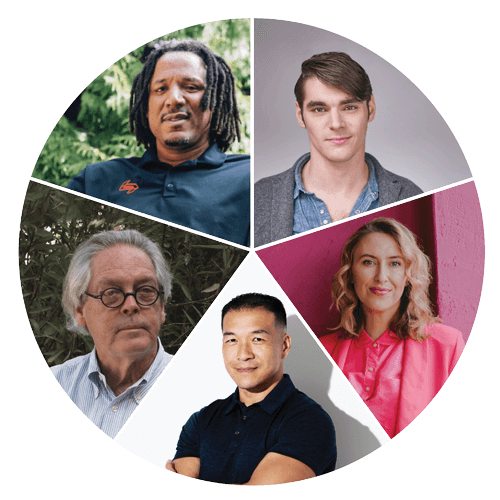
During this holiday week, Drs. Daniel Correa and Audrey Nath look back on 2022 and share clips from episodes that highlight the importance of elevating the voices of individuals whose lives have been impacted by neurologic conditions. Dr. Nath first shares a conversation she had with actor RJ Mitte who discusses his journey in finding confidence despite the bullying he endured in childhood as someone with cerebral palsy. Dr. Correa brings back a conversation with Greg O’Brien, a journalist diagnosed with Alzheimer’s disease, who shares how navigating the holidays can be especially trying while living with a neurologic condition. We hear more clips from past episodes including author/podcaster Nora McInerny, former NBA player Brian Grant, and more. Happy holidays (Felices fiestas) to you and yours!
Follow and subscribe wherever you get your podcasts!
Apple Podcasts Spotify Libsyn
Additional Resources
- Cerebral palsy overview
- Brain tumor overview
- Alzheimer's disease overview
- Parkinson's disease overview
- From the Editor: A Season for Giving
- Healthy Holiday Side Dish Recipes
Follow us!
- Guest: RJ Mitte @RJMitte; Nora McInerny @noraborealis; Brian Grant @bwgrant (Twitter), @briangrant44 (Instagram)
- Hosts: Dr. Daniel Correa @neurodrcorrea; Dr. Audrey Nath @AudreyNathMDPhD
- Twitter: @BrainandLifeMag
- Instagram: @BrainandLifeMag
- Facebook: Brain & Life Magazine
We want to hear from you!
Have a question or want to hear a topic featured on the Brain & Life Podcast?
Record a voicemail at 612-928-6206, or email us at BLpodcast@brainandlife.org.
Episode Transcript
Dr. Correa:
Happy holidays and welcome back to the Brain & Life podcast by the American Academy of Neurology. Looking back on the year and the amazing guests that we have had on this podcast sharing their stories.
Dr. Nath:
We are also so excited that in the next year we'll be releasing episodes with new music. Upcoming in season two, we'll be featuring BJ Miller, the famous palliative care physician and author as he talks about his role in Chris Hemsworth's series, Limitless.
Dr. Correa:
And we'll have a mailbag episode with questions from our listeners talking about things like TBI, restless leg, and amygdalahippocampectomy.
Dr. Nath:
There we go. We haven't been talking about that enough. And now in this best of episode as we look back on this year and season, we're going to start with RJ Mitte, the actor with Cerebral Palsy from Breaking Bad. We talked about his own experiences with bullying as a child with CP, as well as his adventures in TV and runway modeling.
Dr. Correa:
This is such a great clip. I can't wait.
Dr. Nath:
You've spoken about bullying and a lot of your advocacy work and was going back and reading about your own background as a kid with a visible disability. And it's heartbreaking. You were bullied, you sustained physical injuries from assaults. As a child. How did you go from that and being literally physically beaten down to having such a strong core of self? Or do you think those things are related?
RJ Mitte:
I think they're related in many capacities. I mean, you can get two... you make two decisions when you're faced with certain challenges: you either run from them or you face them head on, no matter the consequences. And for me, I was very lucky. I grew up with some very strong grandparents on both sides of my family. Instilled in mentalities in me that helped me be who I am today. And one of those was, "Don't take crap from anyone," and be myself. And if someone doesn't understand it, reasonably and non-confrontationally explained. A lot of people attack people or see people from lack of understanding. They have this image of what they see of you, and they project their insecurities or their hate or their disbelief that they have about themselves onto other people. And the realization that you have to find, and I was very lucky at a young age to find was, it's not me, I'm not the issue, they're the issue. They're talking about themselves. They're not talking about you.
They may be attacking that you walk funny or you talk funny or whatever it may be. But it's because they have that same dilemma within themselves. And no matter how much they try to break you down, you still go home and sleep and have your life. And they have to go back to whatever life gave them that idea or that mentality. And so you have to realize, it's not you. Don't hate yourself for how other people see you. Don't devalue who you are as an individual just because someone else doesn't see you as valuable. And when it comes to having a disability, a lot of people look at disability as a liability. And there's a neurological connection to those two words that we've put into society that if you have a disability, you can't do this or you can't do that, or you're sick or you're ill or you're not smart, or you're whatever these things are. And that in the mind is a liability.
Well, the way that I grew up was disability is an asset. A lot of my grandparents had diabetes or polio or stroke, fully paralyzed in wheelchairs. And the thing is I never saw them as disabled. I actually don't see myself as disabled. But what I do see of myself is the opportunity and the knowledge that my disability gave to me, the opportunities that I had through physical therapy and occupational therapy and speech therapy and surgeries and so on and so forth, of everything that comes with it.
Dr. Correa:
What an incredible perspective. Sadly, bullying is an epidemic that affects so many families.
Dr. Nath:
To learn more about bullying in our pediatric neurology patients specifically, I brought back two of my favorite attendings from residency at Boston Children's, Dr. Peter Raffalli and Dr. Liz Barkoudah. Dr. Raffalli runs the bullying clinic within the Department of Neurology, and Dr. Barkoudah is an expert in cerebral palsy.
For the kids with cerebral palsy that may be listening to this show in all parts of the country, is there anything that you want to tell them?
Dr. Barkoudah:
Sure. You can be whatever you put your mind to. The patients that I get to be involved in their life. For me, it's just such an honor. I go to clinic and for me, it's one giant social day for CP Clinic. I have patients who know that their job for me is to come in with a new joke and I look forward to it. I have a few patients who I hire them to make me something. So we work at school and I'll give them a couple choices of things that I'm interested in. I am interested in them as a person. And I want them to have the opportunities that any of us or any of our children have, which I recognize is not equal in this country, but I view them as the world, as their oyster. We just have to figure out a way to make it work for that particular person.
Dr. Raffalli:
I think that for me, just since I'm trying to cover the bullying front, what I tell every kid that I see in the bullying clinic is, "First of all, thank you for coming in. It was really courageous for you to be willing to talk about what's happening, because that does take a lot of courage. It's not a pleasant topic." But I also tell them that it's extremely important that they understand that bullying is never the victim's fault. So if you're being bullied, they're going to try to make you feel like it's your fault, they're going to call you lame. They're going to make fun of you, but don't believe them.
Dr. Nath:
It is so nice to hear their voices again. Dr. Raffalli and Dr. Barkoudah, if you're listening, hello. Even with my own six-year-old, I think about bullying and its effects quite a bit. We give our love and support to families out there navigating both developmental disabilities and bullying.
Dr. Correa:
Yes. Now for our next highlight, we go from pediatric neurology and cerebral palsy to issues surrounding adult brain tumors and grief. I got to talk to one of my own favorite podcast hosts, Nora McInerny from Terrible, Thanks for Asking.
Dr. Nath:
It's a great title.
Dr. Correa:
It's such a great title. The titles for her podcast and her books have been perfect. She joined us to talk about her and her experience with her husband's brain cancer and dealing with the grief of his passing. She brings an honest voice to living on with the memories of our loved ones.
Nora, I wanted to go back. Thinking of where Mo was there for you and where your now husband was there for you to support you. Many people feel paralyzed on what to do or say to someone after a tragedy. If you were there for Nora in the past, what words or actions and support would you offer?
Nora McInerny:
I always tell people to do what you can do and what you will do competently, most importantly, competently, consistently if possible, and humbly always. Because I had this neighbor, truly one of the greatest men of all time. Mark was an engineer. Mark was not going to be a person who could sit on the couch while I watched Real Housewives and cried, that was not what Mark could do. You know what Mark could do? Snow blow my walkway. And so that's what he did. That's what he did. And unless I woke up and peeked out the window, I would never know it was Mark. I would never know it was Mark because he didn't want credit for it and he didn't need a thank-you. For people, when you are afraid of what to do, you do what you can. You do what is in your realm of expertise.
I had this friend, Evan, who was so lovely, and he would come over and he would literally just come down to the basement where I was and he would just sit and watch whatever I was watching. It was so wonderful. I don't know if Evan and I ever talked about our feelings at all, but he was there physically, which was so nice to have a person who is there. You just do the thing that you know can do. That's it. And you don't have to overthink it. It doesn't have to be fancy.
Dr. Correa:
That's such a great point that there's no exact words, there's no specific action that everybody needs. It's really doing what you can.
Dr. Nath:
I love her storytelling and rawness when thinking about such a painful time in her life. And even getting to the detail about Real Housewives. She's my kind of girl.
Dr. Correa:
Now, sometimes we do get into heart-tugging stories with our guests here on the podcasts. Our next episode and clip with author and journalists, Greg O'Brien. Greg shared with us what it was like growing up with Alzheimer's in his family, in multiple family members. And then later learning that he himself was living with Alzheimer's.
Dr. Nath:
Here he talks about navigating some of the issues with family during the holidays, specifically.
Dr. Correa:
What are some of the things that you have found that help you day-to-day manage with everything from mood and the other symptoms that have come with your condition?
Greg O'Brien:
You have to get the right sleep. You have to eat the right diet. Dr. Tanzi will tell you, just looking at it here, Mediterranean diet. You have to try new things. You have to fight against withdrawal. I've been withdrawing... There's not a lot of people I want to be around anymore and I have to fight against that.
Dr. Correa:
So by withdrawal you mean isolating, fighting against isolation. Okay.
Greg O'Brien:
I want to be careful how to say this, but even around family... I'm uncomfortable at family reunions, even with my own family. My brain is like my iPhone, still a sophisticated device, but has a short-term battery, pocket dials and can get lost very easily. Let's say I go into a room where there are a bunch of people that I've known for all my life, 70% I won't know who they are, but I'll know they're a person of interest. I'll work the room, shake a hand, look some in the eye, say, "How you doing? How's your family?" Have no clue who they are. And I'll walk out and I look for an exit door and I work the room. And then I go sit by myself for an hour and a half and people in there don't know. And they go, "I saw Greg, he looked so good. And he sounded good."
This is what people need to know about this disease. It's isolation. And I'll be sitting by myself. I won't be feeling bad by myself because I'm more comfortable sitting by myself. Does that make sense? I'm not out there sobbing. I'm just sighing, "Boy, that was good. I'm glad I escaped."
Dr. Correa:
And you said you've developed some of your own cognitive reserve from the work that you did over the many years with your journalism and your writing. What were some strategies that you learned as a part of your training in journalism and in your practice of writing that you feel come as a resource for you day-to-day now?
Greg O'Brien:
First thing is take good notes. And so when I got my diagnosis, I was worried about a lot of the stuff that I would forget and a lot of it I have. But I spent time with not only research on the disease, but information that I had, anecdotes, family stuff about close to 2000 pages of notes from which I wrote On Pluto. And everywhere I go, you're interviewing me on my MacBook Pro. And so everywhere I go, I take notes. You'll never really see me 'cause we don't see each other, but without my laptop. Someone says something, I write it down, I put it in a category. And then with emails, I save the emails because it gives me background on things in the past. So how in my inbox, how many emails do you think I have saved? I'm looking at it right now.
Dr. Correa:
I would say 9000.
Greg O'Brien:
423,000.
Dr. Correa:
Oh my God.
Greg O'Brien:
I swear to God. If there's a way I could take a picture of it, I'd send it to you. And it goes back to 2006. So it's a strategy. If I need to find out something earlier in my life, I can go up to the find button and I play... for anyone who's listening or cares, I play charades with Google because when I write... and I couldn't write Pluto today, guess my mind's not in that place. I write columns shorter writing. If I'm stuck on a concept or a word or something else, I can't think of the word, but I'll have a general sense of the concept. And I place charades with Google sounds like, and then all the things come up and then I hit another one, all the things come up. And I can spend 20 minutes on that for a single concept. And it's very frustrating. But at the end I felt I won.
Dr. Correa:
And you mentioned a few times your book On Pluto: Inside the Mind of Alzheimer's. Why On Pluto? And tell us a little bit more about what's in that book that can help a person living with it or a family member living with Alzheimer's?
Greg O'Brien:
Well, I'll tell you how I got the name. When it came to writing, I kept thinking, "Okay, I got the notes, I should write now." And my mom had a strong faith and she taught me how to write and speak from the heart when the mind fails. And that's a difficult concept for people. When I write, I don't put a headline on it, I just write and I say, "Well, what do I call this?" And all of a sudden in my heart I heard, "On Pluto." And so I started Googling On Pluto about the desolation and the isolation of Pluto, and I said, "That's a perfect title. I'm On Pluto, inside the mind of Alzheimer's." And so the film, Have You Heard About Greg? as well as On Pluto is candid, detailed, look into the reality of this disease, but also offers faith, hope and humor and how to survive while we can.
Dr. Correa:
And you mentioned some about the hope and humor of living with this condition. What are some of the things that we're looking forward to the future or for yourself in terms of hope and then humor?
Greg O'Brien:
Hope is not giving up. Lying down and wrestling is a position of defeat. Hope is saying, "Okay, I got issues, but how can I make chicken salad without mayonnaise?" Hope is realizing that there are people out there that are really hurting. This afternoon, I'm interviewing a very close friend of mine who has ALS. When I go to church, I'm sitting there, I'm not worried about me, I'm worried about him praying for him. And you look and try to give hope to other people and try to reach out to them. That gives you purpose. I don't know if that makes sense to you, but it's just like it was a baseball player in the ninth inning, you're down by X number of runs and you got to final that bat and you say, "Okay, we're going to win."
Dr. Nath:
It's incredible how he uses the internet and keywords and his own email as his notes for his own life.
Dr. Correa:
To take those kind of journalistic skills and still be able to keep operating despite all of his memory condition and difficulties, that's amazing. In our next clip, we highlight a discussion with Brian Grant, the NBA player and veteran who was diagnosed with early onset Parkinson's disease. He also talks about adaptations he had to make in his own life and he shares how he hid his condition from many people for years. But by opening up and advocating for Parkinson's, so many people were able to connect with him and then find resources that they needed to live better with Parkinson's disease.
What would you suggest to people newly diagnosed or living with Parkinson's or their family members to try to battle and balance out the isolation that comes with the condition?
Brian Grant:
Well, I guess the first thing I would say, and I think a lot of people say it, is that you're not alone. When I was diagnosed, I felt alone. I felt alone those first two years when I was only telling close family members. It wasn't until I had Ric Bucher break the story that I had Parkinson's, that things started opening up because I would go to my son's football game. This is when they were in peewee football and see every day people, I'd see them all the time, "Hey, how you doing this?" This and that. But after that came out, those same people were, "My brother has it. My mother has it. My sister has it." And then one person saying, "My wife has it, but she's too embarrassed to come up and tell you." It was just like the world opened up.
I did not know that so many people were affected by this disease, and it is really mind-blowing. I mean, when that world starts to open up to you... when you open up, it opens up to you and that's when you find your, what I call my family friends who have it that I can turn to and lean on. I love you neurologists. You guys are great with the science and everything, but a lot of things, it's sitting across from someone else who's taking the same drug as you and hearing how it's affecting them goes a long way with this disease because we're all so different. I know that it may get you hyped up, but it does help with your tremor, with me, it puts me to sleep. The meds affect everybody differently and PD affects everyone differently. You're not alone. And when you're ready to open up, open up to people, people we think are normal. You'll see how many people come back that are affected by this disease. At least I did.
Dr. Correa:
I think many people don't realize how many people we walk around thinking that they're normies. There's really lots of people out there living with different neurologic conditions, either themselves or a family member, including Parkinson's. And thank you for the work that the Brian Grant Foundation is doing to help and support the community, encouraging them in exercise and the frank discussions that you guys have with the On Time podcast in opening yourself vulnerably with your book, Rebound: Soaring in the NBA, Battling Parkinson's, and Finding What Really Matters. I think all of these resources are great for the community and really appreciate the effort that you're doing to support the community.
Brian Grant:
Thank you, and I appreciate you having me on the show today.
Dr. Nath:
It really does take a village to navigate these complex neurological conditions. It makes such a difference to lean into a community of other people who have been there and get it.
Dr. Correa:
Totally. A few episodes ago, we interviewed another person with Parkinson's, Jimmy Choi. He's competed on American Ninja Warrior, in many different fitness competitions, fundraising money for Parkinson's, and is an advocate.
Dr. Nath:
I still am blown away by this every time I hear about Jimmy Choi. American Ninja Warrior, this is running up the vertical wall and swinging from the high trapezes while you're timed.
Dr. Correa:
It's so inspirational and great that he's been able to do it as a way to bring awareness to the condition. And in that same episode, we also talked to Dr. Alan Wu, a Parkinson's specialist, and he helps us remember that we are all valuable and everyone contributes to our society despite all the stigma that our community faces.
In our discussion with Jimmy and through his advocacy work, some of the promotion and public awareness that he's done on social media, he has shared many frustrations with the stigma of movement disorders and Parkinson's in the community. Now, speaking to our listeners and the wider society, what do people need to understand about tremors and movements and many of the other symptoms that can often lead to snickers and discrimination?
Dr. Wu:
That's a really great point and a challenge at large for all of us who are taking care of patients with neurological conditions. A lot of it does come down to education of the public, about education of our patients, their caregivers, our colleagues, about understanding that patients who have Parkinson's disease, who have tremor, who have had suffered from stroke, have epilepsy, who have lived with cerebral palsy all their life. These are part of the condition that they have, and it does not limit in the vast majority of cases, the ability to contribute to society, to enrich the lives around them and really live a fulfilling life for themselves and others. And we as healthcare professionals really should strive to be supportive, in addition to that education, promote ways to be non-judgmental.
Dr. Nath:
Thank you to our guests and our listeners for a wonderful year.
Dr. Correa:
Felices Navidades y Feliz año nuevo. See you back for season two. iHasta la proxima! Thank you again for joining us today on the Brain & Life Podcast. Follow and subscribe to this podcast so you don't miss our weekly episodes. You can also sign up to receive the Brain & Life Magazine for free at brainandlife.org.
Dr. Nath:
Also, for each episode, you can find out how to connect with us and our guests along with great resources in our show notes. You can also reach out by email at blpodcast@brainandlife.org, and you can call in anytime and record a question at 6129286206.
Dr. Correa:
Follow me and Audrey and the Brain & Life Magazine on any of your preferred social media channels.
Dr. Nath:
Special thanks to the Brain & Life team, including
Dr. Correa:
Nicole Lussier, our Public Engagement Program Manager.
Dr. Nath:
Twin Cities Sound, our audio editing team.
Dr. Correa:
And Andrea Weiss, our Executive Editor for Education and News Publications.
Dr. Nath:
We are your hosts.
Dr. Correa:
Daniel Correa, joining you from New York City and online @NeuroDrCorrea.
Dr. Nath:
And Audrey Nath beaming in from Texas, and on Twitter @AudreyNathMDPhD.
Dr. Correa:
Thank you to our community members that trust us with their health and everyone living with neurologic conditions. We hope together we can take steps to better brain health and each thrive with our own abilities every day.
Dr. Nath:
Follow and subscribe wherever you get podcasts.
Dr. Correa:
We'd really appreciate it if you could give us five stars and leave a review.
Dr. Nath:
Thank you.
Dr. Correa:
This helps others find the Brain & Life podcast. Thanks again. See you next week.