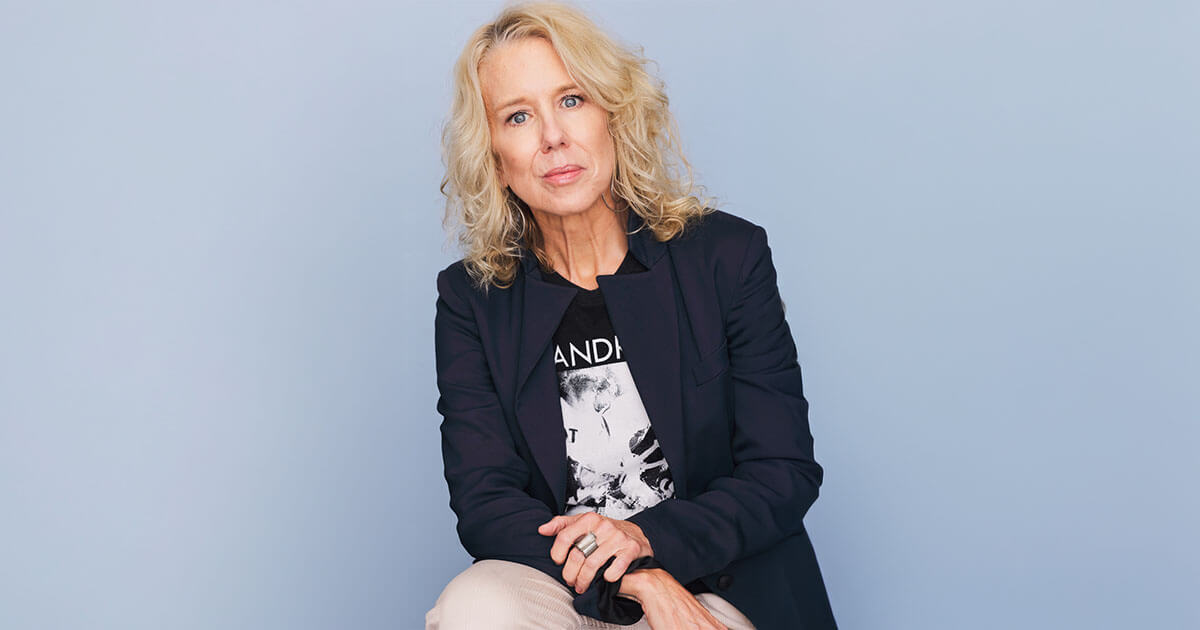
If you spend any time at all on social media, you've probably seen “get ready with me” videos. Popular on Instagram and TikTok, these videos show creators chatting with their followers and sharing stories while going through their makeup or skin care routines, choosing outfits, and preparing for the day ahead.
On Jan. 25, 2024, a young woman named Brooke Eby posted her own version of the trend: “Get ready with me while I tell you how I got a death sentence before my 30th birthday,” she says. Expertly applying makeup, Eby launches into the story of the four-year saga that began with her experiencing tightness in her calf in 2018 and ended with a diagnosis of amyotrophic lateral sclerosis (ALS) in March 2022, when she was just 33.
That video is one of hundreds that Eby, now 36, has posted to her Instagram account, @LimpBroozkit, since her diagnosis. They vary widely, from updates on her disease progression, advice on adaptive technologies, and tough conversations on advance directives to “Telling first dates that I'll be using a cane: red flag edition,” “Pimp my ride: wheelchair edition,” and a “pick my outfit” competition guest starring her parents.
She posts almost every day and has pledged to her more than 500,000 followers that she will do so for as long as she can. Her takes on her life with ALS are irreverent and unflinchingly honest, fearless and funny, thought-provoking and sometimes profane, but always unapologetically herself. She gives a voice to people with neurodegenerative disease—especially younger people—and shares a realistic picture of what it is like to lose your physical abilities day by day.
“When I first started posting videos, I remember always saying, ‘My goal is awareness.’ But over time, it came to be more than that,” Eby says. “I needed to get people invested in me and my story in order to be invested in this disease, because it's not inherently fun to follow a disease story, especially these days when everyone is a content creator and you could spend all day scrolling through videos of dogs doing cute things and girls in pretty fashion outfits. But maybe now when you hear about ALS, you picture me instead of just thinking about statistics. Maybe you realize that it's not only affecting old men, which is what I thought before getting diagnosed. Maybe you think, ‘This person could have been my daughter or my sister or my friend,’ and maybe you're more interested in engaging with the ALS community and helping us advocate.”
Listen now!
Brooke Eby joins the Brain & Life Podcast to discuss her experience living with ALS and why she chooses to share it with the world on social media. Then, Dr. Richard Bedlack explains what hopeful research is on the horizon. Learn more.
Early Signs
After graduating from Lehigh University with a business degree in 2010, Eby lived an exciting life in the financial technology industry, first in New York City and then San Francisco before returning to New York in 2018. Not long after transferring back east as an account executive for the tech company Salesforce, she noticed a troublesome tightness in her left calf.
“At first I just figured that it was sore from a workout or something, but then I started noticing that I was walking slower—and other people began pointing that out to me too,” she recalls. “In New York, people will notice when you're walking slow, and they'll make sure you know about it.”
When the limping persisted, Eby decided to seek help from her sister, a physiatrist. “She had me walk on my heels, and my right foot would stay up, but my left foot would just slam into the ground,” she explained. “So she said, ‘Okay, you definitely have foot drop, but you probably just pinched a nerve.’ That was like, ‘famous last words.’”
Over the next four years, Eby visited a wide array of doctors, seeking an answer to the mystery of her one-sided limp that didn't seem to be getting much worse but wasn't getting better either. “They were testing for everything, and nothing was coming up,” she says. “I had X-rays, CT scans, MRIs, blood work, and it all kept coming back fine. So they would send me to physical therapy and just hope that it got better.”
Two years into her quest for answers, Eby visited a neurologist who conducted a nerve study called an electromyography (EMG). He suggested that ALS might be a possibility but told her that “they couldn't really diagnose it since I only had issues with one foot, and it would need to progress to another place before it could be considered ALS,” she said.
“That definitely freaked me out. I remember crying in the car on the way home,” she adds. “But everyone around me kept reassuring me that ALS is usually such a fast-moving disease that having a limp in one foot for just a couple years without anything else changing didn't make sense. They said that the lifespan with the disease is usually two to five years, so we would have seen a lot more progression in those two years if it was really ALS. But it turned out that my body was just burying the lede.”
The neurologist had told her to come back if anything changed, and in 2022, something did. “I started noticing that walking was getting even harder, so I went back, and they ran another EMG,” Eby says. “It found that the denervation in my left foot had progressed into my right foot, which allowed them to officially diagnose me with ALS.”
She spent the next couple of months largely in bed, alternating between denial, depression, and hope that it was the wrong diagnosis. “I was reading a lot of books and eating a lot of M&Ms. It was like how they portray post-breakup women where you're throwing chocolates at your TV,” Eby says. “I was the epitome of a movie sad person.”
But two months after the diagnosis came a turning point, when Eby served as a bridesmaid in a friend's wedding. “I showed up in a dress that was a little too tight because I had been lying in bed eating M&Ms, and using a walker that was the exact same one as the bride's grandma,” she recalls. “We both had the tennis balls on the bottom. I was so embarrassed. But a couple hours in, my best friend turned to me and said, ‘Look, this could be really awful, or this could be really fun. You could make a great story out of it.’ By the end of the night, we had the bride limboing under my walker, and I was giving walker rides on the dance floor. It hit me that I could still laugh and be myself and have the same personality. I just had an extra layer of material.”
After that experience, Eby hit on the idea of posting videos online. “When I had first started telling people about my diagnosis, it was terrible. People would start crying and then I would start crying, and I felt like I was ruining everyone's day. But at the wedding, being able to laugh about it made us all more comfortable,” she says. “So I thought, if I make a funny video about it, maybe I can just share that, and I don't have to have all these painful one-on-one conversations. It was like my one-fell-swoop weapon, and it just evolved from there.”
She quickly realized she had plenty of material. “I had so many funny moments with using adaptive equipment and mobility aids. And people will say weird things, and honestly you can't fault them for it, because if you see an apparently healthy young person suddenly using a cane, you're probably going to start a sentence and not know how to finish it,” she says. “I just got hooked on making those videos about all these funny things, and I kept seeing good responses, so it just grew naturally.”
Moving Home
In the summer of 2024, Eby moved back in with her parents in her childhood home in Maryland, as living alone in her city apartment had begun to feel unsafe. More and more often, she'd find herself physically stuck somewhere and have to call a neighbor or the doorman for help. “Any time I needed to do something like get out of bed, go to the bathroom, grab a snack, all those things were getting really difficult and increasing my risk of falling,” she says.
The transition has been a lot easier than she expected. “This is my favorite place. It's so beautiful here, and my dog loves it too. And one of my parents is always around in case I need something,” she says. “Like just now, I had a bug land on me when I was outside, and I couldn't reach it to swat it away. So I called out and one of them came and got the little spider off me.”
While she knows the situation must be emotionally hard for her parents, living with them is beneficial “because they know exactly what's going on,” she says. “And they aren't worrying that things might be even worse than they are.”
Watching high school sweethearts Cliff and Ginny Eby when they pop up in their daughter's videos, it's not hard to see where she got her humor and practical, problem-solving nature. Her father produced, filmed, and edited a two-part series of Oscars parodies they dubbed the “ALSCARS” (which one commenter called, “One of the most dad things that ever dadded”), while her mom co-starred in several how-to reviews with Eby trying on adaptive clothing.
“She's the ultimate mom, so she's always trying to fatten me up and take care of me,” Eby says. “And then my dad is an engineer, so he's constantly building things. There's no shortage of work-around fixes and adaptive accessories around here. Right now he's working on a phone holder for my wheelchair that's stretchy enough where I can bring it really close to me, because the one I had was too far away. He also put these tubes on the faucets on the sink so I can easily turn them on or off. The whole house is like ‘Inspector Gadget.’”
The harsh reality is that her dad will probably have to keep devising more solutions and adaptations as Eby's illness progresses. “Both my legs went in the first four or five years, so I was using a wheelchair full-time probably eight months after my diagnosis,” she says. “In the last year, my arms became much weaker, and now I'm not able to move them at all. I still have movement in some of my fingers, and I mainly use voice-to-text to communicate. There are a lot of typos, and I'm slower than I used to be.”
There are no more videos with Eby applying makeup. She recently posted a “day in the life” video illustrating the two minutes of determined effort it takes just for her to open her laptop and log on.
Her condition continues to change. This summer, Eby learned her latest pulmonary function test, which measures how well someone's lungs work, showed a significant drop from her previous one. She also underwent surgery to have a feeding tube inserted and began learning how to use the Eyegaze device (a communication and speech-generating device that the eyes control), which she notes could help her communicate with others as her voice and hands weaken.
Eby wears a non-invasive ventilator 24 hours a day to support her breathing. The device is used in a number of lung diseases, congestive heart failure, and neuromuscular conditions, including ALS. It lets the user's respiratory muscles rest and improves the exchange of oxygen and carbon dioxide, explains Eva Feldman, MD, PhD, an endowed professor of neurology and director of the ALS Center of Excellence at Michigan Neuroscience Institute of the University of Michigan.
“We have found that when it's used at an appropriate point in the course of the disease, BiPap [a bilevel positive airway pressure machine, a type of non-invasive ventilator] extends life upwards of 14 months, which is better than any of the drugs we currently have,” Dr. Feldman says. “People also have less fatigue, and they feel better, and cognition is also improved. So rather than waiting until people have lost 50 percent of their lung function, which is what we currently have to do based on insurance requirements, we need to be treating these people immediately.”
Raising Awareness
Eby still works for the same tech company, Salesforce, bringing in new partners, but she recently took a step back from calls and presentations as that kind of extensive speaking became too laborious. But she teamed up with Eleven Labs—the same company that partnered with former U.S. Rep. Jennifer Wexton, who has progressive supranuclear palsy, a rare, degenerative brain disease—to create a “voice bank” based on videos of her speaking made shortly after her diagnosis. The company offers artificial intelligence (AI) voice generation based off of what a person has banked. The technology will allow Eby to use a text-to-speech device to speak even after ALS inevitably takes her voice.
“It used to be a process where you had to record a thousand sayings into a little device and then send it off to a company, and they would come up with a voice, and it never sounded that good, but now with all the AI, it sounds exactly like I used to,” she says. “It's pretty cool.”
Eby also founded a nonprofit, ALS Together, a centralized community for people with ALS to support one another that is hosted on the communications platform Slack.
“When I first got diagnosed, they handed me the dreaded big packet of papers. It's a bunch of resources, but at the time, you're so overwhelmed, and I was personally still in denial,” Eby says. “I didn't want to learn more about it. I went home and shoved it in a drawer.”
Later, Eby says she realized “that what I wanted was a place where people could go to ask each other questions and access resources, so we built out this communication platform for people living with ALS, caregivers, and organizations. If you have a question about equipment or medication or you want to know what organizations have grants you can take advantage of, you can log into ALSTogether and hopefully avoid that packet altogether.” (The site also is piloting an eye-gazing mode, a simplified method of navigating for members who use eye-tracking devices to communicate, use apps, and surf the web.)
Eby remains determined to keep posting videos as her disease progresses. “There are a lot of easy outs I could take, like saying, ‘Oh, my voice sounds like crap. I don't really want to talk on camera anymore,’ but I get such supportive comments that it encourages me to keep going,” she says. “Hearing that it's helping someone or making someone laugh reminds me that maybe it's worth it.
“I just got an email from someone who is also deteriorating with a different disease, saying that they're exhausted by the time they get into bed and really down, but then they'll watch one of my videos and start laughing and it ends the day on a high note. I thought that email was so nice. So that's my hope: to just keep posting, and we'll see what happens.”
Learn More