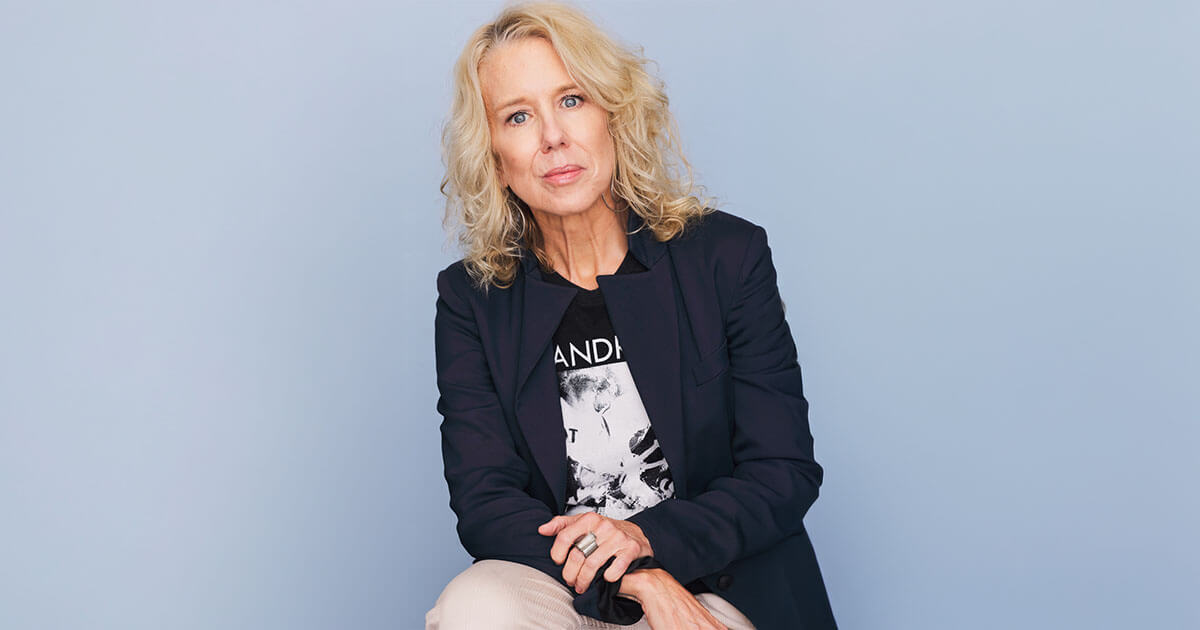
Rep. Jennifer Wexton gave a farewell speech unlike any other.
Robbed of her ability to speak clearly by the neurodegenerative condition progressive supranuclear palsy (PSP), a condition often confused with Parkinson's disease, the Virginia Democrat used a novel augmentative communication device when she addressed her peers on the floor of the House of Representatives in December, weeks before her term ended. The device “speaks” with an artificial intelligence-enabled version of her own voice, generated using past recordings of her speeches.
“This has been a journey which has been so challenging, yet one which I am proud to have stood strong in and done my part to give hope and comfort to others facing similar battles,” Wexton, 56, shared by email. “Our disabilities and our health struggles do not define who we are, and I feel more strongly than ever that it is so important to share that truth with the world.”
That positive attitude is characteristic of Wexton, a former Loudoun County prosecutor who decided to enter politics after hearing then-Sen. Barack Obama speak in 2008. “My mom came to our home in Leesburg every weekend and babysat our young children while my husband, Andrew, and I went out and knocked [on] doors, meeting our neighbors where they were. I did not win that very first campaign, but to this day, I still meet people who remember me from when I knocked on their door almost 14 years ago,” she recalls.
Listen now!
Jennifer Wexton discusses the importance of advocacy and the use of assistive technology, including the AI-generated voice she uses during this podcast episode.
Wexton ultimately won a seat in the Virginia Senate in a 2014 special election and then unseated Rep. Barbara Comstock in 2018. During her six years representing Virginia's 10th District, Wexton prided herself on working across the aisle. “I may have been the first Democrat to win Virginia-10 in nearly four decades, but I campaigned and tried to govern as myself—someone who believes that the best way to get work done is finding common ground and always putting the needs of my community first,” she says.
The first symptoms of PSP began not long after Wexton began her Congressional term, but it took a while before she recognized them as a serious concern. When her toes started clenching up and curling, for example, she assumed “it must be the natural result of my walking tens of thousands of steps on the marble floors in and around the Capitol complex daily, often in less than comfy or supportive shoes,” she says.
As the months passed, her gait became more of a shuffle, and she often tripped on the uneven sidewalks around the Capitol. But with the COVID pandemic at its height, she wrote off the stumbles as related to the stress of the crisis—in addition to representing her constituents, she was gearing up for her first reelection campaign and having her two now-grown sons, Matthew and Jamie, go to school online at home.
Wexton had also begun experiencing alarming changes in her voice. Because of the pandemic, her reelection campaign included a lot of online town halls and Zoom meetings with constituents. During one of these, her voice started wavering, as if she were frightened or shivering from the cold. “Of course, it freaked me out, but at that time, it was just that—a weird, seemingly random freeze-up. But it was scary, and I felt as though I was losing control of my body.”
The symptoms kept mounting, and one day she finally worked up the courage to Google what they might mean. “I typed, ‘Why do my toes keep clenching and curling inward?’ into the search window. The answer? ‘Toes clenching is a common symptom of early-onset Parkinson's disease,’” she recalls. “My initial reaction was disbelief. I thought, ‘I can't have Parkinson's. That's a disease that old men get.’ But the more I read about it, the more all of my recent maladies made sense.”
With no definitive, generally accepted test for Parkinson's, it took months of exams, imaging, and medication trials before Wexton's doctors finally settled on that diagnosis. She went public with the news in a video message shared on social media on World Parkinson's Day in April 2023—but the nagging suspicion that something wasn't quite right still troubled her.
“I had actually had one ‘near miss’ when my first neurologist suspected that I was suffering from another condition called multiple system atrophy,” she says. Although an MRI showed she had areas of midbrain atrophy (in which part of the brainstem shrinks), the findings were not indicative of multiple system atrophy. “I was relieved, but I still felt that something more serious was going on,” Wexton says. “My original neurologist never mentioned PSP or the possibility that I was suffering from a different atypical parkinsonism and seemed mystified. Meanwhile, my symptoms continued and worsened.”
Wexton took the standard Parkinson's drug treatment of carbidopa-levodopa, which at first gave her relief from the worst of her symptoms, relaxing her clenched muscles for the first time in months. But over the next few months, Wexton noticed that her symptoms were progressing more quickly than those of other women in her Parkinson's support group, and her reinvigorated exercise and other therapy regimens did not help as much as she believed they should. “By this point, I knew well the importance of listening to my body and sought out a second and a third medical opinion,” she says. A new neurologist re-examined her earlier MRI and identified the “hummingbird sign,” a telltale pattern of midbrain atrophy highly associated with PSP.
What Is PSP?
PSP is part of a group of neurodegenerative illnesses known as atypical parkinsonian conditions, which also include multiple system atrophy, corticobasal syndrome, and dementia with Lewy bodies (DLB). Alex Pantelyat, MD, professor of neurology and director of the Atypical Parkinsonism Center at Johns Hopkins University in Baltimore, says “the four cardinal exam findings of parkinsonian disorders can be remembered using the mnemonic TRAP”: tremor, rigidity, akinesia/bradykinesia (loss of fine motor control, speed, and coordination), and postural instability. “It is very common for PSP to be misdiagnosed as [Parkinson's], because in many cases, its early symptoms share a number of features with [Parkinson's],” Dr. Pantelyat says. “One of the challenges in getting the diagnosis right early on is that PSP can present in multiple ways.”
“Classic” PSP, also known as Richardson syndrome, is characterized by sudden, unprompted falls (usually backward) and difficulty with vertical eye movements. But a number of other PSP subtypes exist. Wexton's subtype, PSP with predominant parkinsonism (PSP-P), is the second most common variant, representing approximately 20 percent of cases.
“That form of the disease is often not possible to clinically distinguish from Parkinson disease in the first several years after symptom onset,” Dr. Pantelyat says. “If you follow people over time, many of those who present with a variant eventually will meet the criteria for PSP-Richardson syndrome, but that could take years.”
Because Wexton's PSP initially appeared to respond to levodopa, that likely contributed to her misdiagnosis, says Lawrence Golbe, MD, emeritus professor of neurology at Rutgers Robert Wood Johnson Medical School in New Brunswick, NJ; chief clinical officer and scientific advisory board chair of CurePSP; and author of A Clinician's Guide to Progressive Supranuclear Palsy (Rutgers University Press, 2018).
“The drug is slightly effective in PSP but not nearly as much as in [Parkinson's],” he says. “Some people with PSP will have enough of a useful response that will fool the doctor into thinking that nothing is unusual here, and they will just keep increasing the dosage. If the visits are every four to six months, you can see how quickly time can pass before it becomes clear that the treatment isn't working.”
Wexton has described PSP as “Parkinson's disease on steroids,” and Dr. Pantelyat agrees with that characterization. “It progresses rapidly, in terms of disability milestones like speech difficulties and the need for assistive devices [like] a rolling walker or a wheelchair,” he says.
That has been Wexton's experience. “As my symptoms have progressed, the impact on my day-to-day life has become more significant. I rely on a walker to get around, and I haven't driven in over a year. The volume and clarity of my voice make it impossible for people to understand me,” she says. She uses the AI re-creation of her voice to speak not only publicly but also with friends and family. Developed by ElevenLabs, the program uses deep learning models (a type of machine learning that uses neural networks to simulate the brain's decision-making power) to “clone” voices based on a few minutes of audio, aiming to replicate the nuances of an individual voice. The text-to-speech technology converts written text into spoken words with realistic intonation and emotion that sound remarkably similar to the person's natural speech.
Wexton considers herself lucky because her symptoms still respond to levodopa, albeit a high dose. “Every day, I have to perform an elaborate choreography, timing it out with my food, to be able to keep my dopamine levels where they need to be to provide me some relief,” Wexton says. “Getting a good night's sleep, eating well, and staying active can also ease the intensity of my symptoms and help me have better days, but there are many factors that are beyond my control.”
Several treatments exist for many of the associated symptoms. “For example, depression is common in PSP, and antidepressants can be very effective,” Dr. Golbe says. “The dementia that can be associated with PSP does sometimes respond to one of the approved drugs for Alzheimer's disease. Blepharospasm, the forced eyelid closure that is common and quite disabling in this disease, responds very well to botulinum toxin injected into the muscles of the eyelids.”
Unlike Parkinson's, PSP and other related conditions substantially shorten a person's lifespan with an average time from onset of symptoms to death of about seven to 10 years, Dr. Pantelyat says. Those numbers are painful for Wexton and her family to think about. “When I had to tell everyone about my new PSP diagnosis, including, if they asked, the fact that I would be fortunate to live another five to eight years, and that I would likely be unable to speak and [be] confined to a wheelchair within the next year or two—that was not fun,” she says, noting that it was particularly difficult to help her 85-year-old mother understand. “But as I began to talk more about my diagnosis, and the fears and challenges that came along with it, it was somewhat of a relief being able to give people who I care about and care about me an explanation for the increasingly noticeable changes to my health.”
Making the Most of Good Days
One of the first questions Wexton asked her doctor after her PSP diagnosis was if she could still run for re-election. His answer was blunt: “Why would you want to?” In September 2023, Wexton announced that she would serve out her term but not seek re-election the following year.
“The decision to retire from this job I love serving my community was incredibly difficult. There were many more things I felt that I would like to do and continue building on the progress I had achieved in my first few terms,” she says. “But my family is what led me to run for Congress in the first place, and with a diagnosis like this, I know that I have a limited number of good days left, and I want to spend more of my remaining good days with my husband and our boys.”
Determined to make the most of her final year in the House, she began working with Reps. Gus Bilirakis of Florida and Paul Tonko of New York, some of the co-sponsors of the National Plan to End Parkinson's Act, the first federal legislation dedicated to ending Parkinson's and related conditions like PSP. When the bill stalled before an anticipated floor vote, Wexton was not ready to accept its end.
“I knew that this bill would mean hope for millions of families like mine who had to bear the devastating prognosis of these diseases, and I was determined to use whatever means was available to bring everyone back to the table,” she says. “I played the ‘I'm dying, and this is a top priority for me’ card to convince my colleagues to come back to the negotiating table on the National Plan.”
Wexton's nonstop work with her team ultimately paid off. The legislation passed both houses of Congress with overwhelming bipartisan support, and in July 2024, Wexton joined President Joe Biden in the Oval Office as he signed the Dr. Emmanuel Bilirakis and Honorable Jennifer Wexton National Plan to End Parkinson's Act into law. The law establishes a Federal Advisory Council on Parkinson's Research, Care, and Services, charged with developing and advancing the National Parkinson's Project, a national plan to prevent, diagnose, treat, and cure the disease. Including representatives of federal agencies involved with research and care as well as clinicians, researchers, patients, patient advocates, and family caregivers, the council will evaluate all federal programs related to Parkinson's and ensure coordination among them.
Wexton debuted her AI voice in public for the first time during that event, which she says “made an already very important moment for me and my family that much more special.” She had previously used a basic text-to-speech app to help her continue participating in committee hearings and speaking on the House floor and at events. “It got the job done, but it was robotic-sounding, and it wasn't me. It didn't get the cadence or rhythm of my voice or pronounce a lot of words correctly,” she says.
After a few months of relying on that app, she took developer ElevenLabs up on an offer to create an AI model of her voice. Using old audio clips of her speaking, “they were able to turn around a scary-good replica of my voice in just a couple of days,” she says. “My husband was with me when I first heard a sample of my AI voice, reciting Hamlet's soliloquy, ‘To be or not to be, that is the question,’ so we both heard it for the first time at the same time. I cried happy tears. My husband got a big smile on his face. I hadn't seen him so broadly and genuinely smiling in a long time. It made us both feel like I had gotten my voice back.”
Wexton hopes telling her story helps shine a light on how other people facing health challenges could use AI speech, and she urges them to prepare for that option by recording their voice. “My AI voice will never be ‘me,’ but it's more me than I ever believed I would hear again,” she says. “And it empowered me to keep doing the job I love to the fullest and to tell my story, my challenges, and my advocacy on my terms and in my own voice.”
‘Despair Is Not How I Roll’
Although she left Congress, Wexton does not plan to retire from public life. “I've been proud of how I've been able to use this unique platform I've had to bring attention to PSP and other neurodegenerative diseases and to help bring more resources to treat and hopefully one day cure them,” she says. “That work is far from finished, and it helps keep me going. I want to do everything in my power to help other families who are going through the challenges that mine has faced over these past few years.”
Wexton still has her share of dark days. “How could I not, with a horrible disease like this? When I ask the impossible question that inevitably comes with a diagnosis like this—‘Why me?’—the only answer I have is, ‘Why not me?’” she says. “But despair is not how I roll. The one thing I can control is how I approach the situation. I've been so touched by hearing the stories of people from all across the country sharing their health challenges or the conditions their loved ones are fighting. It's helped me feel less alone and given me strength.”
She urges other people with PSP to lean on their family and friends as she has. “When I announced my PSP diagnosis, friends asked me how they could help, and I am not hesitating to tell them how they can make themselves useful to me, from bringing me lunch to driving me to appointments to coming over and going out for a walk with me to something as simple as sending me a text to share cute pictures of their kids (or their pets) or even just to say that they were thinking about me,” she says. “I want anyone out there who is facing the same or a similar degenerative disease like this to know that they can keep going, too. And one day, I hope that by sharing our stories, by raising awareness, and by continuing our advocacy, we will end Parkinson's, PSP, and other atypical parkinsonisms.”
Read More