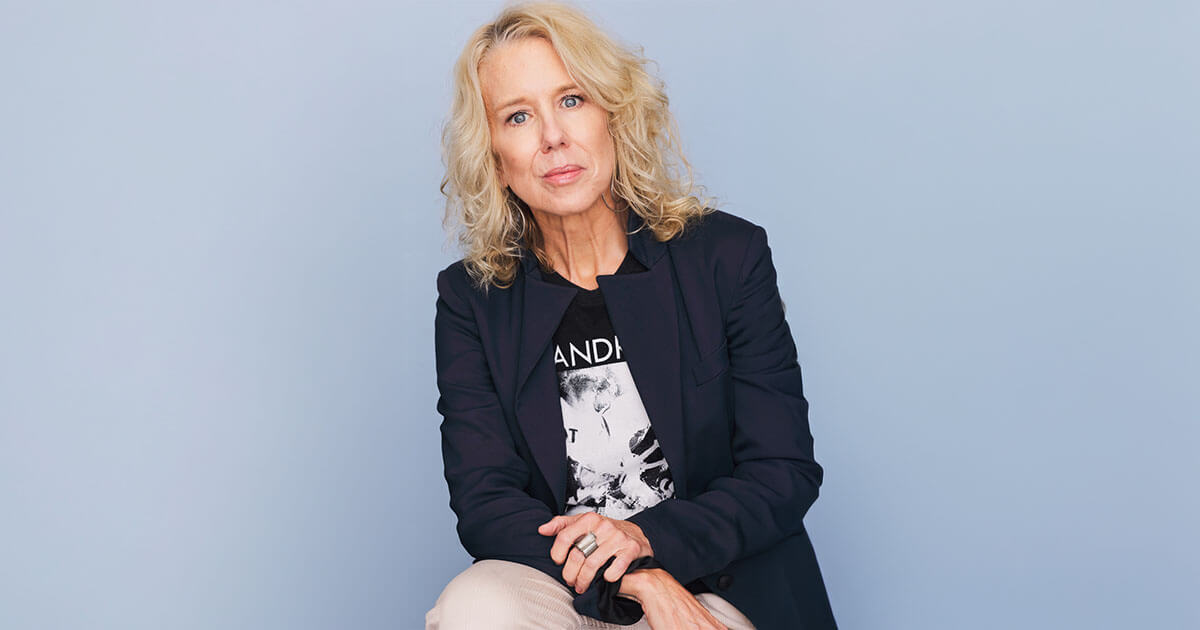
When executives at cable networks TNT and TBS first approached journalist Ann Curry about an innovative new multimedia project called Chasing the Cure, she almost turned them down.
A live television series that uses crowdsourcing to connect people who have undiagnosed or misdiagnosed medical conditions with experts around the world sounded almost impossible to do in a responsible way. "I was very skeptical," Curry admits. But the more she heard about the unique plan, the more she was convinced it could work.
She also considered her own family's history with health problems: two sisters diagnosed with breast cancer, a father who battled non-Hodgkin's lymphoma, and her mother, who survived what she'd been told was a terminal case of tuberculosis in the 1940s and died in 2001 from gallbladder cancer. "My mother probably was sick for more than a decade before she became symptomatic. Then after she developed symptoms, it took about a year before she was diagnosed. This is not an unfamiliar story," Curry says. "As much as medicine has achieved, there are what doctors call medical zebras—rare and surprising diagnoses—as well as other, more common diseases that aren't diagnosed until it's too late."
Being able to tell these stories really appealed to Curry, an Emmy Award-winning journalist and a former news anchor and co-host of NBC's Today show. "When we tell people's stories, listeners are moved to help. That's what makes me believe that Chasing the Cure will help people—not just those who appear on the broadcast and who reach out on our website, but others watching who have similar symptoms or who have never had access to specialists."

In addition to watching the weekly 90-minute episodes on TNT and TBS that follow patients as they meet with doctors in real time, viewers can interact through a Facebook group and other social media platforms. On Chasing the Cure's website, they can submit their own cases as well as recommend experts who might be able to help featured patients. Curry, who is the host and executive producer, says most of Chasing the Cure's cases will be handled online rather than on air. The show's medical team includes an ethicist who reviews all cases.
The first episode is scheduled to air live on August 8 at 9 p.m. ET. One of the early cases features Brenda, a 60-year-old woman from Wichita Falls, TX, who has had a headache every day for the last nine years. She's seen 10 neurologists and has depleted her life savings in her quest to find a cure. The show will access its range of experts to try to solve Brenda's case.

Chasing the Cure brings medical crowdsourcing to television, but it's not the only vehicle that uses crowdsourcing to transform medicine and medical research. At 13 locations across the United States, the National Institutes of Health's Undiagnosed Diseases Program (UDP) and its spin-off, the Undiagnosed Diseases Network (UDN), provide in-depth consultations and diagnostic resources for people with rare, baffling conditions. Patients of the UDP/UDN undergo genetic screening, state-of-the-art imaging, and other tests and panels and meet with a dream team of doctors. The program has operated from the UDP's headquarters in Bethesda, MD, for more than 10 years and in 2015 expanded to 12 other cities, led by a coordinating team at Harvard Medical Center in Boston. It's free to patients as part of a research initiative.
People with neurologic symptoms make up 40 percent of applicants to the UDN, according to a 2018 article in the New England Journal of Medicine. Reporting on a 20-month period, the article said that 35 percent of all patients (132 out of 382) who underwent a complete evaluation at the UDN received a diagnosis. The network has also identified 31 new syndromes, including at least two previously unidentified neurologic conditions.
One of those is Shashi-Pena syndrome, which involves mild developmental delays and physical characteristics that include a large body and large head circumference. It is named for the two doctors who first treated a 3-year-old boy at the UDP in 2013. Vandana Shashi, MD, professor of pediatrics for the division of medical genetics at Duke University School of Medicine in Durham, NC, identified a mutation of a specific gene, known as ASXL2, that had never been associated with a specific disease. By connecting with other UDN sites and using an international database of genes and disease characteristics called GeneMatcher, Dr. Shashi was able to find five additional children with the same features and gene mutation within six weeks.
Another neurologic condition identified by the UDP/UDN is hypotonia, ataxia, and delayed development syndrome (HADDS), caused by a variant in the EBF3 gene. It has some similarities to autism spectrum disorders, including developmental delays, coordination problems, limited facial expressions at an early age, abnormal verbal communication and social behaviors, repetitive motor movements, and a high pain threshold. But there are important differences: People with HADDS have a range of genitourinary disorders, such as malformations of the kidneys or bladder and undescended testicles.
Physician Forums
Crowdsourcing is also conducted on social media platforms where doctors seek consultations on puzzling cases from their peers. Among them are SERMO, with 800,000-plus users, including 30,000 neurologists; Figure 1, which has been described as "Instagram for doctors"; and Synapse, a platform maintained by the American Academy of Neurology (AAN).
On SERMO and Figure 1, doctors can post real-life de-identified cases that may include lab results, imaging, and bloodwork, and solicit advice from their peers. Neurologists who are members of the AAN use Synapse to ask for input on diagnosis, treatment, and other questions.
A recent neurologic case on SERMO centered on a 25-year-old man in Venezuela who began experiencing intense headaches followed by uncontrolled seizures and loss of consciousness. Based on images posted by his physician (a general practitioner), SERMO doctors agreed that the patient had likely experienced a hemorrhagic stroke caused by the rupture of an arteriovenous malformation—a congenital tangle of blood vessels in the brain.
Another case, on Figure 1, was of a patient admitted to the hospital for a headache and loss of muscle control and balance. The patient had also developed a nodule on one lung and wondered if that was related to the headaches. The Figure 1 discussion led to a diagnosis of cryptococcal meningitis, a life-threatening fungal infection of the brain and spinal cord that can occur in immunocompromised patients.
Techies Participate
Other crowdsourcing efforts recruit nonmedical professionals. Researchers at Mayo Clinic in Rochester, MN, are working with the device company Medtronic to develop a next-generation epilepsy therapeutics platform that uses artificial intelligence algorithms to forecast seizures and guide the delivery of electronic brain stimulation. To develop the algorithms, the group launched an online contest, inviting data scientists from all over the world to analyze recordings of electrical activity in the brains of two people and five dogs before and during epileptic seizures.
"In the hope of winning up to $15,000 in prize money and bragging rights in data science circles, hundreds of algorithm developers, most with little or no experience with epilepsy or EEG, worked countless hours to build, test, and rebuild algorithms for seizure forecasting," says Ben Brinkmann, PhD, a data scientist at Mayo Clinic and lead author of the study, which also involved the University of Pennsylvania and the University of Minnesota.
More than 500 teams tested algorithms on close to 350 seizures recorded over nearly five years. The result: More than half of the crowdsourced algorithms performed better than random predictions. The winners, a group of engineers and scientists from Sunnyvale, CA, and Queensland, Australia, predicted seizures with an accuracy of 82 percent.
An approach like Chasing the Cure, which brings medical experts together with tech gurus and potentially millions of viewers and online participants in a massive effort to solve medical mysteries, has never been tried before. It could be exciting, says David S. Liebeskind, MD, FAAN, director of the Neurovascular Imaging Research Core and associate director of the UCLA Stroke Center. In a 2016 paper in Frontiers in Neuroscience, Dr. Liebeskind proposed an idea called the "Million Brains Initiative," which would gather brain imaging data in a secure, searchable, cloud-based system to advance research on stroke and vascular dementia. He says the idea has found favor but is still being discussed.
"As individual care providers, we don't often hear what a group of our colleagues would do in the same scenario unless we're presenting at case conferences," he says. "I think the public will be surprised to hear the differences in perspective among the experts. Reaching a diagnosis is not always easy or straightforward. Chasing the Cure could be an interesting pilot for what could be done on a larger scale."
Others agree: "There's real potential for this show to help people," says Kathrin LaFaver, MD, FAAN, assistant professor of neurology and director of the Movement Disorders Clinic at the University of Louisville in Kentucky, who uses Synapse. Of course, possible downsides exist, including privacy issues and misdiagnoses or wild goose chases. "Another pitfall could be cases in which diagnoses have been made, but the patients are not satisfied with the answers," Dr. LaFaver says. "Charlatans may also be out there who claim to have answers and propose treatments not backed by science."
There could be other drawbacks, says Dr. Brinkmann. "If the problem or question is presented in a way that is unclear or that biases 'the crowd' in some way—for example, suggesting a diagnosis from an authoritative source—you may end up with a biased or unreliable result," he says. "Similarly, there should be limits on idea sharing within the crowd. The idea of the 'wisdom of the crowd' hinges on people exercising independent judgment, but people tend to be influenced by others. And no amount of 'crowd wisdom' can overcome bad information. If the crowd is given inaccurate information, it will come to inaccurate conclusions."
Curry is mindful of these concerns. "The only way I would agree to do this is that we put the patient first," she says. "I'm betting that we still have within us this wish to save others. The story of humanity is how we come together and solve big problems. We are amazing when we connect and interact. That's our secret sauce."
How Ann Curry Enhances Her Brain Health
Now that she's working on Chasing the Cure, a multimedia project to diagnose medical mysteries, journalist Ann Curry is even more mindful of her own health. Here's how she takes care of her brain.
- Expands her knowledge. "Current research seems to indicate that learning is a critical factor for brain health," Curry says. "Although your brain might not be as resilient or plastic as it was when you were younger, you may be able to take care of it by learning new languages, traveling, meeting new people, and studying new things." Curry says she reads a lot, with a focus on history. "Right now I'm in a deep dive on ancient Rome with SPQR by Mary Beard. I'm also rereading Sapiens: A Brief History of Humankind by Yuval Noah Harari. It's so dense you need to read it over and over again. I also make an effort to pick up words in conversational language wherever I travel."
- Stays on the move. "More than virtually anything else you can do, exercise is key to a healthy brain," Curry says. "I'm not as consistent as I should be, but I try to incorporate lots of different kinds of exercise into my schedule. I'm on the treadmill, on the elliptical, lifting weights, running, and doing yoga."
- Watches her diet. "I try to eat less meat and animal products, and more vegetables, fruit, beans, and other high-fiber foods," she says. "Based on the research we have, that kind of diet seems to be healthy for you overall as well as for your brain specifically."