Magnetic, Adaptive Clothing Helps People with Limited Mobility Dress Confidently
Diagnosed with early-onset Parkinson’s disease, Don Horton struggled to dress himself. So, his wife, Maura, designed shirts that didn’t require buttoning. Now the expanded clothing line is a must for travelers and for easy dressing.
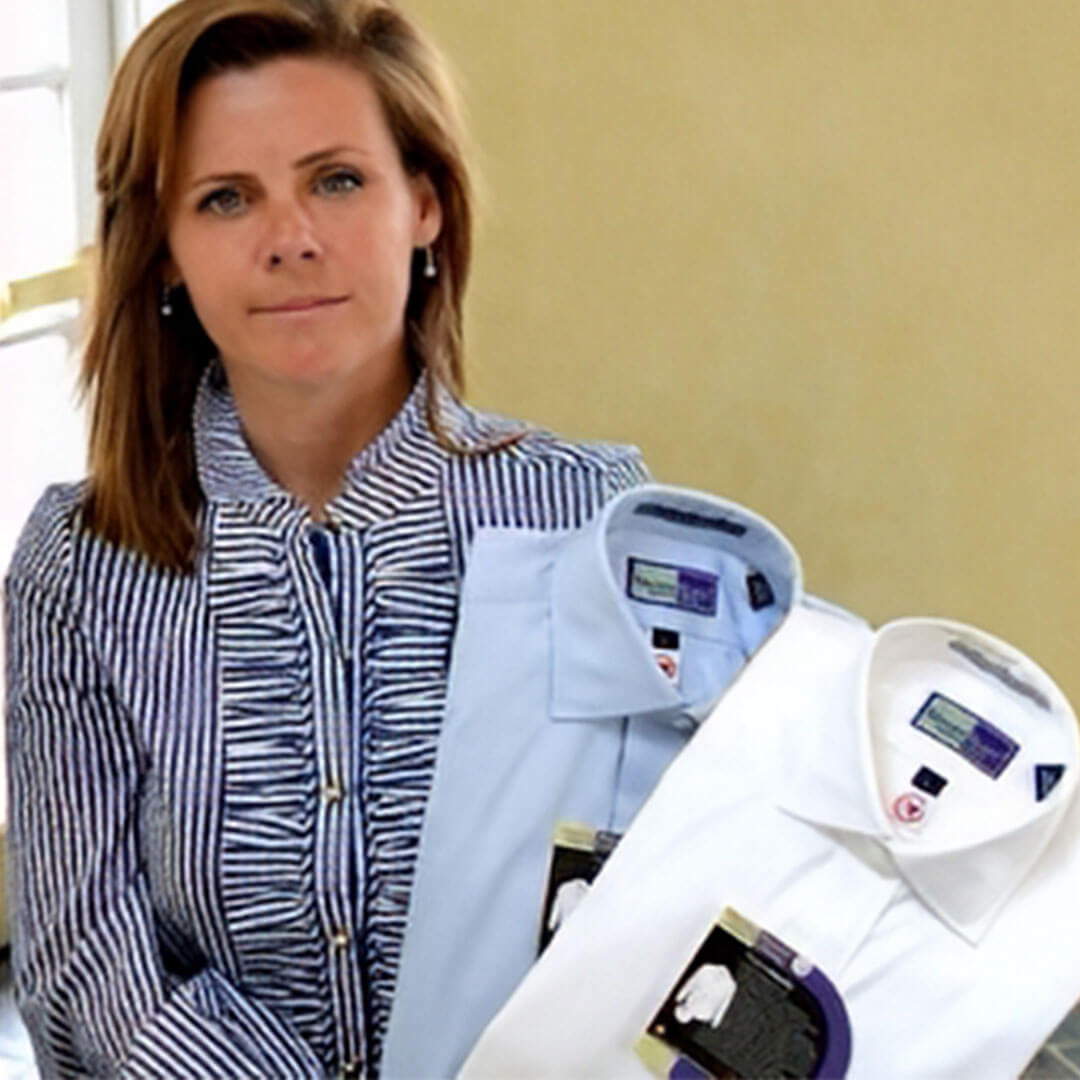
Maura Horton, inventor of MagnaReady adaptive clothing, with two MagnaReady shirts. Photo courtesy Maura Horton.
Beloved college football coach Don Horton was on the field for a decade at Boston College and then six more years at North Carolina State University. But getting Parkinson’s disease at age 48 soon brought rigidity: muscle stiffness, tightness, and loss of mobility in his arms and legs. He struggled to dress himself, unable to zip or button his clothing.
“Don’s progression was quicker than most, which can happen with young-onset [Parkinson’s disease],” says his wife, Maura. “Rigidity worsens. He was falling. His brain was telling his feet what to do, but his feet weren’t doing it,” she recalls. His symptoms got so bad that after a game one night he was stuck in the locker room, unable to button his shirt. He was going to miss his flight home. Thankfully, a player noticed and helped him.
“Don had a lot of pride. He didn’t share what was happening with his symptoms until that incident in the locker room,” Maura says.
She couldn’t stand by and do nothing to help him. “Coaches travel a lot,” she notes. “I found out that Don had to ask hotel concierges to help him get dressed.” Always dapper, he liked Brooks Brothers shirts and khakis. A textile designer by trade, Maura ordered some adaptive clothing—also called accessible, functional, or inclusive clothing, which is made to help people with reduced mobility, dexterity, or disabilities dress themselves with ease and confidence. But one shirt was as thin as a hospital gown and another was not machine washable. Velcro required using both hands, which Don couldn’t do. Then, one day, Maura noticed an iPad case—the magnets aligned and the cover went right into place. She thought she could do that with shirt buttons, too.
She started applying for patents for efficient magnetic closures. The magnetic buttons do not have to be lined up by hand like traditional buttons with buttonholes. They keep the shirt securely closed and are not noticeable. This is important because it allows people with limited mobility to dress on their own and look well-dressed without drawing attention to their condition.
“I was so surprised that there weren’t many new options for fastening clothing since about the 1950s,” says Maura. “It was hook and eye, snaps, buttons, zippers, and Velcro.” By 2013, seven years after Don’s diagnosis, Maura launched her online store, MagnaReady®, the original magnetic apparel company, with men’s dress shirts in white and blue only. They sold out in three months.
Now, 13 years later, MagnaReady offers a range of clothes including shorts, track pants, polos, jackets, jeans, pajamas, women’s clothing, and a special collaboration with iconic Brooks Brothers—business button-down shirts in nine colors. All items are machine washable and dryable and designed to make life easier for caregivers and for people with Parkinson's disease, arthritis, multiple sclerosis, stroke recovery, neuropathy, post-surgery recovery, or limited hand strength.
“Adaptive clothing lets people have dignity,” says Maura. The clothing is also easy to pack for travel, simplifies clothing changes en route, and comes in cooling, lightweight fabrics with SPF protection. It is not generally covered by health insurance plans but may be eligible for reimbursement through Flexible Spending Accounts (FSAs).
“Alzheimer’s disease is so common. We see a lot of dressing difficulties in those patients. For some, it’s hard to keep a routine with a memory deficit,” says Gurdesh S. Bedi, MD, FAAN, at the Minneapolis Clinic of Neurology.
“Buttoning a button is a multi-step process. It’s actually very complicated mapping for your brain, and we take it for granted,” he adds. You have to line up the button with the buttonhole, insert the button, get it through. “The sequence of events requires visual and spatial function. [Patients with] Alzheimer’s and Parkinson’s can lose those abilities.”
Dr. Bedi says his patients talk about missing their self-sufficiency and how much they appreciate adaptive clothing solutions. “Several years into having Parkinson’s, patients often start wearing simpler clothing, like T-shirts, but even that might be difficult to sustain for long. They have to depend on others for this very basic human need,” he notes. “The liberty to dress independently is a very big confidence builder.”
Loss of strength, muscle stiffness, and decreased sensation also make it hard to complete daily activities, notes Mona Bahouth, MD, PhD, FAAN, a stroke neurologist and associate professor of neurology at the Johns Hopkins School of Medicine.
“If you cannot bend your arm or feel the button or snap, you can’t complete the task,” she says. “But the more you can do for yourself, the better, even if you can only manage a portion of something. Maybe you can’t put your shoes on, but you can close your shirt. Maybe you can’t take a shower, but you can wash your face, arms, and chest. The part you do keeps you one step closer to a better quality of life.”
What started as Maura's determination to help her husband get dressed without assistance has grown into a practical solution for people living with Parkinson's disease and many other conditions. MagnaReady gives everyone an opportunity to regain independence, confidence, and comfort in their daily lives.