Ryan Reynolds on His Father’s Parkinson’s Disease and the Symptoms No One Talks About
Actor Ryan Reynolds is breaking the silence about the common and hidden symptoms of Parkinson’s disease.
Actor Ryan Reynolds is breaking the silence about the common and hidden symptoms of Parkinson’s disease.

Ryan Reynolds was in his early thirties when his father, retired police officer James “Jim” Reynolds, became convinced his wife was cheating on him. The accusations were unfounded but unshakable. His father had also started seeing and hearing things no one else could, fighting his son over whether he was still able to drive, and drifting into a world the rest of the family could no longer reach.
“Hallucinations, delusions—we never used those words,” recalls the Deadpool actor and father of four. “It was, ‘Dad’s kind of losing his grip. I don’t know what he’s talking about. I don’t know what this is that he thinks he’s seeing or hearing.’ He had a lot of suspicion about Mom stepping out with the neighbor—things that were completely unfounded, untrue, and wildly out of left field.”
Jim Reynolds was initially diagnosed with Parkinson’s disease in 1998, when he was 57 years old and Ryan was 22 years old. For a long time, his symptoms followed the course of the disease most people are familiar with: tremor, stiffness, a slowing gait. However, other symptoms began around ten years in: hallucinations and delusions, which affect at least 50% of people with Parkinson's disease over the course of the disease. Clinicians sometimes call these symptoms “Parkinson’s disease psychosis.”
Reynolds describes the household in those years as “a pretty democratically dispersed hell show,” not so much because of the physical symptoms of Parkinson’s disease, but because his father was unable to communicate what he was going through. “My dad was incredibly proud and really didn’t feel comfortable expressing vulnerability on any aspect of the spectrum. He had a real inability to talk about what it was he was experiencing,” he says. “So it affected me personally, because I internalized this idea that if something’s wrong, don’t talk about it. Had my father spoken openly about this, I think my entire family nucleus would have changed forever.”
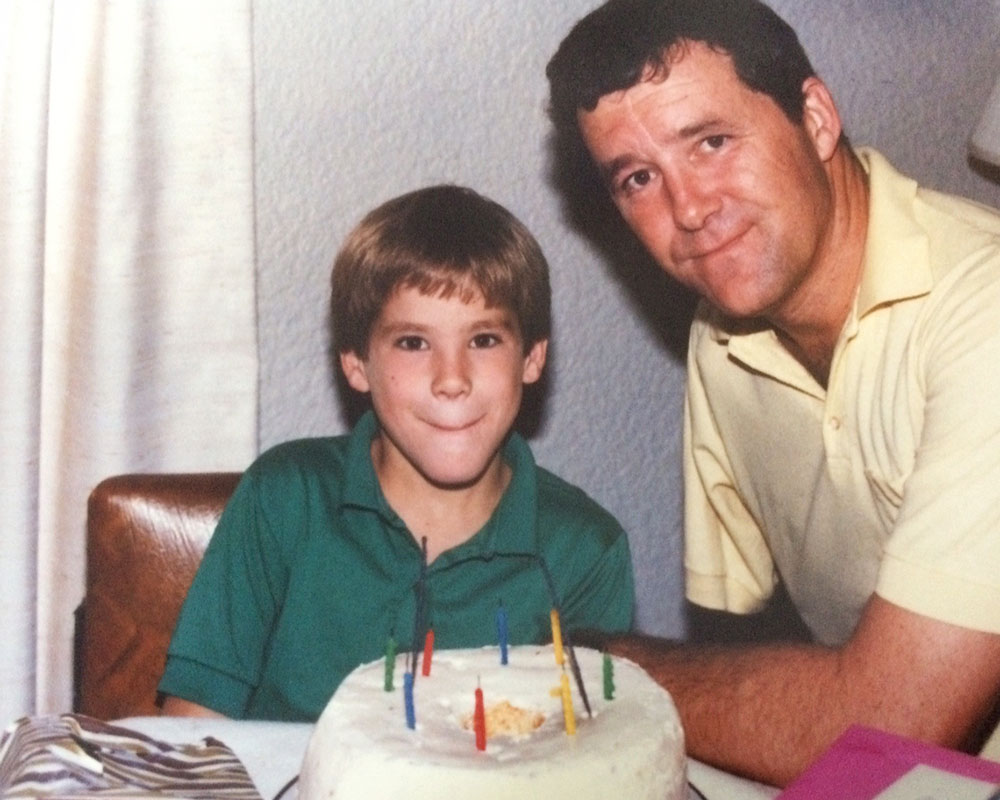
Jim Reynolds died in 2015 at age 74, after nearly two decades with the disease. “My relationship with my father continues to evolve, weirdly, even though he’s been gone more than 10 years,” he says. “I’m constantly asking myself, is that true?”
In August 2024, Reynolds, who also serves on the board of the Michael J. Fox Foundation, partnered with Acadia Pharmaceuticals to launch More to Parkinson’s, a national awareness campaign focused on the hallucinations and delusions that affected his father. Acadia is the manufacturer of pimavanserin (Nuplazid), currently the only FDA-approved treatment for Parkinson's-related hallucinations and delusions.
“If you look at the statistics, this is a really unknown aspect of Parkinson’s disease,” he says. “That’s wild to me. At least half of people that are dealing with Parkinson’s are experiencing this. So how is it unknown? It’s because nobody’s talking about it.” Since the campaign launched, he says he has been stopped on the street again and again. “I’ve been approached by countless people saying, ‘Thank you for talking about [this],’ or ‘Oh my God, I’m down that same kind of rabbit hole with my dad.’”
For neurologists who specialize in Parkinson’s disease, the symptoms Reynolds describes are very familiar. “If we follow people for 15 or 20 years, 50% or more of people with Parkinson’s will develop hallucinations,” says Jori Fleisher, MD, FAAN, a movement disorders specialist and associate professor at Rush University Medical Center in Chicago. “I think about it as an old-school film projector that’s going on without their permission in their brain. They’re looking at the world around them, but they’re also seeing this projection of something else. And to them, it’s real.”
Visual hallucinations are the most common, and they tend to evolve. They often begin as transitory illusions, like a hat rack mistaken for a person or a face glimpsed in a wallpaper pattern. At first, many patients can recognize afterward that what they thought they saw wasn’t really there. Over time, if the symptoms aren’t addressed, the experiences can become more vivid, and the patient becomes harder to dissuade. “We can go from someone seeing a little bird on the window that blinks and goes away to seeing their childhood dog who might have passed away 50 years ago,” Dr. Fleisher says. “And it’s nice to see Bingo back again. It’s not a scary thing. But then I’ve had patients where they’re seeing the SWAT team coming in through their window, where there isn’t even a window.”
Experiences of hearing or feeling things that aren't there are also common, known as auditory and tactile hallucinations. “Often people will describe that they hear a knock at the door, even though no one’s there,” Dr. Fleisher says. “Or they’ll hear a loved one call out from another room, and no one has said anything.” Tactile experiences are particularly subtle and easy to miss. “I have folks who will sit, not saying anything, but they’re pulling at what look like invisible strings on their hands. They’ll describe almost feeling like there’s a membrane, like a thin glove or something sticky that they just can’t get to go away.”
Delusions are different from hallucinations. They are fixed false beliefs, often paranoid: a partner is unfaithful, a stranger has entered the house, a family member has been replaced by an imposter. Like Jim Reynolds’ suspicions about his wife, they can be deeply upsetting for everyone involved.
Hallucinations and delusions may be part of the disease process itself or may be triggered or worsened by some standard Parkinson’s disease medications. Sometimes, a dose change or discontinuation of some Parkinson’s disease medications can improve or resolve the issue. Other times, a specific medication can be added to manage it. In any case, the conversation has to start with someone telling a doctor, Dr. Fleisher says. “Number one is just normalizing and validating that this is part of the Parkinson’s experience, not for every single person, but for more people than not. It’s not something that the person is doing intentionally. They are not trying to hallucinate. We don’t say to someone, ‘Hey, with that tremor—stop doing that. If you thought about it enough, you could make it go away.’ And it’s not something the care partner is doing either. They’re not doing anything wrong to make this happen.”
She asks every one of her patients with Parkinson's disease about hallucinations and delusions at every visit to increase awareness of the symptoms and the likelihood of reporting them. “I know you hate this question,” she says, “and just because I ask it does not mean it’s going to happen.”
That upfront acknowledgment can help calm a fear most patients are already carrying. "The common denominator with most people [with Parkinson’s disease] is that they're worried they're going to lose their independence, their autonomy, that they're going to become an unreliable narrator in their own life," Reynolds says. "I completely understand why they would feel like that. But if they're open about it and talking about it and they understand it's actually treatable, those kinds of pitfalls are much less likely to be part of their lives."
For families navigating a hallucination in the moment, Dr. Fleisher offers three guidelines:
Tammy Reynolds, Reynolds’ mom, carried most of the caregiving for her husband alone, and her son knows it. “Care partner fatigue is such a real thing,” Reynolds says. The strongest caregiving partnerships he has observed, he says, are those in which the well partner doesn’t treat the disease as something happening to someone else. “They kind of look at it like they both have Parkinson’s. They look at it like they are a team, and they don’t really see it any other way.”

But that balance can be hard to achieve. Dr. Fleisher explains that "anger can be a normal part of caring for someone who's having symptoms that are scary and symptoms that are changing them from who they've always been. And how do you cope with that, knowing that five minutes later they might be back to their normal sweet self? That’s really, really hard.”
That isolation is what she is trying to address through the PERSEVERE Trial, a National Institutes of Health–funded virtual study that pairs newer care partners of people with Parkinson’s or Lewy body dementia with experienced mentors. “I’ve had patients look at me and say, ‘With all due respect, you have no idea what it’s like to try to get your loved one to come out of the linen closet because they think we’re under attack at two in the morning,’” Dr. Fleisher says. “And I tell them, ‘You’re absolutely right. But I know someone who does.’”
Reynolds’ message to families navigating Parkinson’s disease symptoms is the one he wishes his own family had heard earlier: The silence is the danger. “If we’re not talking about it, the stigma is there,” he says. “If we are talking about it, the stigma goes away. If I’m ashamed of something, or I’m worried about something, as soon as I open up and speak about it, it’s gone. It doesn’t own me. It doesn’t govern me. It doesn’t do anything. It’s just another passing cloud in the day.”
Correction (May 14, 2026): A previous version of this article stated, “Sometimes Parkinson's disease psychosis may be triggered by medications, and a dose change or discontinuation of that medication can resolve the issue.” It has been corrected to say, “Hallucinations and delusions may be part of the disease process itself or may be triggered or worsened by some standard Parkinson’s disease medications. Sometimes, a dose change or discontinuation of some Parkinson’s disease medications can improve or resolve the issue.”
Dr. Correa:
From the American Academy of Neurology, I'm Dr. Daniel Correa.
Dr. Peters:
And I am Dr. Katy Peters and this is the Brain & Life podcast.
Hello listeners and welcome to the Brain & Life podcast. It's me, your co-host, Dr. Katy Peters. I am coming from the wonderful Durham, North Carolina right now, but I don't know where Dr. Correa is. I think he's on vacation. We'll find out maybe when he comes back, but I'm solo today, but I'm not going to be alone for long because I'm going to be joined by one of Hollywood's most accomplished actors. You know him as Deadpool, as a leading man in The Proposal and the Free Guy, and as an entrepreneur. We want you to know more now about the actor Ryan Reynolds. Ryan Reynolds has built a career on sharp timing, self-aware humor, and a rare ability to make us laugh while still feeling deeply human. Whether he is deftly trading one-liners on screen or poking fun at himself online, his humor is truly approachable and genuine. But beyond comedy, Ryan Reynolds is elevating his public platform to advocate for individuals and their care partners living with Parkinson's day-to-day. Ryan, welcome to the Brain & Life Podcast.
Hello, Ryan. Thank you so much for being here today and to discuss Parkinson's disease. First off, how did your father's Parkinson's disease-related hallucinations and delusions really impact you personally?
Ryan Reynolds:
Well, first off, thank you for having me, Dr. Peters. I really appreciate it and I appreciate the work you do. And I'll get right to your question. I mean, I would say it was quite a pretty democratically-dispensed hell show in our house in many respects. I would say that that was less due to the physiological symptoms of Parkinson's and more due to the sort of inability to communicate. I think my family, especially when I was young, is probably quite similar to a lot of families all over the world, which is that my dad was a man that was incredibly proud and really didn't feel comfortable expressing vulnerability on any aspect of the spectrum. He had a real inability to kind of express himself or talk about what it was he was experiencing. So it affected me personally because I think at that age, and I thankfully have really addressed it now, but at that age, I internalized this idea that if something's wrong, don't talk about it.
And boy, had my father spoken openly about this, I think that the destiny, and I mean that, that's not hyperbole, of my entire family nucleus would've changed forever. I think it would've been so much better off if this was something that was out in the open and discussed, but it wasn't.
Dr. Peters:
So how did this sort of impact your own relationship with your father?
Ryan Reynolds:
It's one of those things that it's easy to look back and kind of diagnose anything in the past. My dad's not here anymore to kind of express his point of view about the situation. And if he were, I'm sure it would be ... I'm sure I would learn a lot from it. But when I look back at it, I still struggle with it. My relationship with my father continues to evolve weirdly, even though he's been gone 10 years. So, yeah, I find that I'm constantly asking myself, "Is that true?" If I think about something when it happened in our household or something that I found incredibly frustrating, sometimes people have a tendency of romanticizing it in a way and thinking of it like, "This is my pain or my wound. This is the sort of pool from which I draw my inspiration to do my work." And that's actually not necessarily true.
So some of the things as I've looked back and I thought, "Is that true?" And I think, "I don't know if that is." I think I kind of had a story about him. But again, I go back to the whole reason I'm working with Acadia is in part to really encourage families to discuss this and discuss ... My dad experienced hallucinations and delusions and he had pretty prolific hallucinations and delusions. And I would say that as I look back, it wasn't something we were aware of. We never used those words. It was, "Dad's kind of losing his grip." I don't know what he's talking about. I don't know what this is that he thinks he's seeing or hearing. He has a lot of suspicion about mom stepping out with the neighbor or something. It's like these things that were completely unfounded, untrue, and wildly out of left field.
And had we known about that and had there been any kind of treatment at the time, God, we would've been grateful, but we just didn't have anything like that. It's available now and other families don't have to go through this, and I'm sure they are, I know they are, because being a part of this campaign, I've been approached on the street by countless people constantly saying, "Thank you for talking about it," or, "Oh my God, I'm down that same kind of rabbit hole with my dad or my mom." Yeah.
Dr. Peters:
And I think that's what's so important is hallucinations and delusions are not a commonly-known symptom of Parkinson's disease, but really upwards of 50% of people that have Parkinson's will experience hallucinations and delusions. And I think what you're doing is truly to raise awareness of this. What also are you doing to reduce stigma? Because people can sometimes, there can be a stigma associated with psychiatric disorders. What are you doing now for raising awareness and working to reduce stigma?
Ryan Reynolds:
Well, I think things are stigmatized because there's no ... I mean, if you look at those statistics even that you just mentioned, how this is a really unknown aspect of Parkinson's disease, let's say. That's wild to me because it's an unknown aspect of it, but yet 50%, half of the people that are dealing with Parkinson's, are experiencing this. So how is it unknown? It's because nobody's talking about it, I think. So in terms of the stigma that would be associated with this, I think that can be self-imposed and I think that can also be externally imposed.
So I talk to people all the time who their biggest fear is ... the common denominator with most people is that they're worried that they're going to lose their independence, their autonomy, that they're going to become an unreliable narrator in their own life. And I completely understand why they would feel like that. If they're open about this and talking about it and kind of understand that it's actually treatable, those kinds of pitfalls are much less likely to be a part of their lives. I don't think that losing your independence or autonomy is going to happen as readily and easily if these are things that are being addressed.
But at the same time, man, I can't even imagine what that must feel like to think, "Oh, I don't know what is real or what's not real in this moment." I can't imagine how isolating and alone some people might feel. I can't imagine how much they struggle. And I know my dad had this issue and I had fights with my father about driving a car, about all kinds of things like that, because I didn't feel like he could handle that and I didn't want him driving around and, God forbid, someone else gets hurt, another family, and that's just driving along ... Those are things that were real struggles that we had. And I think had my dad had access to the vital medicine that might be able to treat something like this, I think things would have been a lot different.
But there's always going to be a stigma attached to something like this if we're not talking about it. If we are talking about it, the stigma goes away. Anything you're ashamed of in life, like if I'm ashamed of something or I'm worried about something, as soon as I open up and speak about it, it's gone. It doesn't own me. It doesn't govern me. It doesn't do anything. It's just another passing cloud in the day.
Dr. Peters:
Well, I appreciate that you're using our podcast as a megaphone to really highlight this issue. So sort of beyond this, what would be your message to the Parkinson's community and their care partners?
Ryan Reynolds:
I'm glad you mentioned the care partners because care partner fatigue is such a real thing. And I think that a couple of people that I know who are in really strong, vital partnerships in their home where one person is the PD patient, the other one is the care partner, they kind of look at it like they have Parkinson's. The care partner is generally the one, I've found, and I'm not saying this is the unilateral rule, but the care partner is usually the one that is out there receiving a lot more kind of input about treatments and different sort of things that might help make life a little bit easier for both of them really. So really it's just if you're experiencing something or feeling something, just talk to your healthcare provider, talk to your doctors. Really having that dialogue is going to ensure so many different options.
Not only that, just speaking about anything. Some people might just want to speak about their concern about a future in which this might be something they experience. I know I feel like that. If I'm ever worried about something with respect to my health and I talk about it, right away, that's a huge, huge boon.
Dr. Peters:
Yeah. And I was going to ask you, that's a perfect segue to our last question is it's all about also your health too and what you can do for yourself.
Ryan Reynolds:
For today, for my own brain health, I touch grass. That is probably the biggest prescriptive antidote to anything that ails me in life. I go outside, I touch grass. I know that sounds so corny and sort of simple, but I always worry that one day if there is a pearly gates or something like that, that we have to look back and we have that This Is Your Life moment and you look back. I don't want to look back and have to go through a 30-year period where I'm staring at a little glowing rectangle and I have no idea what I'm looking at except the only thing I do know is that I'm looking at garbage when I could have been out in the world touching grass and living my life. And I'm not saying I don't fall ... I fall prey to the same things everybody else does when it comes to that kind of stuff.
But lately I've been really trying to practice what I preach. I think people teach what they need to learn on some level. So I have four kids, so I'm constantly teaching things that I need to learn. And the biggest one is like, let's put the screens down and let's go outside and feel the world and experience awe. Awe is something so underrated and overlooked.
Dr. Peters:
Well, I'm going to go outside and touch some grass, so I appreciate it. You inspired me, Ryan.
Ryan Reynolds:
I'm going to throw my phone in the river. I would, but I don't hate the river that much. So maybe if I find some other way to destroy it as it beeps despite my do not disturb thing being on. So ...
Dr. Peters:
And thank you so much for sharing all your thoughts and your advocacy with our listeners. It's really appreciated.
Ryan Reynolds:
Dr. Peters, thanks for everything that you do for this community and so many more communities with this podcast and with your message.
Dr. Correa:
Thank you so much for joining us. And if you're enjoying the Brain & Life podcast, we'd love your support. Take a moment to rate and review the show on Apple Podcasts, Spotify, or whichever platform you're listening from.
Dr. Peters:
Your feedback helps more people discover these stories, learn from experts, and feel connected to the brain health community. Thanks for listening and for helping us grow.
Hello, Brain & Life podcast audience. We have one of our favorite experts back again, Dr. Jori Fleisher. She's going to be telling us all about Parkinson's again today. And as you know, she's a movement disorders neurologist and associate professor at Rush University Medical Center in Chicago. She is the co-director of the Rush Parkinson's Foundation Center of Excellence and directs the Lewy Body Dementia Association Research Center of Excellence, the CurePSP Center of Care, Comprehensive Lewy Body Dementia Clinic, and Rush Advanced Interdisciplinary Movement Disorder Supportive Care Clinic. And she has time to hang with us today.
Her research focuses on designing and implementing novel models of care and support for people living with neurodegenerative disorders, including families affected by Parkinson's dementia, and hallucinations. She's the principal investigator on the NIH-funded Persevere trial, a first of its kind, entirely virtual, national, randomized controlled trial to educate and empower family care partners whose loved ones have Parkinson's or Lewy body dementia. Again, Dr. Jori Fleischer, welcome back to the Brain & Life Podcast.
Dr. Fleisher:
Thank you so much, Dr. Peters. This is one of my favorite things.
Dr. Peters:
It is one of my favorite things to hang out with you. So can you give us a reminder about just the basics of Parkinson's?
Dr. Fleisher:
Absolutely. So Parkinson's disease is a very common neurodegenerative condition, meaning it affects different areas of the brain and causes brain cells to die before they should, which leads to the symptoms that people develop. And we think about Parkinson's as a movement disorder. So we often picture the tremor, so a hand or a thumb or maybe a foot shaking when it shouldn't, when the person isn't using that. We also see stiffness or rigidity of the muscles, which often can show up as a frozen shoulder that just won't get better no matter how much physical therapy is done. It kind of tips us off that there might be something going on. We also see slowness of movement or movements that get smaller as people go. So it might be harder to write. We might see that our handwriting gets tighter and smaller and sloppier or slantier. And we also can see changes in walking. That person who used to lead the pack as they were walking with their family or their loved ones is now trailing behind, is dragging a leg, is shuffling, might be catching their foot on a curb.
And we think about Parkinson's as this movement disorder and it actually affects about 1.2 million people in the United States alone and is more common as people age, but there's so much more to Parkinson's than the movement symptoms.
Dr. Peters:
What are some of the non-neurologic symptoms that maybe will show up before even the neurologic symptoms?
Dr. Fleisher:
This is so key is that people can have several changes and they can be years, even decades before. So people can lose their sense of smell, not overnight, not suddenly, so it's really subtle. And yes, people can have sinus changes and, yes, people might be smokers, so there can be different things going on, but gradually over time a decreased sense of smell. Also constipation. And people can be constipated for all kinds of reasons, but when we ask someone who we're diagnosing with Parkinson's, it's very common that years or decades before they started to notice changes in their bowel habits and they might kind of wave this away and go, "Oh, well, just getting older." But no, actually constipation is kind of a predictor.
And one of the other really big ones is changes in sleep and especially acting out dreams during sleep. So a bed partner might say, "Oh, yeah, well, they've yelled in bed and they almost whacked me one time." Really important is to say, "Does your bed partner sleep in the same bedroom?" Because you'd be shocked at how many people develop this what's called REM behavior disorder where they're acting out dreams, they're thrashing, they're kicking, they're punching, and their significant other moves into a different bedroom. And that could have been going on for 10 years and the person often does realize that they're doing it because they're not bothering anyone. There isn't a spouse to go, "Hey, stop it."
But these are symptoms that can happen years or decades before, as can changes in mood. So depression in someone who wasn't previously depressed, anxiety or apathy, kind of a lack of motivation. The person who used to be the go-getter, the doer of all the things, is kind of taking the backseat and is less engaged. These are things that we can see before that tremor, before the stiffness, before the changes in walking.
Dr. Peters:
So what about psychiatric symptoms? So we talked to Ryan Reynolds and he said that his father had Parkinson's, but one of the predominant symptoms was hallucinations and delusions that were really challenging on the family. Can you tell us about those hallucinations or delusions that can happen to Parkinson's patients?
Dr. Fleisher:
Absolutely. And I just want to call this out as something that takes such tremendous courage to be able to discuss because it's not something that is as recognized in Parkinson's in the public view, but it is something very common. So if we follow people for 15 or 20 years, different studies give us different numbers, but upwards of 70% or more of people with Parkinson's will develop hallucinations. And these can vary. So we think about most commonly their visual hallucinations. Someone sees something that isn't there. So this might begin as what can happen to all of us if we're really sleep-deprived, you might catch something out of the corner of your eye, you see a hat rack or something, you think it's a person, you blink and go, "Oh, wait, that's not that." So something is really there and we just mistake it for being something else. We would call that an illusion.
But as time goes on, that can evolve to, for example, seeing a pattern or seeing something in a pattern on a tablecloth or in the wallpaper that isn't really there, seeing a face where there isn't one. It can be seen for a split second, a bug on the floor where there isn't something there, or seeing kids playing on a front lawn. It's often something that's potentially could be happening. It's not something outlandish. And a person often has insight when it first begins. So they'll kind of see something and go like, "That was weird," and just kind of blink and then it goes away. They know that it wasn't real and it's not scary. But because this isn't talked about nearly enough, because it sounds so scary, I think for many people they kind of keep this quiet until things get much more out of hand.
And so as time goes on, if we don't manage these symptoms, the hallucinations, the person can lose insight and the hallucinations can become scarier. They can become more realistic. So we can go from someone seeing a little bird on the window that blink and it goes away, to seeing, for example, their childhood dog who might have passed away 50 years ago, and it's nice to see Bingo back again and it's not a scary thing, right? But I've had patients where they're seeing the SWAT team coming in through their window where there isn't even a window, right? I mean, entire, very detailed, very frightening scenarios. And these hallucinations are often recurrent, meaning the same one happens over and over again, sort of like a groundhog day but kind of a nightmare. And so we want folks to tell us before we reach that point because there are a lot of different things we can do.
And while we focus on visual hallucinations of being the most common thing, we also know that people can have auditory hallucinations, meaning that they're hearing something that's not there. Often my patients will describe, they hear a knock at the door even though no one's there, or they'll hear a loved one calling out to them from another room and no one has said anything. But people can have tactile hallucinations where they're feeling something. So I have folks who will sit, not say anything, but they're kind of pulling at what look like invisible strings on their hands. They'll describe almost feeling like there's a membrane, there's like a thin glove or something sticky on their hands that they just can't get to go away. And it's there for moments and then it's gone. And if you didn't ask, you might think that someone was just fidgeting, but it can be really, really bothersome. So we want to empower people to know, number one, that this is part of their Parkinson's and that there are things that we can do about it.
Dr. Peters:
I think that's so important. What happens with the family members when they're dealing with a loved one that has these hallucinations? What kind of things do you do to sort of help those family members, I guess, first, understand, and next is, what can you do to sort of help them?
Dr. Fleisher:
Yeah. So I think there are a lot of different things. Number one is just normalizing and validating that this is part of the Parkinson's experience, not for every single person, but for more people than not. And it's not something that the person is doing intentionally. They are not trying to hallucinate. They are not making this up. And for the care partner to know it's not something that the care partner is doing either. They're not doing anything wrong to make this happen, just like we don't look at anyone and go, "Hey," with that tremor, "stop doing that. If you thought about it enough, you could make it go away." That's not how any of this works. And so, number one, when we've got the hallucinations, there are some behavioral things that are really, really important, and first is don't argue.
You cannot make it go away. You cannot convince the person consistently that that hallucination is not real because their brain is making them think that it is. And so what you can do is reassure them that they're safe, that you're not going to leave them, that you're there with them, and then you can distract or redirect. So, for example, if they're saying, "Hey, those kids are back in the dining room again. I told them they're not welcome here for dinner." I have care partners that will walk into the dining room and go, "Okay, guys, this is your five-minute warning. You have five minutes and then I need you to leave." And they'll come back and they'll tell their loved one, they'll say it loudly so their loved one heard them and they'll go, "Okay, they're putting their coats on and they're getting ready to go. Let's go get a snack." So acknowledge what they believe is their reality. You don't have to say, "Yes, this is really, really happening," but arguing is not going to make it better. So acknowledge and then let them know, "I'm with you. Let's go do something else." So distracting, redirecting can be really, really [inaudible 00:23:45].
Dr. Peters:
That is a really important technique, because, I mean, I think, again, we don't see that going on, but in that person's mind, something is happening. And I can see how the most important thing is to keep the patient safe and also to give them that feeling of safety because it can be unsettling.
Dr. Fleisher:
I mean, I almost think about it as an old school film projector that's sort of going on without their permission in their brain.
Dr. Peters:
Wow, that's a good way to think about it.
Dr. Fleisher:
And so they're just sort of looking at the world around them. And we don't have that film projector running for us, but for them they're seeing what's really there, but they're also seeing this projection of something else and to them it's real. And so if you're next to them and you're the person that they trust the most and you're going, "Uh-uh, no, no, it's not real," but their brain is showing them something that feels so real, it's just going to engender more fear potentially and mistrust of that person that they really need to trust and feel safe with. So it's sort of like you don't have to buy in fully, but you're not making the hallucination worse by not trying to fight it, if that makes sense.
Dr. Peters:
Absolutely. And so I guess in your practice, when do you sort of let, I guess, care partners know that this can be a problem? Because you're all about helping educate family care partners. And I'm going to ask you also to talk about the Persevere trial that sounds so ... First of all, congratulations, but it sounds really exciting about how you're bringing this information to those care partners. Can you tell us more about how you do that in practice and about the trial?
Dr. Fleisher:
Yeah. So, I mean, in practice, I probably annoy a lot of my patients and families because at every single visit for everyone with Parkinson's, I always ask them, "Any hallucinations, any delusions?" And delusions are like a fixed belief that something's going on that's not real. So they might be having paranoid thinking, they might believe that someone else is an imposter, for example, but I ask them, I'll say to them, "I'm going to ask you this question. I know you hate this question and just because I ask it does not mean it's going to happen. And with that, any hallucinations, any delusions?" And usually people will [inaudible 00:26:12] at me and then they'll say no. And especially as I'm starting to establish a rapport with a patient, if there's any pause between that, "no," I'll sort of look at them and go, "That took a bit. Tell me more. What's happening there?" Or I'll say, "If you were, would you tell me?"
And I've had folks be very honest and go, "Nope." And that's where I know just I flag that to myself, that's like, "Okay, I need to check in really well with the care partner because this may be someone where something's going on, but they're not going to admit it to me and I need the care partner to know this could be part of a Parkinson's journey and I want them to feel comfortable telling me so that I can help that loved one, even if we have to sort of go in a roundabout way." And there's a lot we can do because sometimes there are medications, either Parkinson's-related or not, that could be making hallucinations more likely to happen. So it's not just a case, I think sometimes people are worried, "If I say that this is happening, she's just going to tell me to take more meds." And that's not always true. We love to take away things that could be making things worse and we have things in our arsenal to help make things better.
What we're doing as part of our Persevere trial, we've been so fortunate over the last 10 years to build towards this study with input from Parkinson's and Lewy body dementia care partners at every step of the way telling us this is such an isolating experience. This is so different than other forms of dementia or cognitive impairment, and people just don't get it. And we wish that there was a way to bring 24/7 caregiving into the home that wasn't exorbitantly expensive and that was knowledgeable about how do you approach someone who's having a hallucination in a sensitive, compassionate way. And that just doesn't exist for most people. But what does exist is the wisdom that all of these care partners who've gone before have, just the approach to the loved one, the knowledge of what could happen, these amazing little tips and tricks and strategies that people figured out the hard way but are willing to share with other care partners to make life a little bit better for them.
And so we took care partners at every step along the way for the last many years and they said, "Yes, there's stuff out there on the internet, but I don't even know where to look and I don't know what to trust." So we would love it if we just had like a syllabus with some guidelines about what to do. And so with their input, we built a curriculum that includes both symptoms including the hallucinations, the delusions, but also the strategies for care partners, recognizing how hard it is that there's so much unpredictability. How do we cope with that unpredictability? How do we cope with the anger that can be a normal part of caring for someone who's having symptoms that are scary and symptoms that are changing them from whom they've always been to, in moments, someone who might seem very, very different? And how do you cope with that knowing that five minutes later they might be back to their normal, sweet self? That's really, really hard and I don't know the right answer, but I got a bunch of care partners who have many right answers of how they've navigated.
And so we created this curriculum and we train these experienced care partners to serve as mentors to people early in the journey. And so we take earlier care partners, these loved ones who are just starting to have changes in their thinking and memory, just starting to have hallucinations, and we give them this curriculum to empower them and educate them, but I think more importantly we pair, here's this book learning, you've I know the book learning really comes from care partners, but we give them a mentor who has been in their shoes. I've had patients look at me when I try to offer advice on how to cope with hallucinations and they're like, "With all due respect, you have no idea what it's like to try to get your loved one to come out of the linen closet because they think that we're under attack at 2:00 in the morning." And I said, "You're absolutely right, but I know someone who does. Would you want to talk with them?"
And I think that's ... this condition, both for people with it and for family members and care partners, can feel so scary and so isolating and there's often so much stigma to talking about these things. The tremor is recognized, but hallucinations, that's hard. So to connect with someone who gets it, you don't have to make excuses or apologize for it, you can just kind of let it all hang out and they can tell you, "Here's what I did. It may work, it may not, but here's something to try," is so encouraging for people.
Dr. Peters:
That is such an awesome trial. And, I mean, you think about sort of the scope of it, because you just mentioned at the beginning of this discussion about how many people have Parkinson's. Well, now you have to multiply that to how many care partners there are for their loved ones with Parkinson's and that just sort of amplifies it more. So first of all, congratulations on the trial.
Dr. Fleisher:
Thank you.
Dr. Peters:
I'm very excited for it. Can't wait till you're up on the podium presenting your results. It'll happen. It'll happen. We'll see. We'll see you up on the podium.
Dr. Fleisher:
Fingers crossed.
Dr. Peters:
Fingers crossed. But again, Dr. Fleisher, thank you so much for all that you do to take care of your patients and their loved ones that essentially are having issues with movement disorders such as Parkinson's disease. And thank you for being a regular expert on our podcast. We really appreciate it.
Dr. Fleisher:
Thanks so much for the opportunity and for raising awareness.
Dr. Correa:
Thank you again for joining us today on the Brain & Life Podcast. Follow and subscribe to this podcast so you don't miss our weekly episodes. You can also sign up to receive the Brain & Life Magazine for free at brainandlife.org.
Dr. Peters:
Also, for each episode, you can find out how to connect with our team and our guests along with great resources in our show notes. We love it when we hear your ideas or questions. You can send these in an email to blpodcast@brainandlife.org and leave us a message at (612) 928-6206.
Dr. Correa:
You can also find that information in our show notes and you can follow Katy and me and the Brain & Life Magazine on many of your preferred social media channels. We're your hosts, Dr. Daniel Correa, connecting with you from New York City and online at NeuroDoctorCorrea.
Dr. Peters:
And Dr. Katy Peters joining you from Durham, North Carolina, and online at KatyPetersMDPhD.
Dr. Correa:
Most importantly, thank you and all of our community members that trust us with their health and everyone living with neurologic conditions.
Dr. Peters:
We hope together we can take steps to better brain health and each thrive with our own abilities every day.
Dr. Correa:
Before you start the next episode, we would appreciate if you could give us five stars and leave a review. This helps others find Brain & Life podcast. See you next week.